
[Paper Review] X-ray Magnetic Circular Dichroism in Altermagnetic $α$-MnTe
The paper predicts and experimentally confirms XMCD in the altermagnetic α-MnTe, showing a characteristic XMCD lineshape for compensated moments in a plane perpendicular to the light, and analyzes its microscopic origin and domain effects.
Altermagnetism is a recently identified magnetic symmetry class combining characteristics of conventional collinear ferromagnets and antiferromagnets, that were regarded as mutually exclusive, and enabling phenomena and functionalities unparalleled in either of the two traditional elementary magnetic classes. In this work we use symmetry and ab initio theory to explore X-ray magnetic circular dichroism (XMCD) in the altermagnetic class. Our results highlight the distinct phenomenology in altermagnets of this time-reversal symmetry breaking response, and its potential utility for element-specific spectroscopy and microscopy in altermagnets. As a representative material for our XMCD study we choose $α$-MnTe with the compensated antiparallel magnetic order in which an anomalous Hall effect has been already demonstrated both in theory and experiment. The predicted magnitude of XMCD lies well within the resolution of existing experimental techniques.
Motivation & Objective
- Identify XMCD in altermagnetic α-MnTe and relate it to time-reversal symmetry breaking in a collinear altermagnet.
- Predict and measure XMCD spectra at Mn L2,3 edges for different Néel vector orientations and light propagation directions.
- Disentangle microscopic contributions from valence and core states, SOC, and core–valence interactions.
- Demonstrate domain effects and field-induced canting on XMCD magnitude and shape.
- Highlight differences between AHE and XMCD origins in altermagnets and assess imaging potential of XMCD for domain structure.
Proposed method
- Use DMFT with an Anderson impurity model (AIM) built on a Wien2k-derived multi-band Hubbard model for Mn d and Te p bands.
- Parametrize Mn d-shell interactions with U=5.0 eV, J=0.86 eV and μdc=22.5 eV.
- Compute XAS and XMCD spectra at Mn L2,3 edges and compare with 140 K epitaxial MnTe films using circularly polarized light along the c-axis.
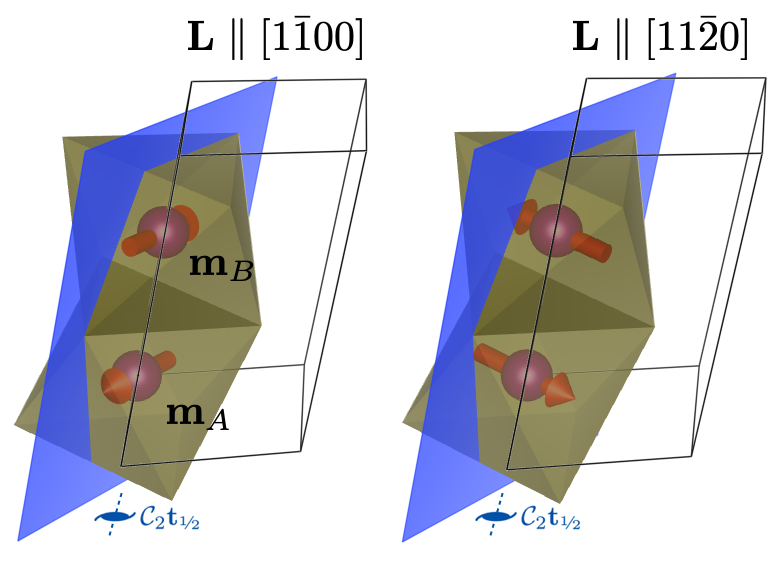
- Decompose XMCD into site-resolved contributions from sublattices A and B using relativistic symmetry, including C3 rotations and T symmetry arguments.
- Investigate four model variants to assess the roles of valence 3d SOC and core–valence interactions.
- Incorporate domain averaging to reflect multiple L orientations and consider field-induced canting (m6T ≈ 0.1 μB) for 6 T field.
Experimental results
Research questions
- RQ1Does XMCD arise in altermagnets with compensated antiparallel order like α-MnTe?
- RQ2How does the orientation of the Néel vector L relative to the light propagation direction affect the XMCD signal?
- RQ3What is the microscopic origin of XMCD in α-MnTe—valence SOC, core SOC, or core–valence interactions—and how does this compare to AHE?
- RQ4What is the impact of magnetic-domain structure and field-induced canting on the XMCD magnitude and spectrum?
- RQ5Can XMCD serve as an optical/microscopy probe to image altermagnetic domains and their dynamics?
Key findings
- XMCD spectra in Mn L2,3 edge show a characteristic shape for L in the plane perpendicular to the light, in agreement between theory and experiment.
- The measured XMCD magnitude is about ten times smaller than calculated, due to domain averaging over six easy-axis L orientations.
- For k parallel to L, valence 3d SOC plays a negligible role; core–valence multipole interaction changes spectral shape but not magnitude.
- For k perpendicular to L, XMCD is weaker but adds up from A and B sublattices to yield a net XMCD; its sign and presence depend on L orientation and vanish for L along certain in-plane axes due to symmetry.
- Canting of sublattice moments toward c-axis in zero field yields negligible weak-ferromagnetic XMCD compared to the k ⟂ L contribution; in 6 T field, a net m6T ≈ 0.1 μB scales the spectra with m6T/m_sat ≈ 1/50, aligning theory with experiment.
- XMCD in α-MnTe arises from a combination of core SOC and core–valence exchange interaction rather than valence SOC of the 3d states, distinguishing it from the AHE origin.

Read this paper
Open the full text in the Nubint reader and ask about any passage as you read.
Read this paper on NubintThis review was generated by AI from the original paper. Please check the paper before citing it.