
[Paper Review] Extracting the Quantum Geometric Tensor of an Optical Raman Lattice by Bloch State Tomography
This paper presents the first experimental measurement of the complete quantum geometric tensor (QGT) in a 2D optical Raman lattice using Bloch state tomography with ultracold atoms. By reconstructing the full wavefunction via momentum-resolved Raman pulses, the authors extract both the Berry curvature and quantum metric tensor, experimentally verify a fundamental inequality between them, and demonstrate their roles in topology and quantum state geometry.
In Hilbert space, the geometry of the quantum state is identified by the quantum geometric tensor (QGT), whose imaginary part is the Berry curvature and real part is the quantum metric tensor. Here, we propose and experimentally implement a complete Bloch state tomography to directly measure eigenfunction of an optical Raman lattice for ultracold atoms. Through the measured eigenfunction, the distribution of the complete QGT in the Brillouin zone is reconstructed, with which the topological invariants are extracted by the Berry curvature and the distances of quantum states in momentum space are measured by the quantum metric tensor. Further, we experimentally test a predicted inequality between the Berry curvature and quantum metric tensor, which reveals a deep connection between topology and geometry.
Motivation & Objective
- To experimentally measure the complete quantum geometric tensor (QGT) in a topological band of an optical Raman lattice.
- To reconstruct the full Bloch wavefunction via complete Bloch state tomography using a controlled Raman pulse.
- To extract topological invariants from the Berry curvature and quantify quantum state distances via the quantum metric tensor.
- To test a predicted inequality between the Berry curvature and quantum metric tensor, linking topology and geometry in quantum systems.
Proposed method
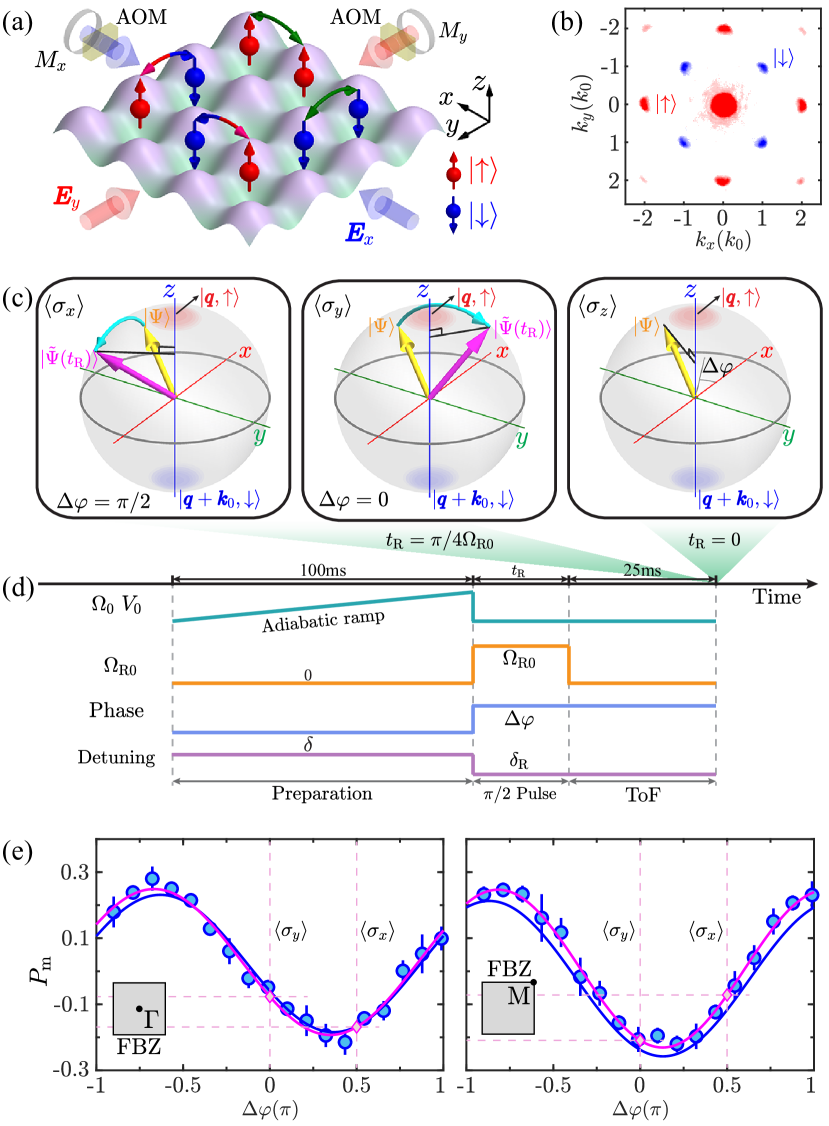
- Implement a momentum-transferred Raman laser pulse to perform complete Bloch state tomography on ultracold atoms in a 2D optical Raman lattice.
- Use time-resolved spin-echo measurements to reconstruct the full spin texture and extract the wavefunction at each momentum point.
- Apply a correction procedure to isolate the population in the lowest band by accounting for higher-band contributions using numerically evolved states.
- Normalize and smooth the reconstructed spin polarization data across momentum space to enhance resolution and reduce noise.
- Extract the quantum geometric tensor components from the reconstructed wavefunctions using standard geometric phase and metric definitions.
- Verify the theoretical inequality between the quantum metric tensor and Berry curvature through direct experimental comparison.
Experimental results
Research questions
- RQ1Can the full quantum geometric tensor, including both the Berry curvature and quantum metric tensor, be experimentally measured in a synthetic lattice system?
- RQ2How does the quantum metric tensor influence the geometry of quantum states in momentum space, and can it be quantitatively extracted from experimental data?
- RQ3What is the relationship between the topological invariant (Berry curvature) and the geometric distance (quantum metric tensor) in a 2D optical lattice?
- RQ4Does the predicted inequality between the quantum metric tensor and Berry curvature hold in a real experimental system?
- RQ5To what extent do higher-band populations distort the measurement of the quantum geometric tensor in cold atom systems?
Key findings
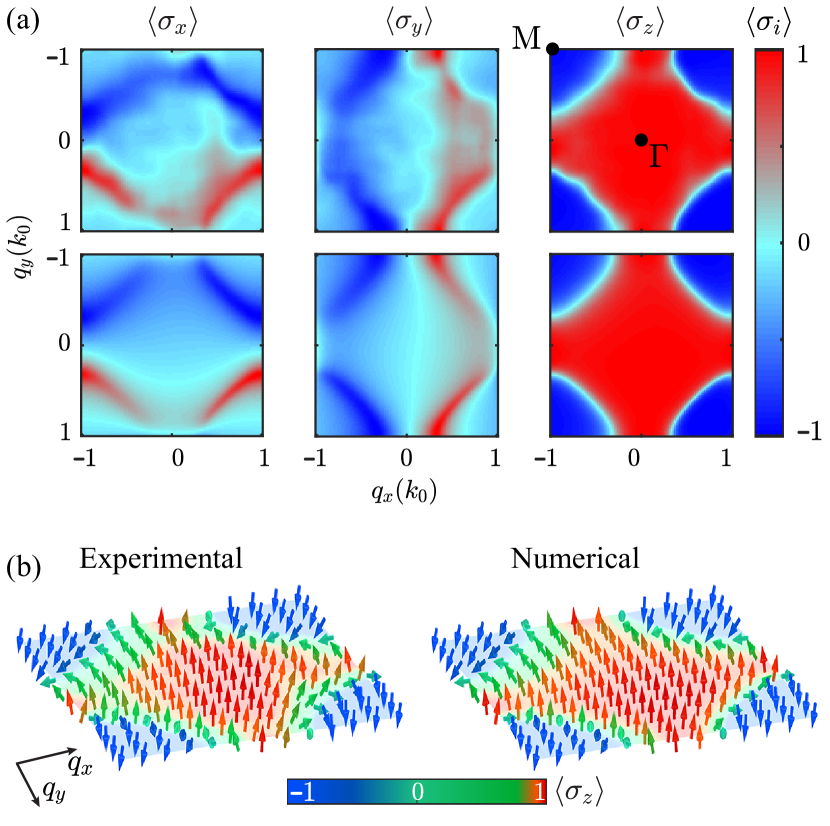
- The complete quantum geometric tensor, including both the Berry curvature and quantum metric tensor, was experimentally reconstructed across the entire Brillouin zone of a 2D optical Raman lattice.
- The topological invariant was extracted from the integrated Berry curvature, confirming the system's nontrivial topology.
- The quantum metric tensor was measured directly from the reconstructed wavefunctions, enabling quantification of quantum state distances in momentum space.
- A direct experimental test confirmed the predicted inequality between the quantum metric tensor and the Berry curvature, revealing a deep geometric-topological connection.
- The correction method for higher-band contamination successfully isolated the lowest-band contribution, improving the fidelity of the reconstructed spin textures and geometric tensor components.
- The reconstructed spin textures, after normalization and smoothing over ~0.3% of the Brillouin zone, showed high momentum-space resolution (~2.6 μm per point), enabling precise tensor mapping.
Read this paper
Open the full text in the Nubint reader and ask about any passage as you read.
Read this paper on NubintThis review was generated by AI from the original paper. Please check the paper before citing it.