
[Paper Review] Florence-2: Advancing a Unified Representation for a Variety of Vision Tasks
Florence-2 presents a unified, prompt-based vision foundation model trained on FLD-5B to perform diverse tasks (captioning, detection, grounding, segmentation) with zero-shot and fine-tuning capabilities. It introduces an extensive data engine and a seq2seq architecture to unify vision tasks under a single model.
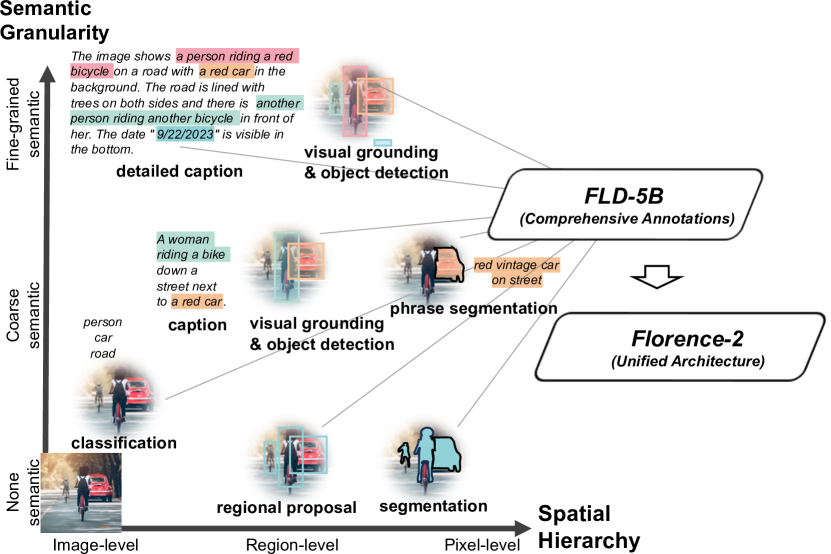
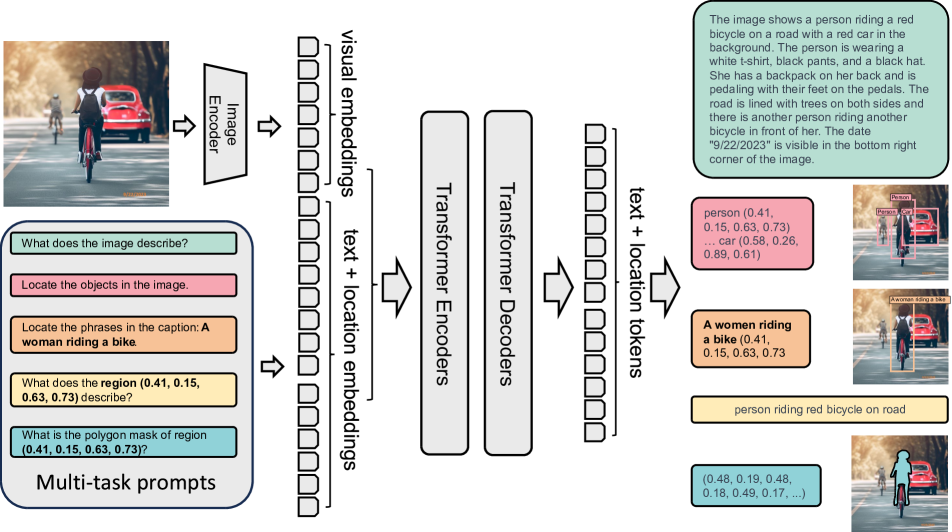
We introduce Florence-2, a novel vision foundation model with a unified, prompt-based representation for a variety of computer vision and vision-language tasks. While existing large vision models excel in transfer learning, they struggle to perform a diversity of tasks with simple instructions, a capability that implies handling the complexity of various spatial hierarchy and semantic granularity. Florence-2 was designed to take text-prompt as task instructions and generate desirable results in text forms, whether it be captioning, object detection, grounding or segmentation. This multi-task learning setup demands large-scale, high-quality annotated data. To this end, we co-developed FLD-5B that consists of 5.4 billion comprehensive visual annotations on 126 million images, using an iterative strategy of automated image annotation and model refinement. We adopted a sequence-to-sequence structure to train Florence-2 to perform versatile and comprehensive vision tasks. Extensive evaluations on numerous tasks demonstrated Florence-2 to be a strong vision foundation model contender with unprecedented zero-shot and fine-tuning capabilities.
Motivation & Objective
- Aim to build a universal vision foundation model with a single architecture and weights that handles spatial hierarchy and semantic granularity across tasks.
- Overcome data scarcity by creating a large-scale, high-quality multitask dataset (FLD-5B) through autonomous annotation and iterative refinement.
- Enable task activation via textual prompts and achieve strong zero-shot and fine-tuned performance across captioning, grounding, detection, and segmentation.
Proposed method
- Use a sequence-to-sequence framework to translate image+prompt into text or region outputs.
- Adopt a DaViT-based vision encoder and a multi-modality encoder-decoder to fuse visual and textual tokens.
- Extend the tokenizer with 1,000 location tokens to represent region coordinates for region-based tasks.
- Train on FLD-5B, a 5.4B-annotation dataset spanning 126M images, created via a three-phase data engine (initial specialist annotations, filtering, iterative refinement).
- Formulate multitask objectives across image-level, region/pixel-level, and fine-grained visual-semantic alignment tasks.
Experimental results
Research questions
- RQ1Can a single model with a unified architecture achieve competitive zero-shot performance across a broad set of vision tasks?
- RQ2Does large-scale multitask pre-training with text-prompt task instructions enable robust few-shot and fine-tuned capabilities across captioning, grounding, detection, and segmentation?
- RQ3What impact does a text-prompt based task activation have on coordinating diverse vision tasks within one model?
- RQ4How does the Florence-2 backbone improve downstream tasks when used as a backbone for object detection and segmentation?
- RQ5What are the benefits and limitations of the FLD-5B data engine for scalable, multi-granularity annotations?
Key findings
- Florence-2 achieves new state-of-the-art zero-shot results on COCO captioning, Flick30k grounding, and RefCOCO/+/g referring expressions.
- Fine-tuned Florence-2, despite its compact size, attains new state-of-the-art results on RefCOCO/+/g benchmarks.
- Pre-trained Florence-2 backbones improve COCO object detection, instance segmentation, and ADE20K semantic segmentation beyond supervised and self-supervised baselines.
- Florence-2-L reaches 135.6 CIDEr on COCO captioning in zero-shot, outperforming larger models with fewer parameters.
- The FLD-5B data engine yields a dataset with 5B annotations and diverse spatial and semantic granularity, enabling versatile multitask learning.
Read this paper
Open the full text in the Nubint reader and ask about any passage as you read.
Read this paper on NubintThis review was generated by AI from the original paper. Please check the paper before citing it.