
[Paper Review] A Comprehensive Survey of Deep Learning for Image Captioning
This comprehensive survey reviews deep learning-based image captioning methods, categorizing them into 13 distinct approaches such as attention-based, encoder-decoder, and multimodal architectures. It evaluates performance using standard datasets like MSCOCO and metrics including BLEU, ROUGE, METEOR, and SPICE, highlighting attention mechanisms and multimodal fusion as key drivers of improved caption quality and semantic accuracy.
Generating a description of an image is called image captioning. Image captioning requires to recognize the important objects, their attributes and their relationships in an image. It also needs to generate syntactically and semantically correct sentences. Deep learning-based techniques are capable of handling the complexities and challenges of image captioning. In this survey paper, we aim to present a comprehensive review of existing deep learning-based image captioning techniques. We discuss the foundation of the techniques to analyze their performances, strengths and limitations. We also discuss the datasets and the evaluation metrics popularly used in deep learning based automatic image captioning.
Motivation & Objective
- To provide a comprehensive review of deep learning-based image captioning techniques published after 2015, which were underrepresented in prior surveys.
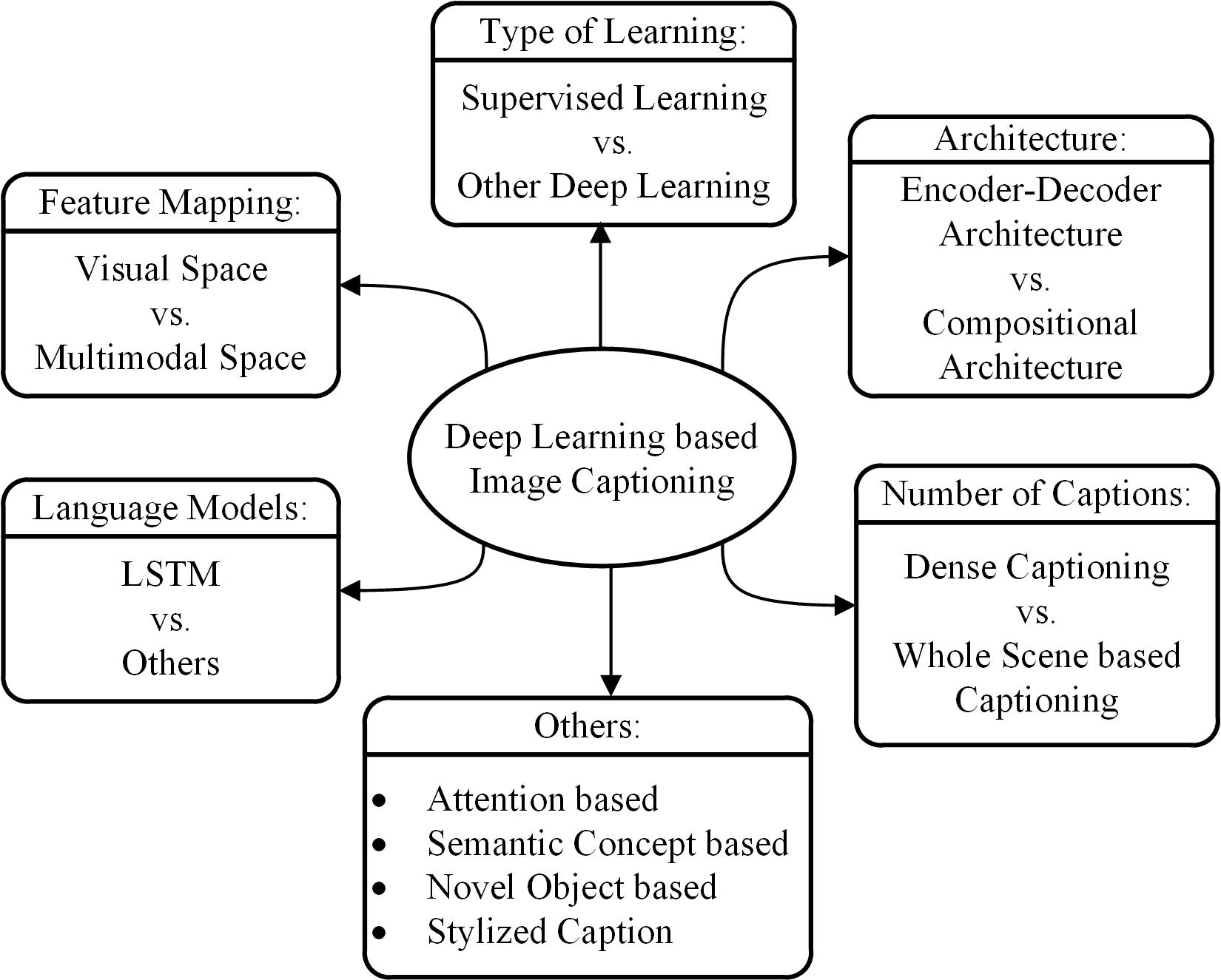
- To categorize and analyze 13 distinct deep learning-based image captioning methods, including attention-based, encoder-decoder, and multimodal approaches.
- To evaluate and compare the performance of these methods using standard datasets such as MSCOCO, Flickr30k, and Visual Genome.
- To analyze and contrast widely used evaluation metrics—BLEU, ROUGE, METEOR, CIDEr, and SPICE—on their ability to assess fluency, adequacy, and semantic accuracy.
- To identify limitations in current methods and propose future research directions, including open-domain captioning, external knowledge integration, and unsupervised/RL-based learning.
Proposed method
- The paper conducts a systematic taxonomy of deep learning-based image captioning, grouping methods into 13 categories including attention-based, encoder-decoder, and semantic concept-based models.
- It evaluates methods using standard benchmarks: MSCOCO, Flickr30k, and Visual Genome, which provide diverse, multi-captioned images for training and testing.
- The study analyzes performance across multiple evaluation metrics: BLEU for n-gram precision, ROUGE for recall and fluency, METEOR for segment-level alignment, CIDEr for saliency, and SPICE for semantic accuracy.
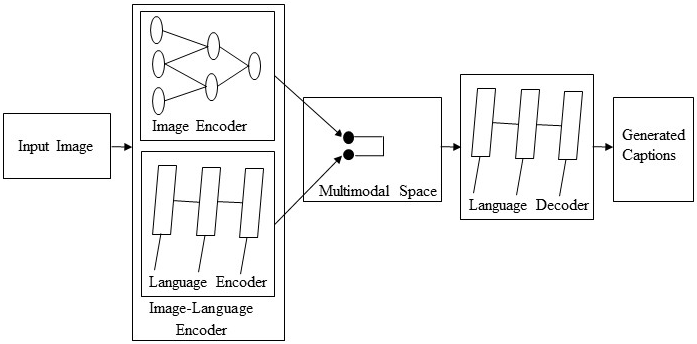
- It compares architectures such as CNN-LSTM encoders, attention mechanisms, and multimodal fusion strategies that jointly embed visual and linguistic features.
- The survey emphasizes supervised learning with cross-entropy loss, while also discussing reinforcement learning and GAN-based approaches for improved diversity and quality.
- It highlights the role of visual attention in focusing on salient image regions and improving caption relevance and coherence.
Experimental results
Research questions
- RQ1How do different deep learning architectures—such as attention-based, encoder-decoder, and multimodal models—compare in generating accurate and diverse image captions?
- RQ2What are the strengths and limitations of existing evaluation metrics (BLEU, ROUGE, METEOR, CIDER, SPICE) in measuring caption quality?
- RQ3To what extent do current models fail to detect prominent objects, attributes, and their relationships in images?
- RQ4How can external knowledge and unsupervised or reinforcement learning improve caption generation beyond supervised learning?
- RQ5What are the key challenges in generating high-quality, semantically rich, and diverse captions for open-domain images?
Key findings
- Attention-based models outperform standard encoder-decoder architectures by dynamically focusing on relevant image regions, improving both accuracy and relevance of generated captions.
- SPICE outperforms other metrics in capturing semantic content, making it more effective for evaluating caption quality than BLEU or ROUGE alone.
- Methods like Gu et al. and Yao et al. achieve high semantic correctness, while Rennie et al. and Lu et al. produce captions with better fluency, adequacy, and grammatical accuracy.
- Despite progress, current models still struggle with detecting key objects and relationships, especially in complex or open-domain scenes.
- Supervised learning methods depend heavily on large-scale annotated datasets, highlighting the need for unsupervised and reinforcement learning approaches to reduce annotation dependency.
- Future research should focus on open-domain captioning, integration of external knowledge, and improving diversity and factual consistency in generated captions.
Read this paper
Open the full text in the Nubint reader and ask about any passage as you read.
Read this paper on NubintThis review was generated by AI from the original paper. Please check the paper before citing it.