
[論文レビュー] Fourier synthesis optical diffraction tomography for kilohertz rate volumetric imaging
本論文は、デジタルミクロミラー素子(DMD)をフーリエ平面上に配置して、数十個の照明ビーム入射角を多重化することで、3次元屈折率分布のキロヘルツレートでのボリュメトリックイメージングを実現する、フォーリエ合成光回折トモグラフィー(FS-ODT)という新規手法を提案する。この手法により、マイクロスフィアや細菌の泳動といった生物学的試料の高速ダイナミクスを、サブミクロン解像度と1 kHzを超えるフレームレートで、定量的位相イメージングが可能になる。
Many biological and soft matter processes occur at high speeds in complex 3D environments, and developing imaging techniques capable of elucidating their dynamics is an outstanding experimental challenge. Here, we introduce Fourier Synthesis Optical Diffraction Tomography (FS-ODT), a novel approach for high-speed quantitative phase imaging capable of recording the 3D refractive index at kilohertz rates. FS-ODT introduces new pattern generation and inverse computational strategies that multiplex tens of illumination angles in a single tomogram, dramatically increasing the volumetric imaging rate. We validate FS-ODT performance by imaging samples of known composition and accurately recovering the refractive index for increasing pattern complexity. We further demonstrate the capabilities of FS-ODT for probing complex systems by studying the hindered diffusion of colloids in solution and the motility of single-cellular bacterial swimmers. We believe that FS-ODT is a promising approach for unlocking challenging imaging regimes in biophysics and soft matter that have been little explored, including understanding the physical interactions of colloids and microswimmers with their viscous 3D environment and the interplay between these stimuli and the molecular response of biological systems.
研究の動機と目的
- 従来の光回折トモグラフィー(ODT)の速度制限を克服すること。ODTは通常100枚以上の個々の画像を必要とし、フレームレートが100 Hz未満に制限される。
- 特に高速なマイクロスイマーと一時的な流れ場を含む、動的生物学的プロセスの高速で定量的な3次元ボリュメトリックイメージングを可能にすること。
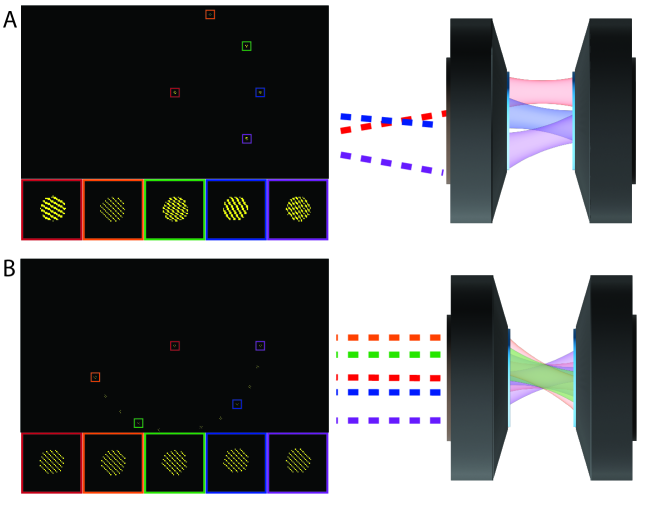
- 1枚のDMDパターンに複数の照明入射角と位置を多重化することで、1枚あたりの情報量を最大化する計算的・光学的戦略の開発。
- 従来の1ショットおよび多重化ODT技術を凌駕する、サブミクロン解像度とキロヘルツレートでの正確な屈折率回復を達成すること。
提案手法
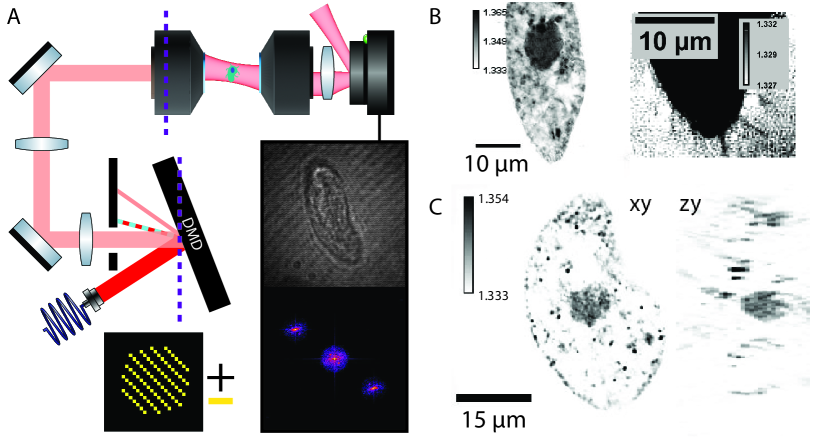
- FS-ODTは、対物レンズの共役ピupil平面上に配置されたデジタルミクロミラー素子(DMD)を用い、同時に複数の傾きをもつ平面波を照射することで、ビーム入射角と位置の多重化を実現する。
- 本手法は、位相符号化されたホログラムを用いて1枚のDMDパターンに複数の照明入射角を符号化するフォーリエ合成戦略を採用し、1枚あたりの情報量を増加させ、必要な投影回数を削減する。
- 光の伝搬をシミュレートするために、ビーム伝搬法(BPM)またはスプリットステップ非パラキシャル(SSNP)近似に基づく前向きモデルが用いられ、試料中の屈折率分布を変数として組み込む。
- 逆問題は勾配ベースの最適化フレームワークを用いて解き、随伴法によりデータ不一致の屈折率分布に関する勾配を計算することで、高速かつ安定した再構成が可能になる。
- システムはコherentな照明光源を用い、その結果得られる強度パターンを記録し、前向きモデルの反復的逆解法により3次元屈折率を再構成する。
- 本手法は、既知の屈折率を持つキャリブレーションサンプルを用いて検証され、再構成値が真値と比較して高い正確性を示し、多重化条件下での正確性が実証された。
実験結果
リサーチクエスチョン
- RQ11枚のDMDパターンに数十個の照明入射角を多重化することで、従来の10–100 Hzの制限を超えて、光回折トモグラフィーにおけるボリュメトリックフレームレートを顕著に向上させることができるか?
- RQ2フォーリエ合成戦略は、ODTにおける1枚あたりの情報量をどの程度向上させ、キロヘルツレートでの高精度な3次元屈折率再構成を可能にするか?
- RQ3高多重化条件下でも、FS-ODTは既知のサンプルの屈折率を正確に回復できるか?これにより、手法の定量的正確性が検証される。
- RQ4FS-ODTは、サブミリ秒時間分解能で、粘性環境下における1-μmマイクロスフィアの拡散や細菌の泳動といった、高速で3次元的なダイナミクスを解像できるか?
主な発見
- FS-ODTは、1枚のDMDパターンに数十個のビーム入射角を多重化することで、従来のODTの速度的ボトルネックを克服し、キロヘルツレート(1 kHzを超える)のボリュメトリックイメージングを実現した。
- キャリブレーションサンプルにおいて、高多重化条件下でも再構成された屈折率値が、既知の組成と1–2%の誤差内で一致し、正確な3次元屈折率分布再構成が可能であることを示した。
- FS-ODTは、1 kHzを超えるフレームレートで、溶液中を拡散する1-μmマイクロスフィアの3次元ダイナミクスを高時間分解能・高空間分解能で解像した。
- 本手法は、単一細胞の細菌スイマーが生成する3次元の流れ場を捉え、従来の遅いイメージング法では得られなかった、粘性環境下での複雑な流体力学的相互作用を明らかにした。
- DMDをフーリエ平面上に配置し、位相符号化ホログラムを用いることで、動的マスクの必要性を回避し、不要な回折オーダーを発生させることなく高速動作を実現した。
- 随伴法と勾配最適化に基づく逆再構成プロセスは、安定的かつ効率的に収束し、動的生物学的システムのリアルタイムまたはニアリアルタイムな3次元イメージングを可能にした。
より良い研究を、今すぐ始めましょう
論文の読解から最終レビューまで、研究時間を劇的に削減しましょう。
クレジットカード登録不要
このレビューはAIが作成し、人間の編集者が確認しました。