
[Paper Review] Friction Interventions to Curb the Spread of Misinformation on Social Media
The paper proposes a friction intervention with embedded learning about community standards to reduce the spread of low-quality content on social media. Agent-based simulations show that while friction alone reduces post volume without improving quality, combining mild friction (f = 0.01–0.05) with learning (ℓ = 0.1–0.3) significantly increases average post quality, offering a scalable, non-intrusive method to enhance information quality without harming engagement.
Social media has enabled the spread of information at unprecedented speeds and scales, and with it the proliferation of high-engagement, low-quality content. *Friction* -- behavioral design measures that make the sharing of content more cumbersome -- might be a way to raise the quality of what is spread online. Here, we study the effects of friction with and without quality-recognition learning. Experiments from an agent-based model suggest that friction alone decreases the number of posts without improving their quality. A small amount of friction combined with learning, however, increases the average quality of posts significantly. Based on this preliminary evidence, we propose a friction intervention with a learning component about the platform's community standards, to be tested via a field experiment. The proposed intervention would have minimal effects on engagement and may easily be deployed at scale.
Motivation & Objective
- To investigate whether friction in content sharing can reduce the spread of low-quality and misleading content on social media platforms.
- To evaluate the impact of friction combined with learning about platform standards on the quality of shared content.
- To design a scalable, non-intrusive intervention that minimally affects user engagement while improving information quality.
- To test whether friction can counteract cognitive biases and algorithmic amplification that favor high-engagement, low-quality content.
- To provide a field-testable prototype intervention grounded in behavioral science and agent-based modeling.
Proposed method
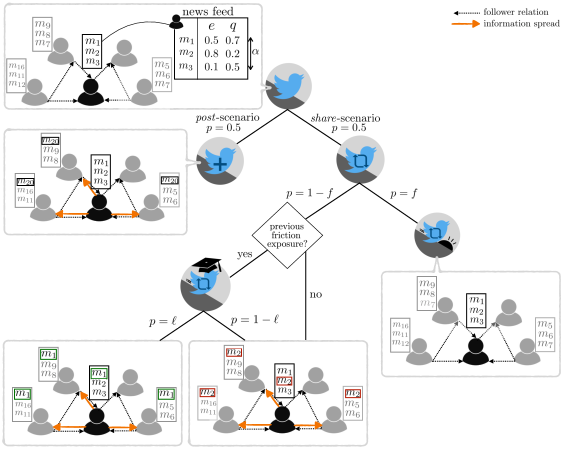
- An agent-based model simulates social media interactions, with agents sharing posts based on engagement (e-distance) or, after friction, based on perceived quality.
- Friction is modeled as a probability (f ∈ [0,1]) that an agent is prevented from sharing due to a mandatory quiz or reflection prompt.
- Learning is modeled as a probability (ℓ ∈ [0,1]) that agents, after prior friction exposure, shift sharing behavior from engagement to quality-based selection.
- Post quality (q) and engagement (e) are drawn from a linear probability density function P(x) = 2(1−x), reflecting that high-quality and high-engagement content are rare.
- The system tracks exponential moving average quality (ρ = 0.99) to determine stabilization, halting simulations when changes fall below ε = 10⁻⁵.
- Simulations test 813 combinations of friction (f) and learning (ℓ), each run 10 times across five sampled networks, with results averaged for robustness.
Experimental results
Research questions
- RQ1Does friction alone reduce the spread of low-quality content without improving its quality?
- RQ2Can combining friction with learning about community standards significantly increase the average quality of shared content?
- RQ3What is the optimal balance between friction intensity and learning probability to maximize content quality while preserving engagement?
- RQ4How does the presence of duplicate posts (due to re-sharing) affect the long-term quality of information ecosystems?
- RQ5To what extent do cognitive biases and algorithmic amplification of popular content undermine the effectiveness of friction interventions?
Key findings
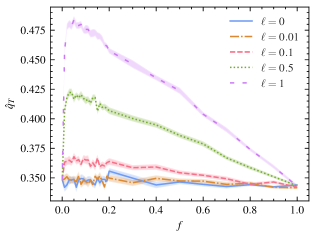
- Friction alone reduces the number of shared posts but does not improve the average quality of content, as agents still prioritize engagement over quality.
- A small amount of friction (f = 0.01–0.05) combined with moderate learning (ℓ = 0.1–0.3) leads to a significant increase in average post quality across simulations.
- The highest average quality is achieved at low friction and moderate learning, suggesting a sweet spot where cognitive effort is sufficient to promote deliberation without deterring sharing.
- The intervention stabilizes at a higher quality level than baseline, with exponential moving average quality converging to a new equilibrium after sufficient simulation time.
- The model shows that learning enables agents to shift from engagement-based to quality-based sharing, even after a single exposure to friction prompts.
- The proposed intervention is scalable and minimally disruptive, as it does not significantly reduce user engagement or require major platform redesign.
Read this paper
Open the full text in the Nubint reader and ask about any passage as you read.
Read this paper on NubintThis review was generated by AI from the original paper. Please check the paper before citing it.