
[Paper Review] Generative models improve fairness of medical classifiers under distribution shifts
The paper shows that conditioning diffusion-based generative models on labels and sensitive attributes to augment training data improves robustness and fairness of medical classifiers across histopathology, chest radiology, and dermatology under distribution shifts.
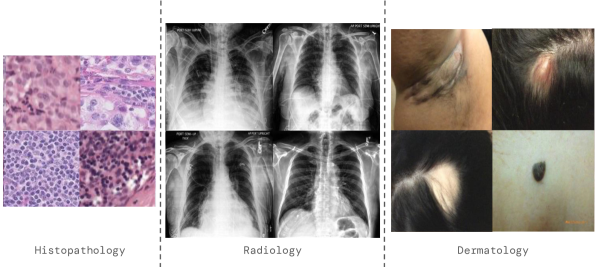
A ubiquitous challenge in machine learning is the problem of domain generalisation. This can exacerbate bias against groups or labels that are underrepresented in the datasets used for model development. Model bias can lead to unintended harms, especially in safety-critical applications like healthcare. Furthermore, the challenge is compounded by the difficulty of obtaining labelled data due to high cost or lack of readily available domain expertise. In our work, we show that learning realistic augmentations automatically from data is possible in a label-efficient manner using generative models. In particular, we leverage the higher abundance of unlabelled data to capture the underlying data distribution of different conditions and subgroups for an imaging modality. By conditioning generative models on appropriate labels, we can steer the distribution of synthetic examples according to specific requirements. We demonstrate that these learned augmentations can surpass heuristic ones by making models more robust and statistically fair in- and out-of-distribution. To evaluate the generality of our approach, we study 3 distinct medical imaging contexts of varying difficulty: (i) histopathology images from a publicly available generalisation benchmark, (ii) chest X-rays from publicly available clinical datasets, and (iii) dermatology images characterised by complex shifts and imaging conditions. Complementing real training samples with synthetic ones improves the robustness of models in all three medical tasks and increases fairness by improving the accuracy of diagnosis within underrepresented groups. This approach leads to stark improvements OOD across modalities: 7.7% prediction accuracy improvement in histopathology, 5.2% in chest radiology with 44.6% lower fairness gap and a striking 63.5% improvement in high-risk sensitivity for dermatology with a 7.5x reduction in fairness gap.
Motivation & Objective
- Motivate and address distribution shifts and potential bias in medical ML models.
- Develop a label-efficient augmentation approach using diffusion models to model data distributions for subgroups.
- Demonstrate that learned augmentations can outperform heuristic augmentations and improve fairness without sacrificing accuracy.
- Show generalization of the approach across multiple imaging modalities with varying difficulty and resolutions.
Proposed method
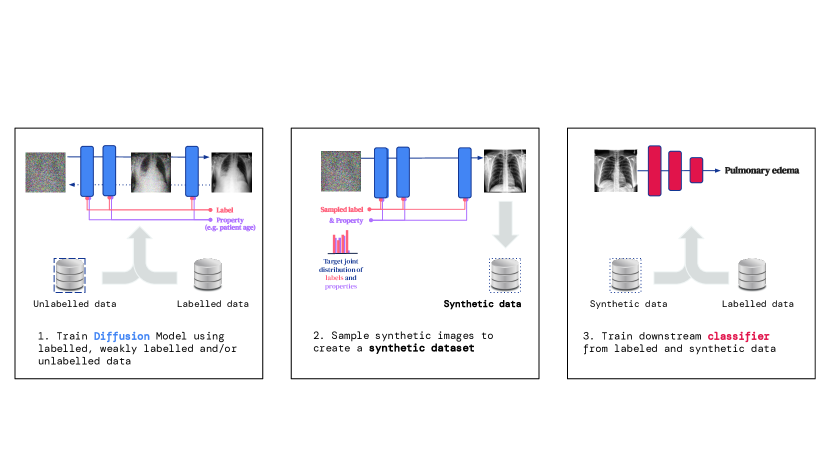
- Train a diffusion model on labelled and unlabelled data (conditioning on diagnostic labels or on diagnostic labels plus a sensitive attribute).
- Sample synthetic images according to a fair sampling strategy from the diffusion model.
- Train downstream classifiers on a mix of real labelled data and synthetic data, with mixing ratio as a hyperparameter.
Experimental results
Research questions
- RQ1Does conditioning diffusion model augmentations on labels and sensitive attributes improve performance under distribution shifts?
- RQ2Do learned augmentations reduce fairness gaps across subgroups in histopathology, chest radiology, and dermatology?
- RQ3How does the method perform in high-resolution, high-difficulty dermatology tasks compared to other baselines?
- RQ4What is the impact of combining synthetic data with color augmentation or other heuristics on accuracy and fairness?
Key findings
- 7.7 percentage point improvement in test-set accuracy for histopathology with synthetic data and color augmentation.
- 5.2 percentage point average AUC improvement in out-of-distribution chest radiology with a 44.6% lower fairness gap.
- 63.5% improvement in high-risk sensitivity and a 7.5x reduction in fairness gap for dermatology under distribution shifts.
- Diffusion-based augmentations outperform baselines and reduce fairness gaps across modalities and distribution shift scenarios.
- High-resolution dermatology results used cascaded diffusion upsampling to 256x256 with notable gains in OOD settings.
Read this paper
Open the full text in the Nubint reader and ask about any passage as you read.
Read this paper on NubintThis review was generated by AI from the original paper. Please check the paper before citing it.