
[Paper Review] Hamiltonian Analysis of $f(Q)$ Gravity and the Failure of the Dirac-Bergmann Algorithm for Teleparallel Theories of Gravity
This paper demonstrates that the Dirac-Bergmann constraint analysis fails in $f(\mathbb{Q})$ gravity and related teleparallel theories due to a breakdown in the algorithm's foundational assumptions, particularly the invertibility of the kinetic matrix. Using an alternative field-redefinition approach based on diagonalizing a master kinetic matrix, the authors show that $f(\mathbb{Q})$ gravity propagates at most seven physical degrees of freedom, contradicting a prior claim of eight and highlighting a critical flaw in standard Hamiltonian methods for non-metric gravity theories.
In recent years, $f(Q)$ gravity has enjoyed considerable attention in the literature and important results have been obtained. However, the question of how many physical degrees of freedom the theory propagates -- and how this number may depend on the form of the function $f$ -- has not been answered satisfactorily. In this article we show that a Hamiltonian analysis based on the Dirac-Bergmann algorithm -- one of the standard methods to address this type of question -- fails. We isolate the source of the failure, show that other commonly considered teleparallel theories of gravity are affected by the same problem, and we point out that the number of degrees of freedom obtained in Phys. Rev. D 106 no. 4, (2022) by K. Hu, T. Katsuragawa, and T. Qui (namely eight), based on the Dirac-Bergmann algorithm, is wrong. Using a different approach, we show that the upper bound on the degrees of freedom is seven. Finally, we propose a more promising strategy for settling this important question.
Motivation & Objective
- To resolve the long-standing ambiguity in the number of physical degrees of freedom in $f(\mathbb{Q})$ gravity.
- To identify the failure of the Dirac-Bergmann algorithm in teleparallel theories based on non-metricity or torsion.
- To correct the erroneous claim of eight physical degrees of freedom in $f(\mathbb{Q})$ gravity from a prior study (Hu et al., 2022).
- To develop a robust alternative method for counting degrees of freedom in higher-derivative, non-metric gravity theories.
- To establish a more reliable framework for Hamiltonian analysis in teleparallel gravity by avoiding the pitfalls of the standard Dirac-Bergmann procedure.
Proposed method
- The authors analyze the Hamiltonian structure of $f(\mathbb{Q})$ gravity using a generalized form of the Dirac-Bergmann algorithm, identifying where its assumptions break down.
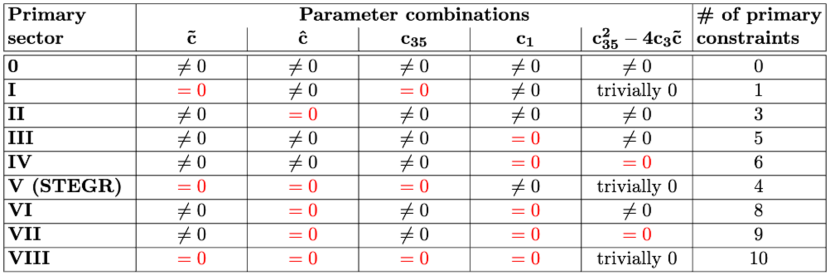
- They identify that the failure arises because the kinetic matrix $\mathcal{K}$ in the equations of motion cannot be inverted due to the presence of non-trivial spatial derivative mixing matrices $\mathcal{M}^{(i)}$.
- A new method is proposed involving a nonlinear field redefinition that diagonalizes a master kinetic matrix, eliminating the $\mathcal{M}^{(i)}$ matrices and restoring invertibility.
- The method relies on constructing a symmetric master matrix from the Lagrangian's kinetic and derivative terms, which can be diagonalized to decouple the fields.
- The number of physical degrees of freedom is then determined by counting the non-zero eigenvalues of the diagonalized kinetic matrix.
- The approach is generalized to other teleparallel theories based on non-metricity or torsion, showing the same failure mechanism applies broadly.
Experimental results
Research questions
- RQ1Why does the standard Dirac-Bergmann algorithm fail in $f(\mathbb{Q})$ gravity and related teleparallel theories?
- RQ2What is the correct number of physical degrees of freedom in $f(\mathbb{Q})$ gravity, and how does it depend on the function $f$?
- RQ3Can a consistent Hamiltonian analysis be performed in theories with non-trivial mixing of second-order time and spatial derivatives?
- RQ4Is the claim of eight physical degrees of freedom in $f(\mathbb{Q})$ gravity (Hu et al., 2022) valid, and if not, what is the correct upper bound?
- RQ5Can a field-redefinition strategy be systematically constructed to restore the applicability of the Dirac-Bergmann algorithm in such theories?
Key findings
- The Dirac-Bergmann algorithm fails in $f(\mathbb{Q})$ gravity because the kinetic matrix $\mathcal{K}$ is not invertible due to the presence of non-trivial spatial derivative mixing matrices $\mathcal{M}^{(i)}$.
- The prior claim of eight physical degrees of freedom in $f(\mathbb{Q})$ gravity (Hu et al., 2022) is incorrect due to the algorithmic failure.
- Using a nonlinear field redefinition, the authors construct a master kinetic matrix that can be diagonalized, eliminating the problematic $\mathcal{M}^{(i)}$ terms.
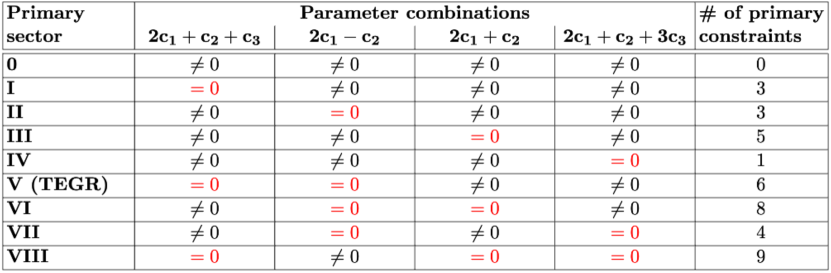
- After diagonalization, the number of physical degrees of freedom is determined by counting non-zero eigenvalues, yielding an upper bound of seven.
- The failure mechanism is not isolated to $f(\mathbb{Q})$ gravity but affects all teleparallel theories based on non-metricity or torsion with similar derivative structure.
- The proposed method provides a more reliable alternative for Hamiltonian analysis in higher-derivative, non-metric gravity theories where standard Dirac-Bergmann fails.
Read this paper
Open the full text in the Nubint reader and ask about any passage as you read.
Read this paper on NubintThis review was generated by AI from the original paper. Please check the paper before citing it.