
[Paper Review] Intergenerational Mobility Trends and the Changing Role of Female Labor
Using harmonized Scandinavian administrative data, this study finds that intergenerational income mobility has declined since the 1950s, primarily due to rising female labor force participation and better alignment of women’s earnings with their underlying skills. The increase in mother-daughter income rank associations reflects improved measurement of latent economic status, suggesting that greater gender equality in labor markets reveals previously obscured intergenerational mobility trends.
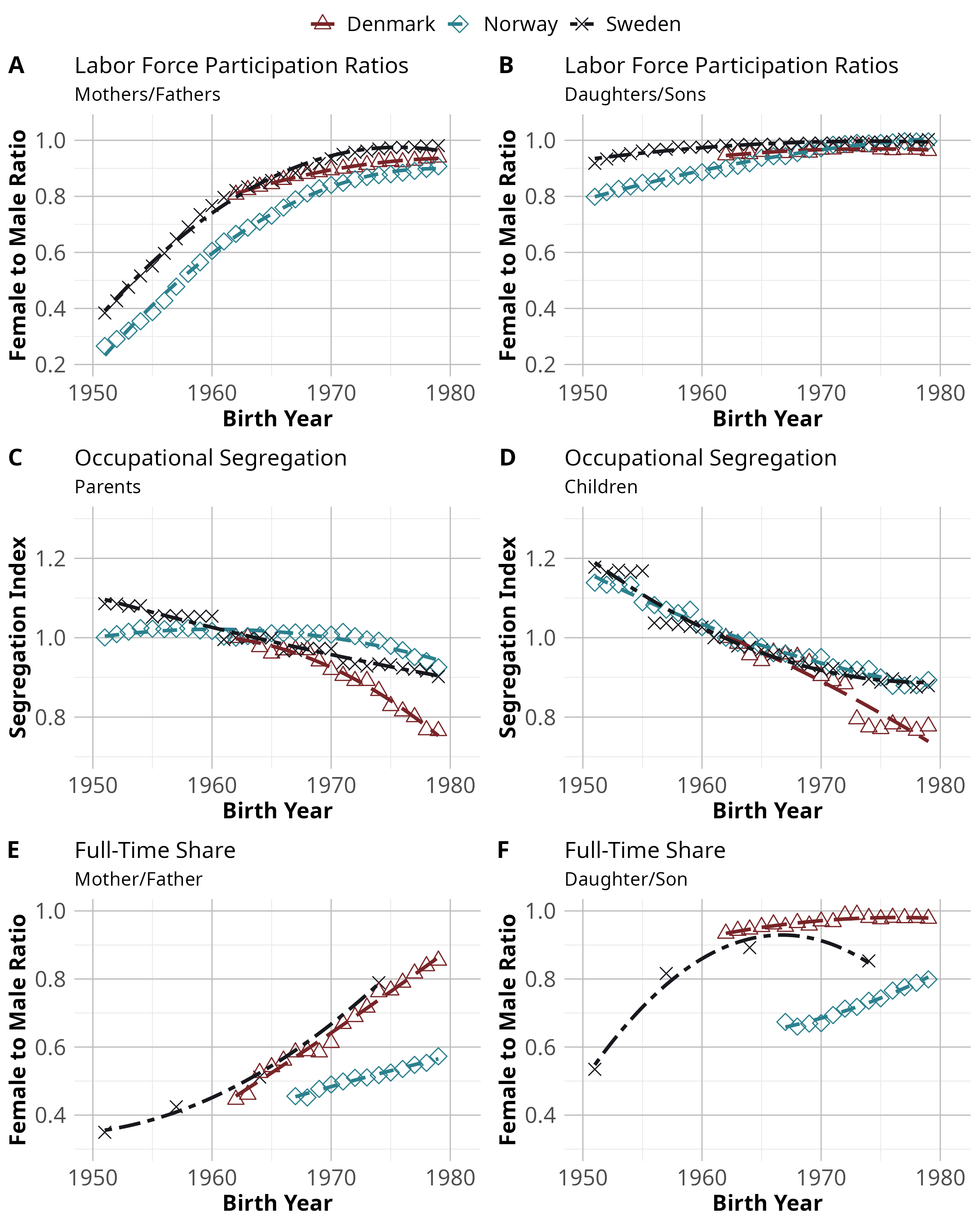
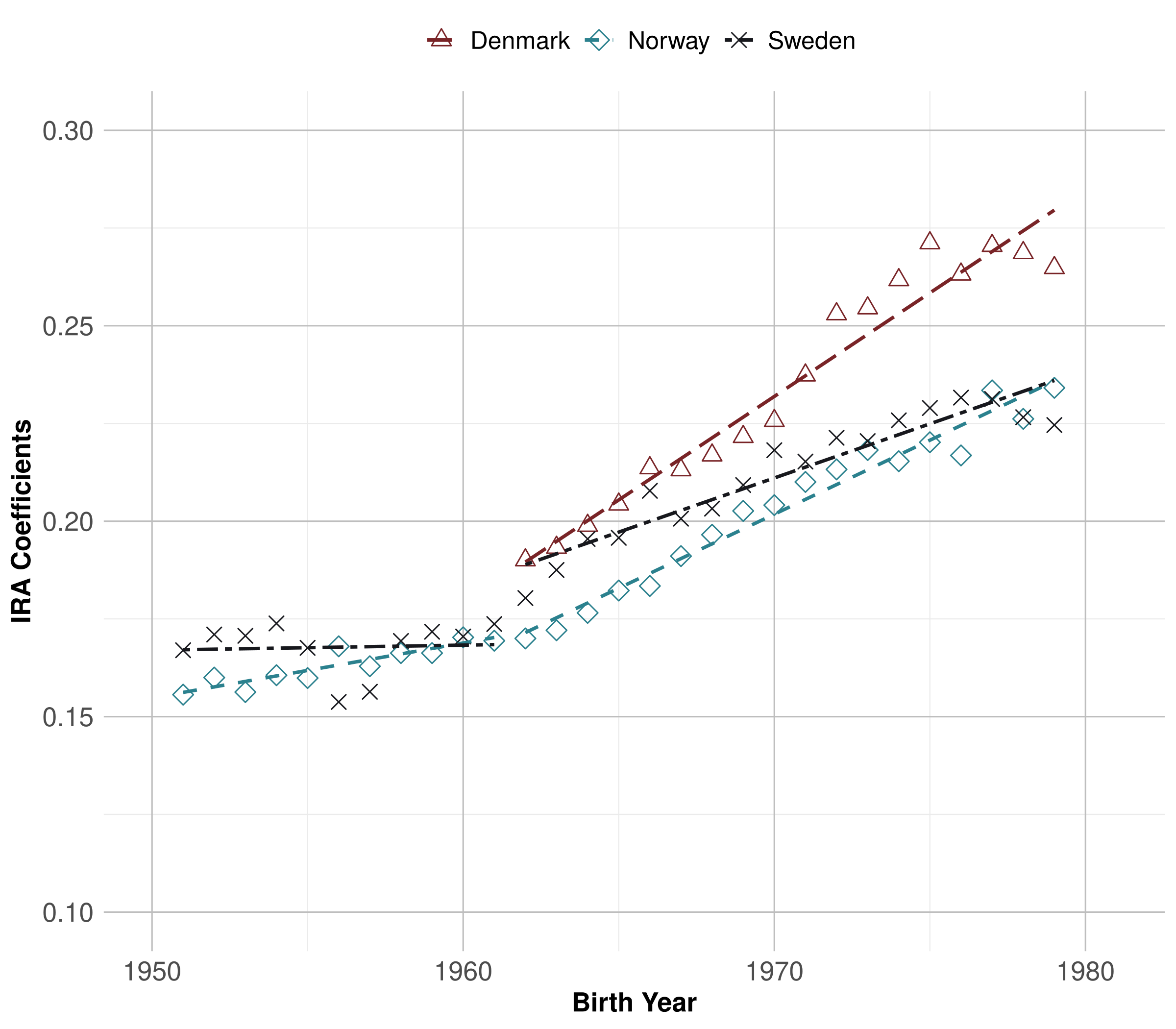
Using harmonized administrative data from Scandinavia, we find that intergenerational rank associations in income have increased uniformly across Sweden, Denmark, and Norway for cohorts born between 1951 and 1979. By gender, father-son mobility remains stable, while correlations for mothers and daughters rise. Similar patterns appear in US survey data, albeit with different timing. We show that the decline in income mobility reflects female income more accurately capturing underlying productivity, rather than stronger intergenerational transmission of human capital or changes in assortative mating. Finally, we show parent-child correlations increase mainly when women gain access to jobs that match their productivity.
Motivation & Objective
- To examine how changes in female labor market participation and skill expression affect intergenerational income mobility in Scandinavia.
- To address the underestimation of female human capital in traditional mobility estimates due to historical measurement bias in women’s income.
- To assess whether increasing labor force attachment among women has led to a more accurate reflection of intergenerational economic status transmission.
- To compare trends in Scandinavia with U.S. data to test the robustness and timing of observed mobility patterns.
- To evaluate whether declining mobility reflects reduced equality of opportunity or improved measurement of latent economic potential.
Proposed method
- Utilized full-population, harmonized administrative earnings data from Sweden, Denmark, and Norway for individuals born 1951–1979, covering income from 1968 to 2017.
- Applied intergenerational rank association (IRA) regression models to estimate the correlation between parent and child earnings ranks, using within-cohort ranking to control for cohort-level income shifts.
- Split results by gender of parent and child to isolate trends in father-son, mother-daughter, father-daughter, and mother-son mobility.
- Used maternal uncle–child income correlations as a proxy for unobserved female earnings potential, leveraging sibling correlations to isolate the impact of female labor supply on mobility trends.
- Conducted robustness checks using alternative income definitions (gross vs. net of tax, log earnings vs. rank), ensuring results were not driven by tax or transfer policy changes.
- Compared findings with U.S. Panel Study of Income Dynamics (PSID) data to assess cross-country consistency and timing differences.
Experimental results
Research questions
- RQ1How have intergenerational income mobility trends evolved in Scandinavia for cohorts born between 1951 and 1979?
- RQ2To what extent do changes in female labor market participation and skill expression explain observed shifts in intergenerational mobility?
- RQ3Why do mother-daughter income rank associations show a stronger upward trend than father-son correlations?
- RQ4How does the inclusion of maternal uncles as proxies for female earnings potential affect the interpretation of mobility trends?
- RQ5Are the observed mobility trends in Scandinavia consistent with patterns observed in U.S. survey data?
Key findings
- Intergenerational rank associations in income increased uniformly across Sweden, Denmark, and Norway for cohorts born between 1951 and 1979.
- Father-son income mobility remained stable over time, while mother-daughter and father-daughter correlations showed significant upward trends.
- The strongest increase in intergenerational rank association occurred between mothers and daughters, indicating a growing transmission of economic status through female lines.
- The use of maternal uncles as proxies for female earnings potential revealed that a substantial portion of the mother-daughter trend is attributable to changes in women’s labor market attachment and skill expression.
- Similar but slightly delayed mobility trends were observed in U.S. PSID data, supporting the robustness of the Scandinavian findings.
- The decline in mobility is not due to tax or transfer policy changes, as results were robust across different income definitions and measures.
Read this paper
Open the full text in the Nubint reader and ask about any passage as you read.
Read this paper on NubintThis review was generated by AI from the original paper. Please check the paper before citing it.