
[Paper Review] Intrinsic Dimension Estimation for Robust Detection of AI-Generated Texts
The paper introduces a persistent homology-based intrinsic dimension (PHD) estimator for text samples and shows that human texts have higher intrinsic dimension than AI-generated texts, enabling a robust, model- and domain-agnostic detector.
Rapidly increasing quality of AI-generated content makes it difficult to distinguish between human and AI-generated texts, which may lead to undesirable consequences for society. Therefore, it becomes increasingly important to study the properties of human texts that are invariant over different text domains and varying proficiency of human writers, can be easily calculated for any language, and can robustly separate natural and AI-generated texts regardless of the generation model and sampling method. In this work, we propose such an invariant for human-written texts, namely the intrinsic dimensionality of the manifold underlying the set of embeddings for a given text sample. We show that the average intrinsic dimensionality of fluent texts in a natural language is hovering around the value $9$ for several alphabet-based languages and around $7$ for Chinese, while the average intrinsic dimensionality of AI-generated texts for each language is $\approx 1.5$ lower, with a clear statistical separation between human-generated and AI-generated distributions. This property allows us to build a score-based artificial text detector. The proposed detector's accuracy is stable over text domains, generator models, and human writer proficiency levels, outperforming SOTA detectors in model-agnostic and cross-domain scenarios by a significant margin.
Motivation & Objective
- Identify invariant text properties that distinguish human-written texts from AI-generated texts across domains and languages.
- Develop a low-dimensional, computation-friendly detector that generalizes to unseen generation models and sampling methods.
- Demonstrate robustness to domain shifts, model shifts, and adversarial alterations.
- Provide multilingual data and code to enable replication and further ATD research.
Proposed method
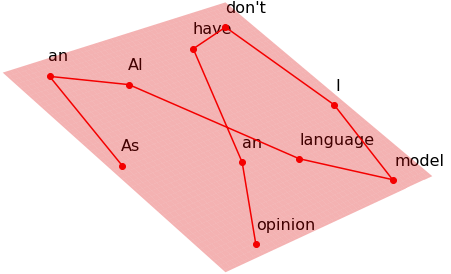
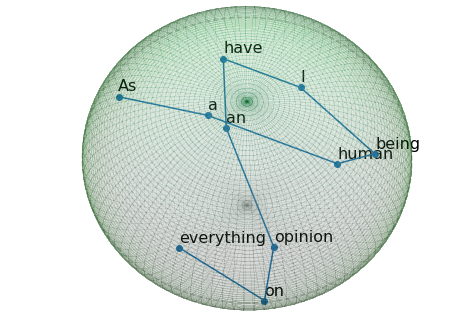
- Estimate the intrinsic dimensionality of a text sample by representing token embeddings as a point cloud in a fixed-dimensional space.
- Compute contextualized token embeddings using pretrained RoBERTa-base (English) or XLM-R (multilingual).
- Apply the persistent homology dimension (PHD) estimator via a growth-rate analysis of MST-based lifespans to obtain a dimension d from log-log regression.
- Sample multiple subsets of token embeddings, compute E0^1(Si) per subset, and use linear regression on log-log pairs to estimate the slope and thus d.
- Train a simple one-feature logistic regression classifier using PHD as the feature to distinguish real vs AI-generated texts.
- Compare PHD with baselines (MLE, DetectGPT, GPTZero, OpenAI detector, RankGen) in cross-domain and cross-model settings.
Experimental results
Research questions
- RQ1Can the intrinsic dimensionality of text embeddings serve as a domain- and model-agnostic signal to detect AI-generated text?
- RQ2Does PHD separation between human and AI texts persist across languages, genres, and generation models?
- RQ3How does PHD compare to existing detectors under cross-domain and adversarial conditions?
- RQ4Is the detector robust to domain shifts and less biased against non-native speakers compared to baselines?
- RQ5What are the practical considerations (sampling stability, computation) for applying PHD to text data?
Key findings
- Human-authored texts cluster around intrinsic dimension values near 9–10 (Europe languages) and around 7 for Chinese/Japanese, while AI-generated texts are ≈1.5 lower on average.
- PHD-based detector outperforms universal detectors in model-agnostic and cross-domain scenarios by a large margin.
- PHD shows robustness to domain transfer and cross-model transfer, often outperforming supervised RoBERTa-based classifiers in cross-domain experiments.
- PHD is invariant to generator model and sampling method and remains effective under DIPPER paraphrase attack, unlike several baselines.
- Across 10 languages, PHD achieves ROC-AUC values around 0.71–0.83 (Chinese to Spanish range) with varying language-specific performance.
- The method reduces bias against non-native speakers compared to OpenAI and GPTZero baselines, and maintains high detection rates across adversarial prompt changes.
Read this paper
Open the full text in the Nubint reader and ask about any passage as you read.
Read this paper on NubintThis review was generated by AI from the original paper. Please check the paper before citing it.