
[Paper Review] Introducing the Perturbative Solution of the Inter-Channel Stimulated Raman Scattering in Single-Mode Optical Fibers
This paper presents a perturbative solution to the inter-channel stimulated Raman scattering (SRS) equations in single-mode fibers, enabling accurate and computationally efficient modeling of power transfer across multi-band WDM systems. The method achieves sub-0.1 dB accuracy with 2nd-order expansion in C+L+S bands and 3rd order in U-to-E bands, reducing computational time by at least one order of magnitude compared to numerical integration.
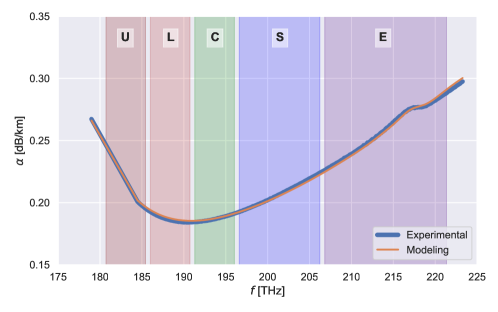
The continuously increasing IP data traffic demand, with geometrical growth rate exceeding 26%, requires a large transmission capacity increment from the fiber optical infrastructure. As the deploy of new fiber cables requires extensive investments, the development of multi-band amplifiers and transceivers, already available as prototypes, is progressively considered towards the entire low-loss single-mode bandwidth beyond the 5 THz C-band. In this perspective, an adequate handling of the variations along the frequency of the fiber physical features becomes crucial for the fiber propagation modeling in multi-band wavelength division multiplexing (WDM) channel comb transmission scenarios. In particular, the inter-channel stimulated Raman scattering (SRS) is the fundamental inter-band effect in this context. The SRS effect on the WDM comb propagated through a single-mode optical fiber is described by a set of ordinary differential equations (ODEs). To date, an exact solution of the SRS ODEs has not been proposed, and in the literature numerical solutions or approximations have been considered in order to take into account this effect. In this work, a perturbative solution of the SRS ODEs is presented enabling an efficient trade-off between the target accuracy and the computational time. Considering a C+L+S transmission scenario, the perturbative expansion up to the 2nd order ensures an excellent accuracy. Whereas, in an U-to-E transmission scenario, the 3rd order is required in order to reach an equivalent accuracy.
Motivation & Objective
- To address the lack of an exact analytical solution for inter-channel SRS in multi-band WDM systems using single-mode fibers.
- To develop a computationally efficient method that balances accuracy and speed for SRS modeling in wideband optical transmission.
- To provide a systematic procedure for determining the required perturbative order to achieve a target tolerance in SRS power transfer estimation.
- To validate the perturbative approach across realistic transmission scenarios, including C+L+S and U-to-E bands, under varying bandwidths and launch power conditions.
Proposed method
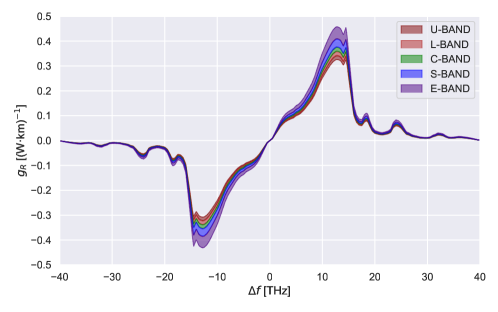
- The paper formulates the inter-channel SRS effect using a set of coupled ordinary differential equations (ODEs) that describe power transfer between channels due to Raman gain.
- It applies a perturbative expansion to the SRS ODEs, expanding the solution in powers of the Raman gain coefficient and channel power, up to 3rd order for high-accuracy scenarios.
- A heuristic criterion based on the maximum absolute value of the Raman gain profile and factorial scaling is derived to estimate the required perturbative order for a given tolerance (e.g., 0.1 dB).
- The method enables spatial integration of perturbative terms at coarser step sizes (tens of km) compared to numerical ODE solvers (0.1–1 km), significantly reducing computational load.
- The approach is validated by comparing perturbative solutions against numerical reference solutions using realistic fiber parameters and channel configurations.
- The method supports scalable modeling by grouping channels into macro-channels when high computational efficiency is required, assuming slowly varying fiber and spectral parameters within each macro-channel.
Experimental results
Research questions
- RQ1What is the optimal perturbative order required to achieve a target accuracy (e.g., 0.1 dB) in modeling inter-channel SRS across wideband WDM systems?
- RQ2How does the computational efficiency of the perturbative solution compare to standard numerical integration of the SRS ODEs for increasing transmission bandwidth?
- RQ3Can a conservative and effective procedure be derived to estimate the required perturbative order without relying on iterative numerical evaluation?
- RQ4How does the perturbative solution perform in real-world scenarios such as C+L+S and U-to-E band transmission with flat per-channel launch power?
- RQ5To what extent can the perturbative solution be extended to support generalized nonlinear noise modeling in wideband optical systems?
Key findings
- The 2nd-order perturbative solution achieves sub-0.1 dB relative error in C+L+S-band transmission scenarios, matching the accuracy of numerical reference solutions.
- For U-to-E-band transmission, the 3rd-order perturbative solution is required to maintain equivalent accuracy, with error bounded within 0.1 dB tolerance.
- The perturbative method reduces computational time by at least one order of magnitude compared to numerical ODE integration across increasing bandwidths (2.5 to 40 THz).
- The spatial integration step size for the perturbative solution can be increased to tens of kilometers while maintaining 0.1 dB accuracy, whereas numerical methods require steps of 0.1–1 km.
- A heuristic criterion based on the Raman gain profile and factorial scaling enables reliable estimation of the required perturbative order for any given tolerance.
- The method enables scalable modeling by allowing macro-channel grouping, reducing computational cost without sacrificing accuracy when spectral parameters vary slowly within each group.
Read this paper
Open the full text in the Nubint reader and ask about any passage as you read.
Read this paper on NubintThis review was generated by AI from the original paper. Please check the paper before citing it.