
[Paper Review] Iterative assembly of $^{171}$Yb atom arrays with cavity-enhanced optical lattices
Demonstrates an iterative protocol that uses a reservoir of atoms, optical tweezers, and cavity-enhanced optical lattices to deterministically fill 1225-site target arrays with 171Yb atoms at ~99% occupancy, enabling scalable, reloadable neutral-atom quantum systems.
Assembling and maintaining large arrays of individually addressable atoms is a key requirement for continued scaling of neutral-atom-based quantum computers and simulators. In this work, we demonstrate a new paradigm for assembly of atomic arrays, based on a synergistic combination of optical tweezers and cavity-enhanced optical lattices, and the incremental filling of a target array from a repetitively filled reservoir. In this protocol, the tweezers provide microscopic rearrangement of atoms, while the cavity-enhanced lattices enable the creation of large numbers of optical traps with sufficient depth for rapid low-loss imaging of atoms. We apply this protocol to demonstrate near-deterministic filling (99% per-site occupancy) of 1225-site arrays of optical traps. Because the reservoir is repeatedly filled with fresh atoms, the array can be maintained in a filled state indefinitely. We anticipate that this protocol will be compatible with mid-circuit reloading of atoms into a quantum processor, which will be a key capability for running large-scale error-corrected quantum computations whose durations exceed the lifetime of a single atom in the system.
Motivation & Objective
- Motivate scalable assembly of large, deterministically filled neutral-atom arrays for quantum computation and simulation.
- Combine optical tweezers with cavity-enhanced optical lattices to enable rapid, high-fidelity imaging and deterministic filling.
- Decouple final array size from single-loading atom supply by using a repeatedly filled reservoir and mid-cycle rearrangement.
- Show maintenance of a filled array over time via reservoir reloading, enabling potential mid-circuit reloading for error-corrected schemes.
Proposed method
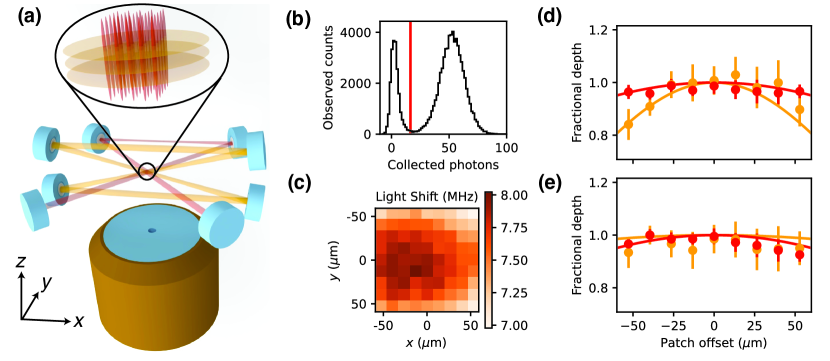
- Use two intersecting optical cavities (XY and Z) to create a 3D, deep lattice for fast, low-loss imaging of atoms.
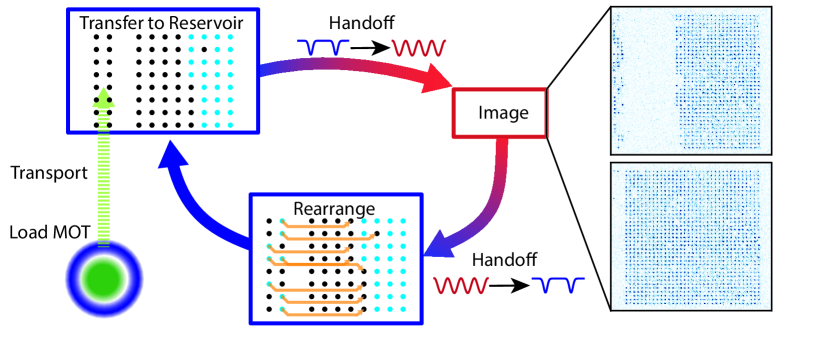
- Implement a reservoir of atoms in optical tweezers and a separate target tweezer array; transfer atoms into a cavity lattice for site-resolved imaging.
- Perform site-resolved fluorescence imaging to determine occupancy with ~99.95% fidelity and ~2e-3 imaging loss.
- Cycle atoms between reservoir and target arrays via a rearrangement tweezer to move atoms into empty target sites based on imaging results.
- Repeat loading cycles to reach ~99% occupancy in a 1225-site target array, while reloading the reservoir from a fresh MOT each cycle.
Experimental results
Research questions
- RQ1Can an iterative, reservoir-based loading scheme achieve near-deterministic filling of very large atom arrays?
- RQ2What are the dominant per-cycle loss mechanisms in reservoir-to-target handoffs and how can they be mitigated?
- RQ3Is it feasible to maintain a fully filled large array over time with continuous reloading and imaging?
- RQ4Can cavity-enhanced optical lattices provide the deep, uniform traps needed for rapid, high-fidelity imaging in large arrays?
- RQ5How compatible is this approach with mid-circuit reloading for scalable quantum computation?
Key findings
- Achieved deterministic filling of a 1225-site target array with 171Yb atoms at ~99% occupancy over multiple loading cycles.
- Reservoir containing up to 105 sites is repeatedly loaded from a fresh MOT and adjacent to the target array to enable continuous replenishment.
- Imaging via cavity-enhanced lattices yields ~50 photons in 7 ms per site with 99.95% occupancy discrimination and ~2e-3 atom loss per image.
- Per-cycle loading performance shows ~45 atoms transferred into the target array per cycle early on, with final vacancy fraction around percent-level losses dominated by vacuum lifetime (~30 s).
- The protocol allows maintaining a filled array indefinitely with repeated reservoir reloads, compatible with mid-circuit reloading concepts for large-scale quantum computations.
Read this paper
Open the full text in the Nubint reader and ask about any passage as you read.
Read this paper on NubintThis review was generated by AI from the original paper. Please check the paper before citing it.