
[Paper Review] JWST observations of galaxy damping wings during reionization interpreted with cosmological simulations
The paper compares JWST-detected damping wings in high-redshift galaxies with inhomogeneous reionization simulations (Sherwood-Relics) and the Miralda-Escudé model, finding good red-side agreement but blue-side discrepancies due to residual neutral gas inside ionized bubbles, and suggesting smaller bubbles with stronger intrinsic Lyα emission as an alternative explanation for observations.
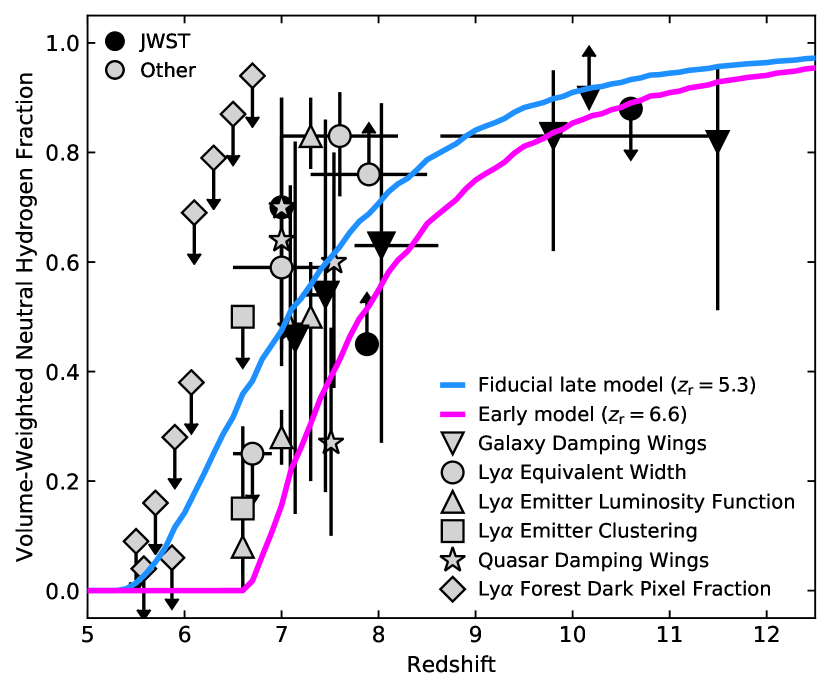
Spectra of the highest redshift galaxies taken with JWST are now allowing us to see into the heart of the reionization epoch. Many of these observed galaxies exhibit strong damping wing absorption redward of their Lyman-$α$ emission. These observations have been used to measure the redshift evolution of the neutral fraction of the intergalactic medium and sizes of ionized bubbles. However, these estimates have been made using a simple analytic model for the intergalactic damping wing. We explore the recent observations with models of inhomogeneous reionization from the Sherwood-Relics simulation suite. We carry out a comparison between the damping wings calculated from the simulations and from the analytic model. We find that although the agreement is good on the red side of the Lyman-$α$ emission, there is a discrepancy on the blue side due to residual neutral hydrogen present in the simulations, which saturates the intergalactic absorption. For this reason, we find that it is difficult to reproduce the claimed observations of large bubble sizes at z ~ 7, which are driven by a detection of transmitted flux blueward of the Lyman-$α$ emission. We suggest instead that the observations can be explained by a model with smaller ionized bubbles and larger intrinsic Lyman-$α$ emission from the host galaxy.
Motivation & Objective
- Motivate using JWST damping wings to constrain the IGM during reionization.
- Assess how well the Miralda-Escudé (1998) analytic model reproduces damping wings from inhomogeneous reionization simulations.
- Investigate how simulation-based damping wings compare with JWST observations of galaxies and published bubble-size inferences.
- Highlight the role of residual neutral gas inside ionized regions in shaping damping wings and implications for interpreting large bubbles.
Proposed method
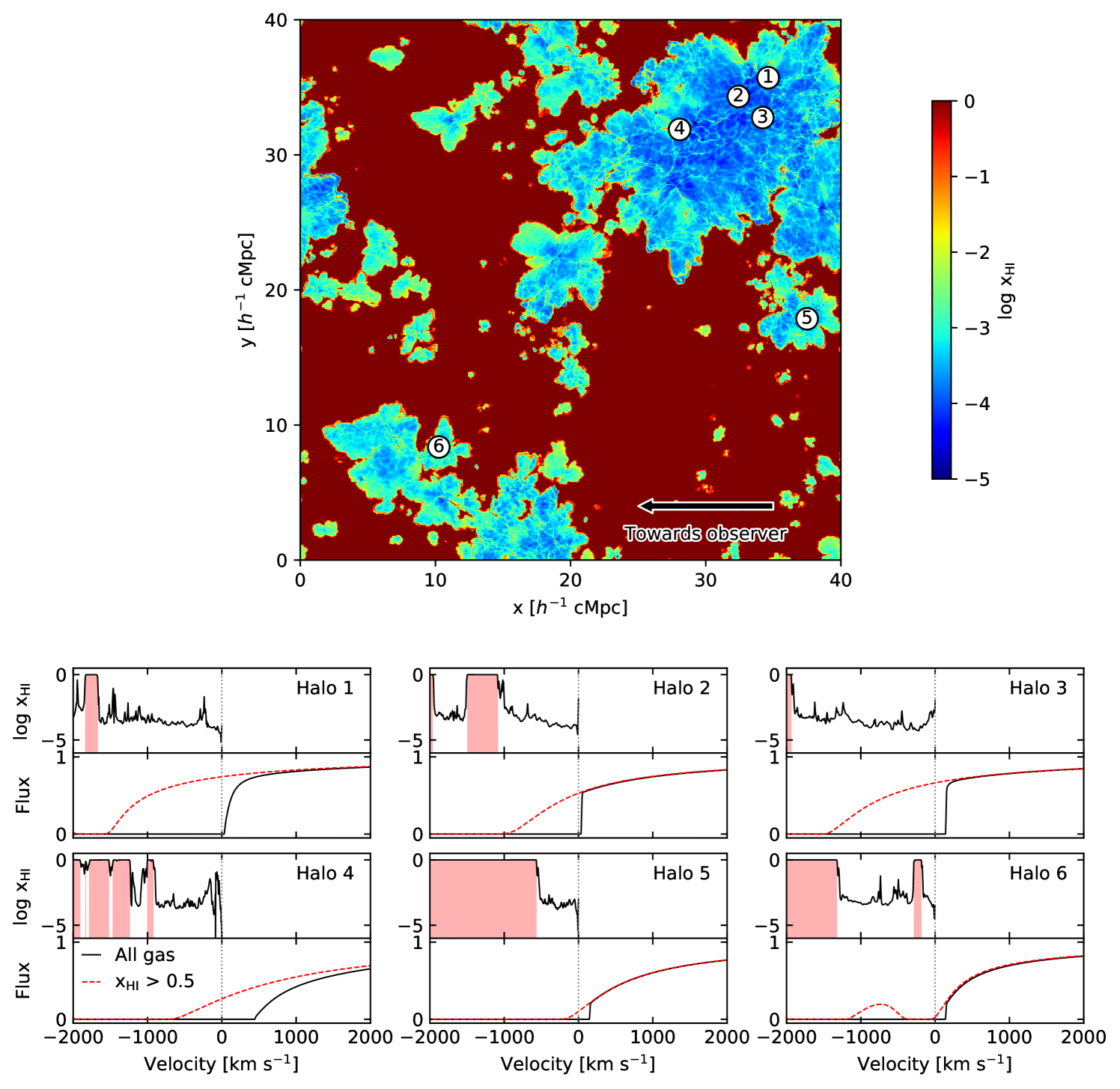
- Use Sherwood-Relics cosmological hydrodynamical simulations with patchy reionization to produce mock IGM damping wings for lines of sight to massive halos at z=7,8,9,10.
- Post-process with radiative transfer to assign a fluctuating UV background and compute Lyα optical depth along sightlines.
- Exclude gas within halos to focus on IGM damping wings and renormalize peculiar velocities so halos have 0 km/s along the line of sight.
- Compute damping wings using an analytic Voigt-profile approximation (Tepper-García 2006) and compare with Miralda-Escudé (1998) model using simulation-derived neutral fractions and bubble sizes.
- Systematically test the impact of gas peculiar velocities, residual neutral gas inside ionized bubbles, and line-of-sight ionization evolution on the damping wings.
- Examine volume effects by comparing 40h−1 Mpc and 160h−1 Mpc simulation boxes and reselect halo samples for fair mass distribution comparisons.
Experimental results
Research questions
- RQ1How well does the Miralda-Escudé (1998) analytic damping wing model reproduce damping wings generated from inhomogeneous reionization simulations?
- RQ2What causes discrepancies between simulated damping wings and the analytic model, particularly blueward of the systemic Lyα?
- RQ3Can JWST-detected damping wings be reconciled with claims of large ionized bubbles at z~7, or do alternative explanations (e.g., smaller bubbles and stronger intrinsic Lyα) prevail?
Key findings
- Miralda-Escudé (1998) reproduces the red-side, median damping wing from simulations but overpredicts transmission blueward of Lyα as bubbles are not perfectly ionized.
- Residual neutral hydrogen inside ionized bubbles, even at xHI ~ 10−3, drives strong Lyα absorption and saturates intergalactic absorption, causing mismatch with the analytic model blueward of the line center.
- Removing residual neutral gas within the host bubble and neglecting peculiar velocities improves agreement between simulations and the Miralda-Escudé damping wing, especially blueward of the halo redshift.
- Even with adjustments, simulations predict less transmitted flux blueward than would be inferred from large observed bubbles at z~7, challenging the interpretation of large bubble sizes from those data.
- The study suggests that the observed damping wings can be explained by smaller ionized bubbles combined with larger intrinsic Lyα emission from the host galaxy.
Read this paper
Open the full text in the Nubint reader and ask about any passage as you read.
Read this paper on NubintThis review was generated by AI from the original paper. Please check the paper before citing it.