
[Paper Review] Lattice Realizations of Topological Defects in the critical (1+1)-d Three-State Potts Model
The paper constructs and analyzes lattice realizations of topological line defects for the critical (1+1)-d three-state Potts model, linking lattice defects/line operators to their continuum CFT counterparts via ED/DMRG, entanglement entropy, and g-functions.
Topological/perfectly-transmissive defects play a fundamental role in the analysis of the symmetries of two dimensional conformal field theories (CFTs). In the present work, spin chain regularizations for these defects are proposed and analyzed in the case of the three-state Potts CFT. In particular, lattice versions for all the primitive defects are presented, with the remaining defects obtained from the fusion of the primitive ones. The defects are obtained by introducing modified interactions around two given sites of an otherwise homogeneous spin chain with periodic boundary condition. The various primitive defects are topological on the lattice except for one, which is topological only in the scaling limit. The lattice models are analyzed using a combination of exact diagonalization and density matrix renormalization group techniques. Low-lying energy spectra for different defect Hamiltonians as well as entanglement entropy of blocks located symmetrically around the defects are computed. The latter provides a convenient way to compute the $g$-function which characterizes various defects. Finally, the eigenvalues of the line operators in the "crossed channel'' and fusion of different defect lines are also analyzed. The results are all in agreement with expectations from conformal field theory.
Motivation & Objective
- Motivate and study topological/defect lines in 1+1D CFTs via lattice regularizations of the three-state Potts model.
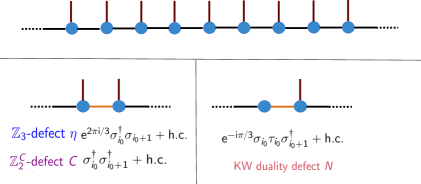
- Provide lattice realizations for primitive topological lines (η, C, N, W) and derive their fusion rules and actions.
- Compute defect spectra and entanglement-based g-functions to test continuum CFT expectations.
- Demonstrate that lattice line operators reproduce the continuum action on primaries and defect Hilbert spaces.
Proposed method
- Define the critical periodic-chain Potts Hamiltonian on L sites and express it in terms of Potts/Temperley-Lieb generators.
- Construct lattice defects by local modifications of two adjacent sites; define defect Hamiltonians H_D.
- Construct line operators on the lattice using symmetry actions and integrability-based transfer-matrix approaches; implement N and W via spectral-parameter shifts.
- Employ exact diagonalization and DMRG to obtain low-lying spectra and entanglement entropy for systems with defects.
- Extract g-functions from the scaling of entanglement entropy and compare with CFT predictions for η, C, N, W defects.
- Relate lattice RSOS (D4) realizations to the Potts chain and discuss equivalences/multiplicities between bases.
- Utilize modular transformations to relate defect spectra (Z_D) and crossed-channel line operators (Ď).
Experimental results
Research questions
- RQ1What are lattice counterparts for the primitive topological lines η, C, N, and W in the critical three-state Potts model?
- RQ2Do defect spectra, line operator eigenvalues, and entanglement-based g-functions on the lattice agree with continuum Potts CFT predictions?
- RQ3How do RSOS and TL-integrable constructions realize the N and W lines on the lattice, and do they reproduce fusion rules?
- RQ4Can entanglement entropy be used to extract the defect g-function and verify its expected values for each defect?
- RQ5What are the fusion properties and crossed-channel behavior of lattice line operators, and do they match CFT expectations?
Key findings
- The lattice realizations of η, C, N are topological on the lattice, while the W defect is not topological at finite lattice spacing but flows to the W line in the continuum.
- Defect g-function values extracted from entanglement entropy agree with CFT expectations: g_η = g_C = 1, g_N = sqrt(3), g_W = (1+√5)/2.
- Line operators η̂, Ĉ, N̂ are topological on the lattice; N̂ implements Kramers–Wannier duality on the Potts chain, while Ŵ is not topological but flows to the continuum line.
- N and N′ (with N′ = CN) can be built via integrable lattice methods or Z3 gauging on half the chain, and satisfy Z3 Tambara–Yamagami fusion rules.
- N̂ is central in the Temperley–Lieb algebra and acts nontrivially on the defect Hilbert spaces as shown in the defect spectra tables.
- The cross-channel spectra Z_D and the action of line operators on primaries match the tables of the Potts CFT, confirming the lattice-realizations reproduce continuum expectations.
Read this paper
Open the full text in the Nubint reader and ask about any passage as you read.
Read this paper on NubintThis review was generated by AI from the original paper. Please check the paper before citing it.