
[Paper Review] Learning Causally Disentangled Representations via the Principle of Independent Causal Mechanisms
This paper proposes ICM-VAE, a variational autoencoder framework that learns causally disentangled representations by enforcing independent causal mechanisms (ICM) through flow-based diffeomorphic mappings and a causal disentanglement prior. The method achieves identifiability of causal factors and mechanisms up to permutation and elementwise reparameterization, demonstrating high disentanglement, robustness to interventions, and consistent counterfactual generation in weakly supervised settings.
Learning disentangled causal representations is a challenging problem that has gained significant attention recently due to its implications for extracting meaningful information for downstream tasks. In this work, we define a new notion of causal disentanglement from the perspective of independent causal mechanisms. We propose ICM-VAE, a framework for learning causally disentangled representations supervised by causally related observed labels. We model causal mechanisms using nonlinear learnable flow-based diffeomorphic functions to map noise variables to latent causal variables. Further, to promote the disentanglement of causal factors, we propose a causal disentanglement prior learned from auxiliary labels and the latent causal structure. We theoretically show the identifiability of causal factors and mechanisms up to permutation and elementwise reparameterization. We empirically demonstrate that our framework induces highly disentangled causal factors, improves interventional robustness, and is compatible with counterfactual generation.
Motivation & Objective
- To address the limitation of existing disentangled representation learning methods that assume independent factors, which is often unrealistic in real-world data with causal dependencies.
- To formalize a new notion of causal disentanglement based on the principle of independent causal mechanisms (ICM).
- To develop a framework that learns causally factorized latent representations using flow-based diffeomorphic functions and a causal disentanglement prior.
- To establish theoretical identifiability of causal factors and mechanisms under mild conditions, up to permutation and elementwise reparameterization.
- To empirically validate improved disentanglement, interventional robustness, and counterfactual generation in weakly supervised settings.
Proposed method
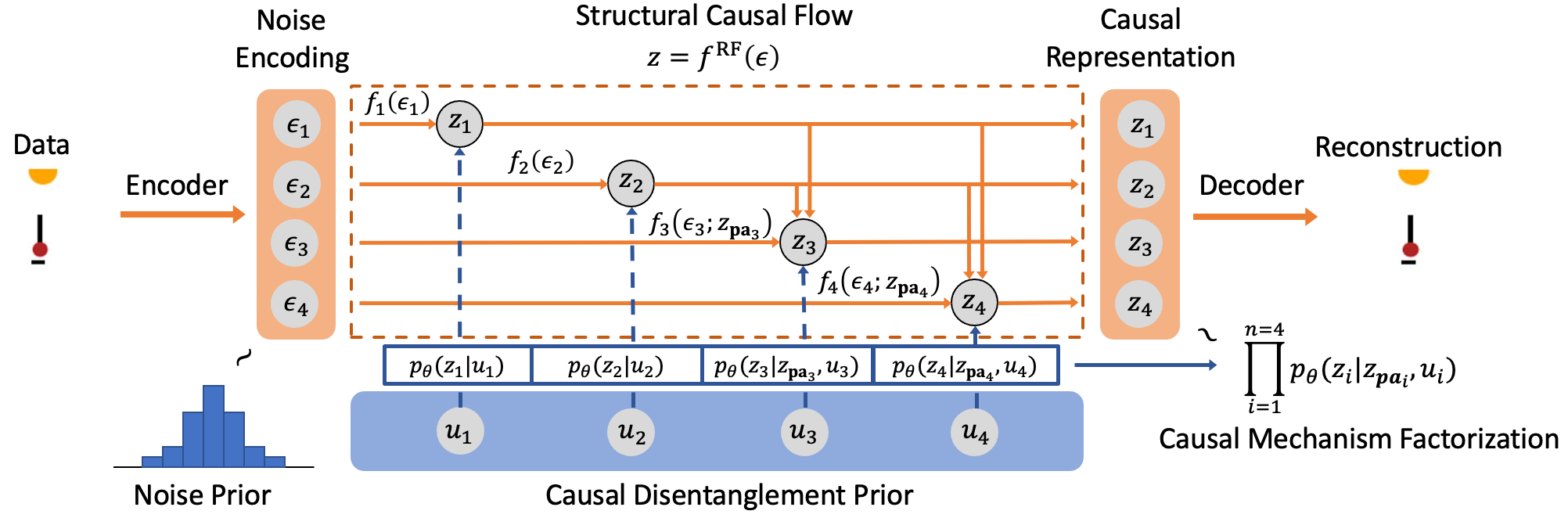
- Proposes ICM-VAE, a variational autoencoder that models causal mechanisms using learnable, flow-based diffeomorphic functions mapping noise variables to latent causal variables.
- Introduces a causal disentanglement prior that leverages known causal structure to encourage a causally factorized distribution in the latent space.
- Uses a conditional prior based on auxiliary labels to enforce identifiability, extending the iVAE framework to causal settings.
- Employs invertible flows to ensure bijective mappings between noise and latent variables, enabling exact inference and counterfactual generation.
- Applies the principle of independent causal mechanisms (ICM) to ensure that changes in one mechanism do not affect others, promoting structural disentanglement.
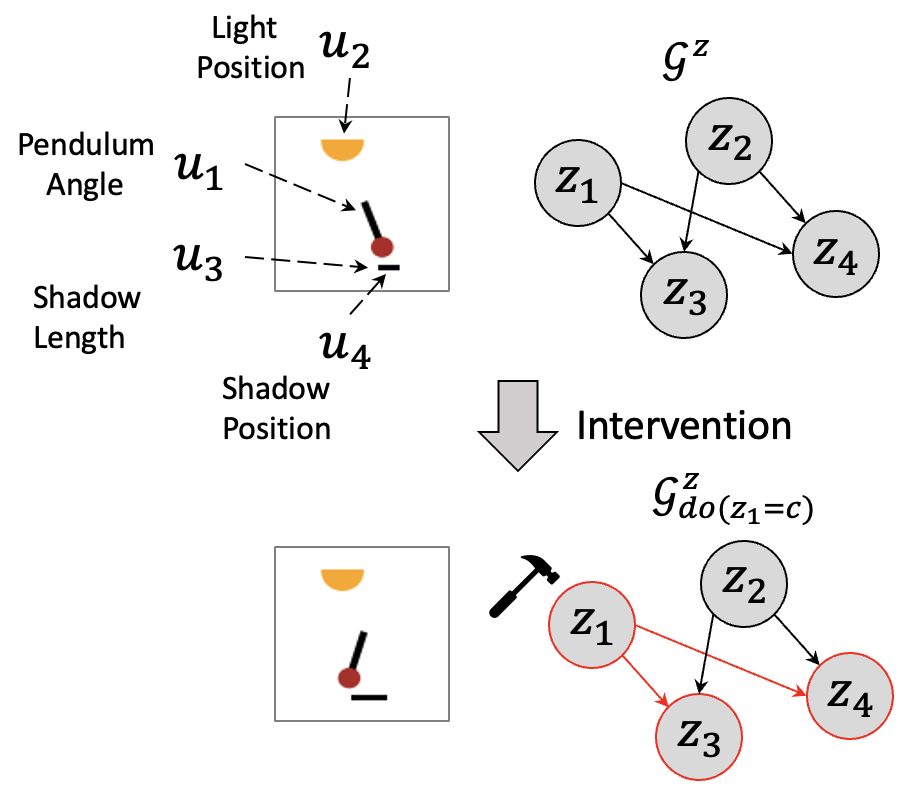
- Employs a two-stage inference process for counterfactuals: abduction (inferring latent noise from observation), action (intervening on latent factors), and prediction (reconstructing data from modified latents).
Experimental results
Research questions
- RQ1Can causal disentanglement be formalized and achieved using the principle of independent causal mechanisms (ICM) in a weakly supervised setting?
- RQ2How can a causal disentanglement prior be designed to promote factorized, identifiable causal representations in the latent space?
- RQ3To what extent can the proposed framework achieve identifiability of causal factors and mechanisms under mild assumptions?
- RQ4Does the model improve robustness to interventions and enable consistent counterfactual generation compared to prior methods?
- RQ5Can the framework maintain high disentanglement performance when factors are causally related rather than independent?
Key findings
- The proposed ICM-VAE framework achieves near-perfect disentanglement of causal factors, as measured by a median DCI score of 0.98 across multiple random seeds.
- The model demonstrates strong interventional robustness, with high consistency in latent representations under interventions on generative factors.
- Counterfactual generation is consistent and semantically meaningful, with the model successfully producing plausible counterfactual images after intervening on causal variables such as pendulum angle.
- Theoretical analysis shows identifiability of causal factors and mechanisms up to permutation and elementwise reparameterization under mild conditions.
- The method outperforms baseline methods like β-VAE and iVAE in disentanglement and robustness, particularly when causal dependencies exist in the data.
- The framework is compatible with both continuous and discrete latent variables, though current results are limited to continuous ground-truth variables.
Read this paper
Open the full text in the Nubint reader and ask about any passage as you read.
Read this paper on NubintThis review was generated by AI from the original paper. Please check the paper before citing it.