
[論文レビュー] Lens Stochastic Diffraction: A Signature of Compact Structures in Gravitational-Wave Data
本稿では、コンパクトなレンズによる微弱で複数像の重ね合わせ信号から生じる重力波データにおける新しい確率的シグネチャ、Lens Stochastic Diffraction (LSD) を導入する。Poisson分布に従うコンパクトな物体から生じる弱く時間遅れのある信号をコherently重ね合わせることで、LSDは単一レンズ解析に比べて、特に約10³M☉以上の質量を持つ巨大な暗黒物質ハローおよび超大質量ブラックホールの検出感度を1桁向上可能である。
Every signal propagating through the universe is diffracted by the gravitational fields of intervening objects, aka gravitational lenses. Diffraction is most efficient when caused by compact lenses, which invariably produce additional images of a source. The signals associated with additional images are generically faint, but their collective effect may be detectable with coherent sources, such as gravitational waves (GWs), where both amplitude and phase are measured. Here, I describe lens stochastic diffraction (LSD): Poisson-distributed fluctuations after GW events caused by compact lenses. The amplitude and temporal distribution of these signals encode crucial information about the mass and abundance of compact lenses. Through the collective stochastic signal, LSD offers an order-of-magnitude improvement over single lens analysis for objects with mass $\gtrsim 10^3 M_\odot$. This gain can improve limits on compact dark-matter halos and allows next-generation instruments to detect supermassive black holes, given the abundance inferred from quasar luminosity studies.
研究の動機と目的
- コンパクトなレンズによって引き起こされる微弱で複数像の重力波信号からなる集団的確率的シグネチャを同定すること。
- 単一レンズイベント解析を越えて、巨大なコンパクトな暗黒物質構造の検出感度を向上させること。
- 次世代重力波観測所がクェーサーの明るさ関数に基づく豊度制約を用いて、超大質量ブラックホールを調べられることを可能にすること。
- 重力波データの振幅および位相情報の両方を活用する、整合的で背景に類似した信号解析手法を開発すること。
- 現実的なレンズ集団に対するLSDの信号対雑音比および時間的分布を定量化すること
提案手法
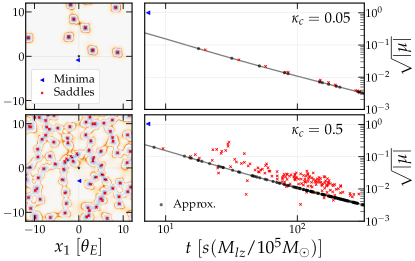
- 点状のコンパクトなレンズからのレンズ効果を標準的なレンズ効果の増幅率式でモデル化し、フラックスのスケーリングは |μ₋| ≈ yₗ⁻⁴、振幅変調は √|μ₋| ≈ yₗ⁻² とする。
- レンズが単一のレンズ平面に投影され、平均数 N_c(<yₗ) = κ_c yₗ² に従うPoisson分布に従うものと仮定する。ここで κ_c はコンパクト物体の表面密度からの収束率である。
- 時間遅れの2次像の確率的時間分布を、時間遅れに比例して Δt ∝ yₗ⁻² とし、大まかな分離に対して導出する。
- 重力波検出器からの位相整合性を仮定して、すべてのレンズ効果を受けた画像をコherently統合することで、集団的LSD信号の信号対雑音比(SNR)を計算する。
- 宇宙論的パラメータとコンパクト物体の割合 f_c に基づいて、平均収束率 κ̄_c(z_S) を導出する。
- LSDフレームワークを用いて、次世代重力波観測所におけるコンパクトな暗黒物質ハローおよび超大質量ブラックホールの検出可能性限界を推定する
実験結果
リサーチクエスチョン
- RQ1コンパクトなレンズからの微弱で複数像の重力波信号が、検出可能な集団的確率的背景を生じるか?
- RQ2LSD信号の信号対雑音比は、単一レンズ検出と比較して、レンズ質量および豊度にどのように依存するか?
- RQ3LSDは、10³M☉以上の質量を持つコンパクトな暗黒物質ハローの制約をどの程度改善できるか?
- RQ4クェーサーの明るさに基づく豊度推定が可能な場合、LSDはレンズシグネチャを用いて超大質量ブラックホールの検出を可能にするか?
- RQ5複数の検出器にわたるLSD信号の時間的分布および整合性構造はいかなるものか?
主な発見
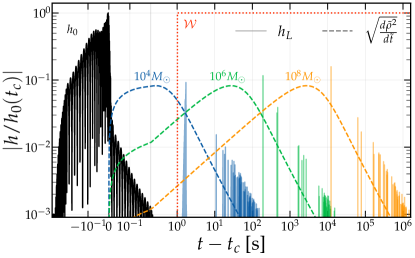
- Lens Stochastic Diffraction (LSD) は、時間にかけてPoisson分布に従う確率的信号を生じ、大まかなレンズ-源分離に対して時間遅れの分布が Δt ∝ yₗ⁻² に比例する特徴を持つ。
- 集団的LSD信号は、質量が10³M☉以上のコンパクト物体に対して、単一レンズ解析と比較して信号対雑音比が1桁向上する。
- 質量が10³M☉以上のコンパクトな暗黒物質ハローに対して、LSDは単一レンズ検出よりもきびしい制約を可能にする。特に低質量領域で顕著である。
- LSDフレームワークにより、次世代重力波観測所がクェーサーの明るさ関数に基づく豊度と一致する場合、超大質量ブラックホールを調べられるようになる。
- 信号の振幅は √|μ₋| ≈ yₗ⁻² で変調されるため、電波観測と比較してコンパクトなレンズからの微弱な像がより検出可能になる。
- LSDの確率的性質により、個々の像が分解不能であっても、相互相関や背景推論技術を用いた検出が可能になる。
より良い研究を、今すぐ始めましょう
論文の読解から最終レビューまで、研究時間を劇的に削減しましょう。
クレジットカード登録不要
このレビューはAIが作成し、人間の編集者が確認しました。