
[Paper Review] Leveraging LLM-Respondents for Item Evaluation: a Psychometric Analysis
This study evaluates the use of Large Language Models (LLMs) as synthetic respondents for psychometric item calibration in educational assessments. Using Item Response Theory (IRT), it finds that GPT-3.5 and ensemble LLM responses closely mirror human ability distributions and yield item parameters with high correlation (r > 0.87) to human-calibrated data, while data augmentation via resampling improves correlation to 0.93, enabling scalable, low-cost item evaluation for formative and summative assessments.
Effective educational measurement relies heavily on the curation of well-designed item pools (i.e., possessing the right psychometric properties). However, item calibration is time-consuming and costly, requiring a sufficient number of respondents for the response process. We explore using six different LLMs (GPT-3.5, GPT-4, Llama 2, Llama 3, Gemini-Pro, and Cohere Command R Plus) and various combinations of them using sampling methods to produce responses with psychometric properties similar to human answers. Results show that some LLMs have comparable or higher proficiency in College Algebra than college students. No single LLM mimics human respondents due to narrow proficiency distributions, but an ensemble of LLMs can better resemble college students' ability distribution. The item parameters calibrated by LLM-Respondents have high correlations (e.g. > 0.8 for GPT-3.5) compared to their human calibrated counterparts, and closely resemble the parameters of the human subset (e.g. 0.02 Spearman correlation difference). Several augmentation strategies are evaluated for their relative performance, with resampling methods proving most effective, enhancing the Spearman correlation from 0.89 (human only) to 0.93 (augmented human).
Motivation & Objective
- To assess whether LLMs can simulate human response patterns in educational assessments using psychometric modeling.
- To compare the psychometric properties of items calibrated using LLM-generated responses versus human responses.
- To evaluate data augmentation strategies that combine LLM-respondents with human data to improve calibration accuracy.
- To explore the feasibility of using LLMs for rapid, low-cost item curation in formative and summative assessments.
Proposed method
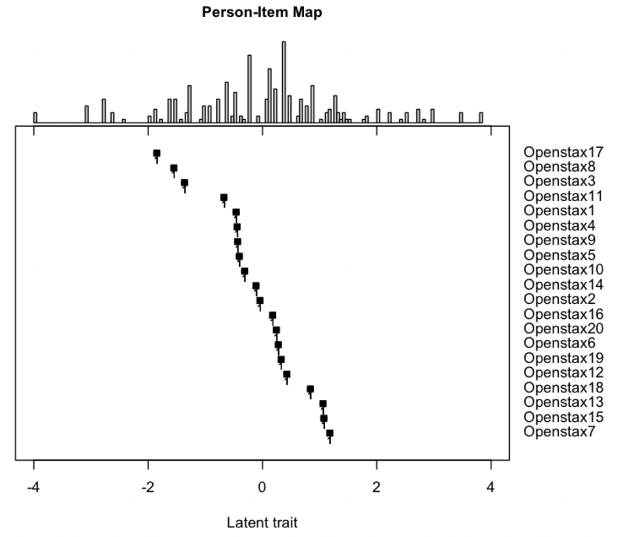
- Six LLMs (GPT-3.5, GPT-4, Llama 2, Llama 3, Gemini-Pro, Cohere Command R Plus) were prompted with 20 College Algebra items from OpenStax, generating 150 responses per model.
- Item Response Theory (IRT) was applied to calibrate item parameters (difficulty, discrimination) from both human and LLM-generated response data.
- Spearman and Pearson correlations were computed between LLM-calibrated and human-calibrated item parameters to assess similarity.
- Three augmentation strategies were tested: direct combination, resampling of LLM data, and a 1:1 mix of resampled LLM and human data.
- Resampling was used to improve the ability distribution of LLM-respondents, reducing skew and better matching human bimodal patterns.
- Model performance was evaluated using correlation metrics, RMSE, and comparison to human baseline distributions.
Experimental results
Research questions
- RQ1RQ1: Which LLM or combination of LLMs best mimics human respondent abilities in mathematics as measured by IRT?
- RQ2RQ2: How do the psychometric properties of items calibrated using LLM-respondents compare to those calibrated using human respondents?
- RQ3RQ3: Can augmenting human response data with LLM-respondent data produce item parameters comparable to those from larger human samples?
Key findings
- GPT-3.5 demonstrated the highest similarity to human respondents, achieving a Spearman correlation of 0.87 with human-calibrated item parameters.
- The ensemble of LLM-respondents using resampling strategies improved the correlation between LLM- and human-calibrated parameters to 0.93, up from 0.89 with human-only data.
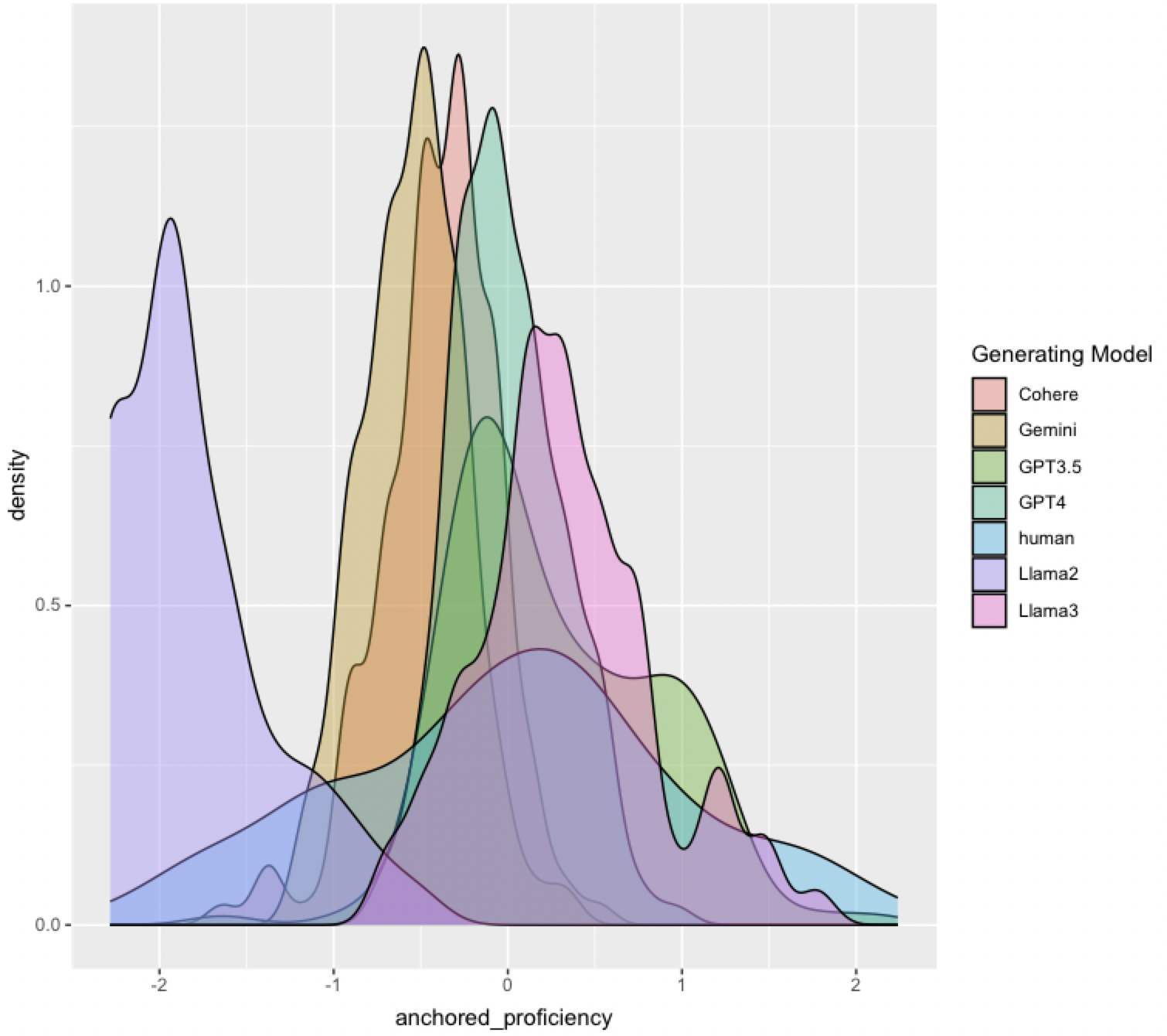
- No single LLM fully replicated the human ability distribution due to narrow proficiency spread, but ensembles with resampling better approximated the bimodal human distribution.
- The best augmentation strategy—1:1 mix of resampled LLM and human data—increased Spearman correlation by 0.04 and Pearson by 0.01, though it also raised RMSE.
- LLM-respondents (150 responses from GPT-3.5) produced item parameters with a correlation of 0.87 to human data, comparable to a sample of 50 human respondents.
- The study reveals a novel, first-of-its-kind ability distribution across multiple LLMs via IRT, moving beyond point estimates to model full proficiency spread.
Read this paper
Open the full text in the Nubint reader and ask about any passage as you read.
Read this paper on NubintThis review was generated by AI from the original paper. Please check the paper before citing it.