
[Paper Review] Local probe of bulk and edge states in a fractional Chern insulator
The authors image bulk and edge states of zero-field fractional Chern insulators in twisted MoTe2 using exciton-resonant microwave impedance microscopy, revealing insulating bulk with conductive edges and edge evolution across topological transitions.
Fractional quantum Hall effect (FQHE) is a prime example of topological quantum many-body phenomena, arising from the interplay between strong electron correlation, topological order, and time reversal symmetry breaking. Recently, a lattice analog of FQHE at zero magnetic field has been observed, confirming the existence of a zero-field fractional Chern insulator (FCI). Despite this, the bulk-edge correspondence -- a hallmark of FCI featuring an insulating bulk with conductive edges -- has not been directly observed. In fact, this correspondence has not been visualized in any system for fractional states due to experimental challenges. Here we report the imaging of FCI edge states in twisted MoTe2 by employing a newly developed modality of microwave-impedance microscopy. By tuning the carrier density, we observe the system evolving between metallic and FCI states, the latter of which exhibits insulating bulk and conductive edges as expected from bulk-boundary correspondence. We also observe the evolution of edge states across the topological phase transition from an incompressible Chern insulator state to a metal and finally to a putative charge ordered insulating state as a function of interlayer electric field. The local measurement further reveals tantalizing prospects of neighboring domains with different fractional orders. These findings pave the way for research into topologically protected 1D interfaces between various anyonic states at zero magnetic field, such as topological entanglement entropy, Halperin-Laughlin interfaces, and the creation of non-abelian anyons.
Motivation & Objective
- Demonstrate bulk-edge correspondence in a zero-field fractional Chern insulator (FCI) using a local probe.
- Visualize edge states in FCI states and distinguish them from trivial insulating states.
- Explore how edge states evolve across topological phase transitions driven by an out-of-plane electric field.
- Investigate spatial inhomogeneity and domain boundaries between different fractional orders at zero magnetic field.
Proposed method
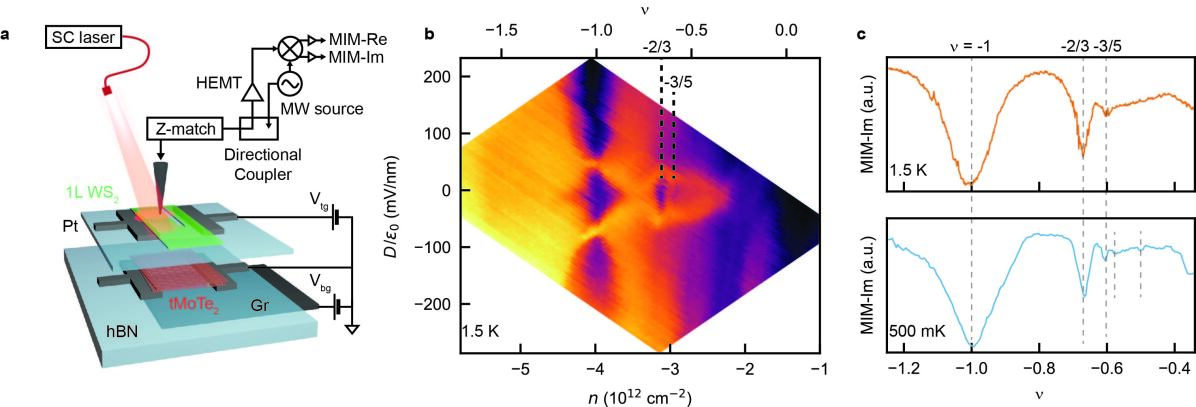
- Develop exciton-resonant microwave impedance microscopy (ER-MIM) enabling dual-gated imaging through a top gate using WS2 as an optical gate.
- Use MIM-Im (imaginary part of microwave signal) as a proxy for local conductivity and electronic compressibility at GHz frequencies.
- Tune carrier density and interlayer electric field to access QAH and FCI regimes in twisted MoTe2 bilayers.
- Map MIM-Im as a function of filling factor ν to identify bulk insulating vs edge-conducting behavior.
- Perform finite-element simulations to relate MIM-Im to 2D sheet conductance and validate spatial resolution.
Experimental results
Research questions
- RQ1Can FCI edge states be directly visualized at zero magnetic field in a moiré system?
- RQ2Do FCI states exhibit insulating bulk with conductive edges consistent with bulk-boundary correspondence in local measurements?
- RQ3How do fractional edge states evolve during topological phase transitions driven by interlayer electric field?
- RQ4What is the role of moiré disorder and domain formation in the manifestation of fractional edge states?
Key findings
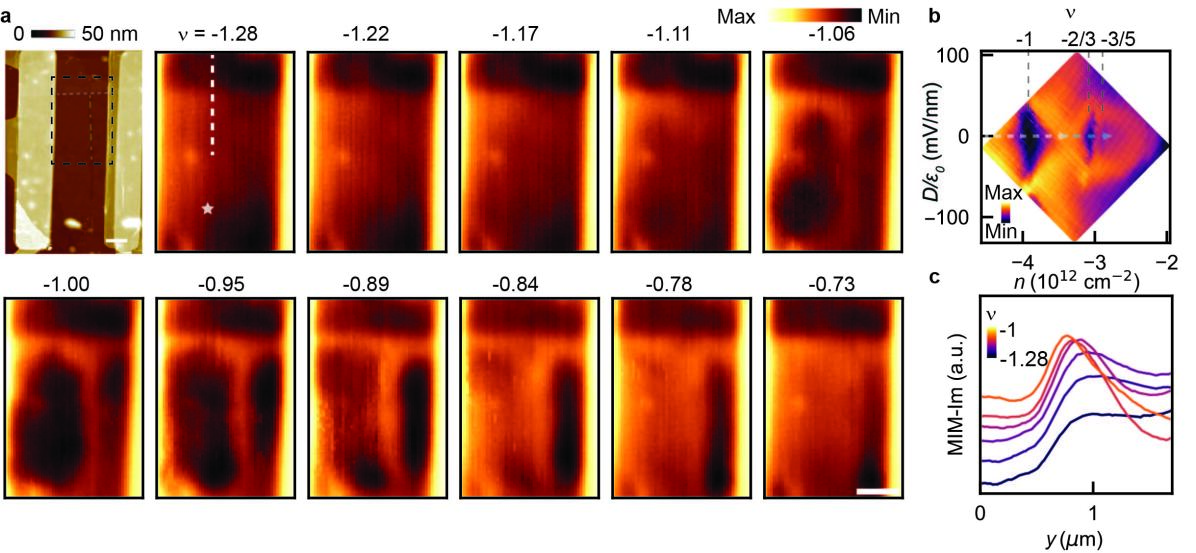
- ER-MIM imaging shows insulating bulk and conductive edges at ν = -2/3 and -3/5 FCI states, consistent with bulk-edge correspondence.
- Edge-state width is about 500 nm in QAH and FCI regimes, broader than tip resolution, likely due to edge magnetoplasmon modes.
- Distinct MIM-Im signals at edges for FCI states are higher than for QAH edges, suggesting different edge dynamics or magnetoplasmon resonance frequencies.
- Coexistence of different fractional orders (e.g., -3/5 and -2/3) is observed in adjacent regions due to gating variations, implying tunable 1D interfaces between anyonic orders.
- Electric-field-driven transitions show edge signals strongest at intermediate D/ε0, indicating gap closure and a metallic intermediate phase during Chern-to-insulator transitions.
- Direct visualization confirms the fractional edge states are not merely trivial edge charging but arise from bulk-boundary physics at zero magnetic field.
Read this paper
Open the full text in the Nubint reader and ask about any passage as you read.
Read this paper on NubintThis review was generated by AI from the original paper. Please check the paper before citing it.