
[Paper Review] Migration Reframed? A multilingual analysis on the stance shift in Europe during the Ukrainian crisis
This study proposes a multilingual stance detection framework using Twitter data from 565 European news outlets to analyze shifts in media and public sentiment toward migration during the Ukrainian crisis. It finds a temporary, country-specific positive stance shift in media coverage and social media reactions—most stable in Poland—driven by linguistic reframing (e.g., 'refugee' over 'migrant') and media influence, though effects fade after 3–4 months.
The war in Ukraine seems to have positively changed the attitude toward the critical societal topic of migration in Europe -- at least towards refugees from Ukraine. We investigate whether this impression is substantiated by how the topic is reflected in online news and social media, thus linking the representation of the issue on the Web to its perception in society. For this purpose, we combine and adapt leading-edge automatic text processing for a novel multilingual stance detection approach. Starting from 5.5M Twitter posts published by 565 European news outlets in one year, beginning September 2021, plus replies, we perform a multilingual analysis of migration-related media coverage and associated social media interaction for Europe and selected European countries. The results of our analysis show that there is actually a reframing of the discussion illustrated by the terminology change, e.g., from "migrant" to "refugee", often even accentuated with phrases such as "real refugees". However, concerning a stance shift in public perception, the picture is more diverse than expected. All analyzed cases show a noticeable temporal stance shift around the start of the war in Ukraine. Still, there are apparent national differences in the size and stability of this shift.
Motivation & Objective
- To investigate whether the perceived positive shift in public attitudes toward migration during the Ukrainian crisis is substantiated by media and social media discourse.
- To examine national differences in the magnitude and stability of stance shifts across European countries.
- To develop a multilingual, context-aware stance detection method capable of generalizing across languages and enabling cross-national comparative analysis.
- To assess the causal relationship between media sentiment and public stance in social media reactions.
- To evaluate whether sentiment alone is a sufficient proxy for public opinion on migration, or whether stance detection offers more nuanced insights.
Proposed method
- Leveraged 5.5 million Twitter posts from 565 European news outlets between September 2021 and September 2022, including replies to news content.
- Developed a multilingual stance detection model using cross-lingual transfer learning, fine-tuned on a multilingual dataset with 1,000 labeled examples per language, and applied to five European countries (Germany, Poland, Spain, France, Italy).
- Used a zero-shot cross-lingual transfer approach, where the model was pre-trained on a multilingual BERT-based architecture and fine-tuned on data from four countries before being applied to Poland to avoid data imbalance bias.
- Applied Granger causality testing to assess directional influence between media sentiment (weekly average) and public stance in replies (weekly average), using a one-week lag to determine causality.
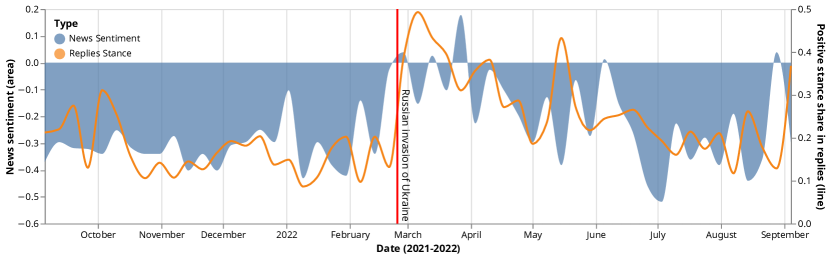
- Combined media sentiment analysis with social media stance detection to trace temporal shifts in public perception and correlate them with major events (e.g., war onset, Belarus border crisis).
- Employed a two-stage data collection: first, news tweets were used as a proxy for media content; second, replies to these tweets were analyzed to capture public stance, avoiding keyword-based filtering and reducing selection bias.
Experimental results
Research questions
- RQ1Is there a measurable shift in media and public sentiment toward migration in Europe following the start of the war in Ukraine?
- RQ2How do national differences in media coverage and public reaction shape the stability and magnitude of this stance shift?
- RQ3To what extent does media sentiment influence public stance in social media, and vice versa?
- RQ4Can multilingual stance detection effectively capture nuanced public opinion on migration, beyond sentiment analysis alone?
- RQ5How does linguistic framing—such as the shift from 'migrant' to 'refugee'—correlate with changes in public sentiment and media tone?
Key findings
- A significant, temporary positive stance shift occurred in media coverage and public replies across all five European countries following the start of the war in February 2022.
- Poland exhibited the most stable and sustained positive shift in both media sentiment and public stance, likely due to its proximity and direct impact from the refugee influx.
- The shift in public stance in social media replies closely followed media sentiment trends, with a peak in positive stance observed in the first four months post-invasion.
- The Granger causality test revealed that media sentiment led public stance with a one-week lag (F = 26.11, p < .0001), indicating media influence on public perception.
- A reverse causality effect was also detected, where public stance influenced media sentiment (F = 12.74, p < .001), suggesting a feedback loop between media and audience.
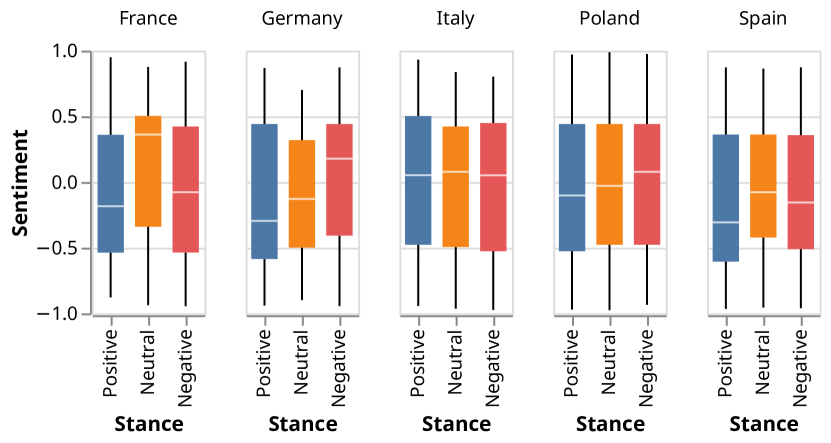
- The study found that sentiment alone is insufficient to capture public opinion on migration, as stance detection revealed more nuanced shifts in attitude that sentiment curves failed to fully represent.
Read this paper
Open the full text in the Nubint reader and ask about any passage as you read.
Read this paper on NubintThis review was generated by AI from the original paper. Please check the paper before citing it.