
[Paper Review] Nature vs Nurture: Three Dimensional MHD Simulations of Misaligned Embedded Circum-Single Disks within an AGN Disk
This study presents the first 3D MHD simulations of circum-single disks (CSDs) around isolated and binary black holes in magnetized, turbulent AGN disks, showing that intermediate and strong magnetic fields induce random misalignment of CSDs due to turbulent angular momentum inhomogeneity—contrasting with hydrodynamic simulations where CSDs align with the AGN disk. The findings highlight the critical role of ambient gas and magnetic fields in shaping disk geometry and black hole spin evolution.
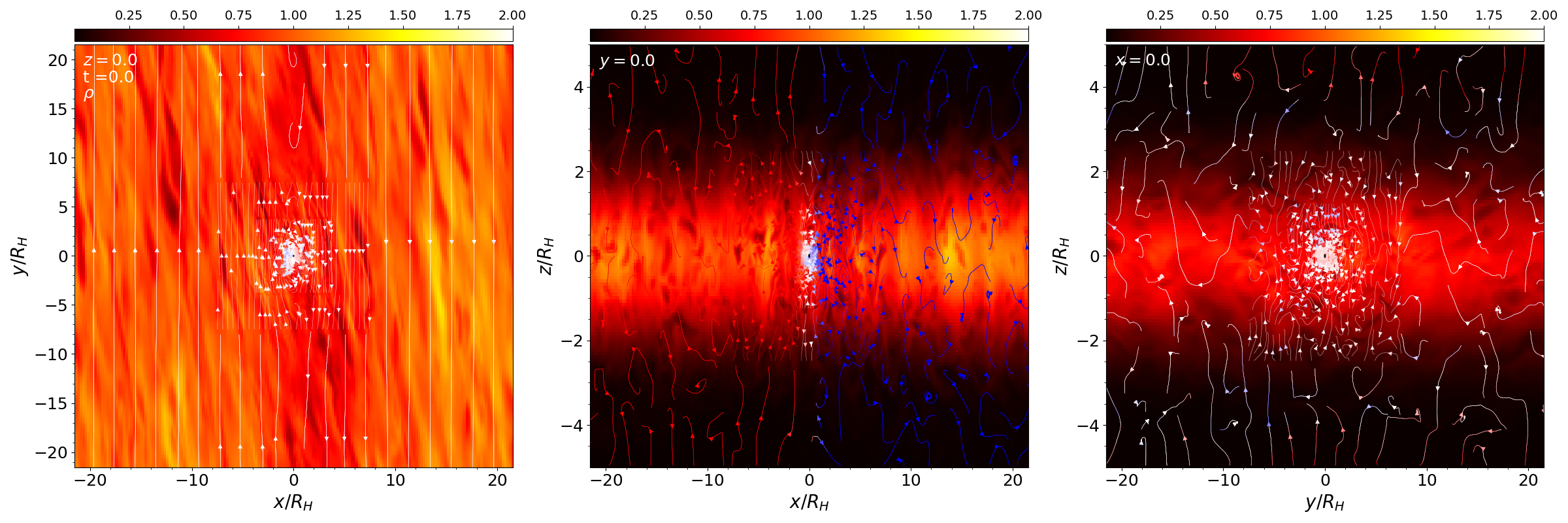
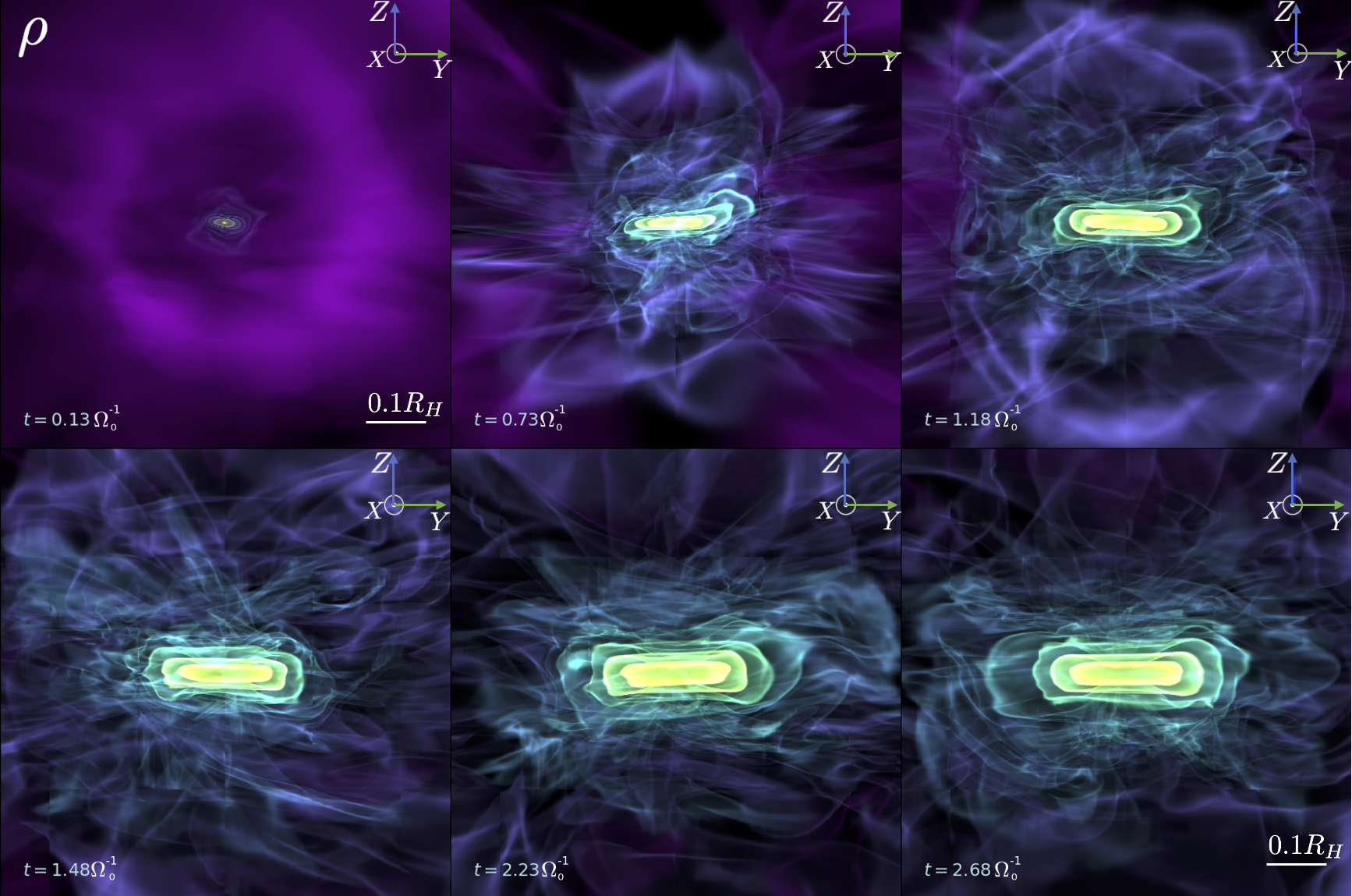
Stellar mass black holes in the disks around active galactic nuclei (AGN) are promising sources for gravitational wave detections by LIGO/VIRGO. Recent studies suggest this environment fosters the formation and merger of binary black holes. Many of these studies often assumed a simple, laminar AGN disk without magnetic fields or turbulence. In this work, we present the first 3D magnetohydrodynamical simulations of circum-single disks around isolated and binary black holes in strongly magnetized, stratified accretion disks with turbulence driven by magneto-rotational instability. We simulated three scenarios with varying initial net-vertical magnetic field strengths: weak, intermediate, and strong. Our results show that weakly magnetized models produce circum-single disks aligned with the AGN disk's equatorial plane, similar to past hydrodynamic simulations. However, intermediate and strong magnetic fields result in randomly misaligned disks, contingent upon the availability of local ambient angular momentum within turbulent regions. Our findings emphasize the significant impact of ambient gas in the AGN disk on the inclination of circum-single disks, linked to magnetically induced inhomogeneity and angular momentum during disk formation. The presence of misaligned disks, both in single and binary black hole systems, could have profound implications for the long-term evolution of black hole spin and the inclination of the disk at the horizon scale.
Motivation & Objective
- To investigate how magnetic fields and turbulence in AGN disks affect the alignment of circum-single disks (CSDs) around embedded black holes.
- To determine whether magnetically driven turbulence leads to disk misalignment, challenging the assumption of disk alignment in prior hydrodynamic models.
- To assess the role of ambient angular momentum and magnetic field strength in determining CSD orientation and stability.
- To explore the implications of misaligned CSDs for black hole spin evolution and electromagnetic counterparts in binary black hole mergers.
Proposed method
- Conducted 3D magnetohydrodynamical (MHD) simulations of isolated and binary black holes embedded in a stratified, MRI-unstable AGN disk.
- Used shearing box approximation with initial net-vertical magnetic fields corresponding to β₀ = 100, 1000, and 10,000 in the midplane.
- Simulated three magnetic field regimes: weak, intermediate, and strong, to examine the transition from aligned to misaligned disk formation.
- Tracked angular momentum accretion and magnetic field evolution to assess disk alignment and toroidal field amplification.
- Employed high-resolution grids to minimize numerical artifacts and ensure physical fidelity in disk orientation.
- Validated results across multiple resolutions to confirm that disk misalignment is physical, not a grid-induced artifact.
Experimental results
Research questions
- RQ1How does the strength of the initial net-vertical magnetic field affect the alignment of circum-single disks (CSDs) around embedded black holes in AGN disks?
- RQ2To what extent does turbulent angular momentum in the AGN disk drive misalignment of CSDs in magnetized environments?
- RQ3Can magnetically induced inhomogeneities in the ambient gas lead to randomly oriented CSDs, even in the presence of a global AGN disk plane?
- RQ4Does the disk inclination stabilize over time, and is it sensitive to the timing and angular momentum content of early accretion?
- RQ5What are the implications of misaligned CSDs for black hole spin evolution and potential electromagnetic counterparts in binary black hole mergers?
Key findings
- In weakly magnetized simulations (β₀ = 10,000), circum-single disks align with the AGN disk’s equatorial plane, consistent with prior hydrodynamic results.
- In intermediate and strong magnetic field cases (β₀ = 1,000 and 100), circum-single disks form with randomly oriented inclinations due to turbulent angular momentum inhomogeneity.
- Disk misalignment is not due to numerical artifacts, as confirmed by high-resolution runs where coordinate-axis alignment effects vanish.
- Once formed, the disk inclination stabilizes after ~1 orbital time (t ≈ Ω⁻¹₀), and further accretion does not alter alignment.
- The circum-single disks develop strong toroidal magnetic fields, with amplification up to 10⁴ times, potentially enabling magnetically arrested disk formation and jet launching.
- The opposite toroidal magnetic polarity in CSDs of binary black holes creates conditions favorable for magnetic reconnection, possibly leading to high-energy particle acceleration and observable radiation.
Read this paper
Open the full text in the Nubint reader and ask about any passage as you read.
Read this paper on NubintThis review was generated by AI from the original paper. Please check the paper before citing it.