
[Paper Review] New constraints on the gamma-ray and high energy neutrino fluxes from the circumstellar interaction of SN 2023ixf
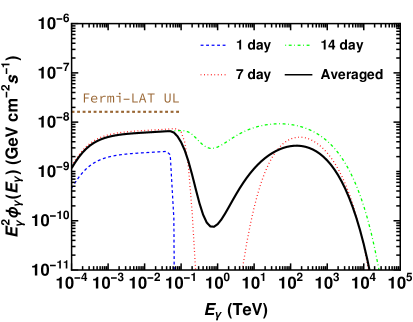
This study derives new upper limits on gamma-ray and high-energy neutrino fluxes from SN 2023ixf using Fermi-LAT and IceCube non-detections, modeling proton-proton interactions in dense circumstellar material. The derived flux upper limits—7×10⁻⁹ GeV cm⁻² s⁻¹ for gamma-rays and 4×10⁻⁹ GeV cm⁻² s⁻¹ for neutrinos—are significantly tighter than experimental constraints, indicating strong multi-messenger constraints on hadronic particle acceleration in nearby Type II supernovae.
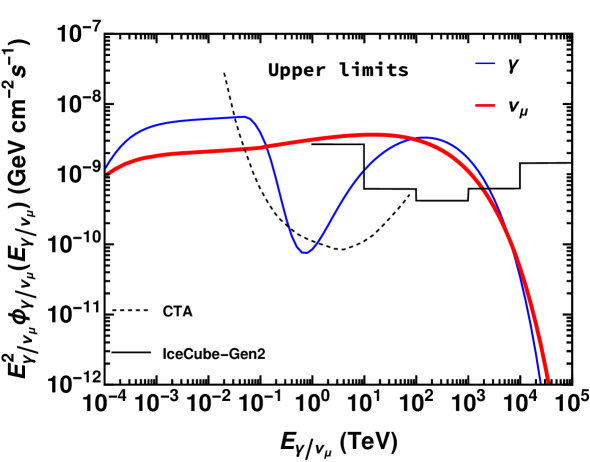
The recent supernova, SN 2023ixf, one of the closest observed type II SNe has revealed the presence of a dense circumstellar material (CSM). Interaction of the SN ejecta with this dense CSM might create high energy protons of PeV energies through shock acceleration. These accelerated protons then colliding with the CSM (inelastic $pp$ collision) can produce secondaries such as high energy gamma-rays and neutrinos. However, no gamma-rays and neutrinos have been detected by Fermi-LAT and IceCube from this event. Fermi-LAT has placed an upper limit on the gamma-ray flux above $100$~MeV to be $2.6 imes 10^{-11}~ m erg~cm^{-2}~s^{-1}$. On the other hand, IceCube's upper limit on muon neutrino flux is $7.3 imes 10^{-2} ~ m GeV~cm^{-2}$. {\color{black} Taking these limits into account and using the shock-CSM properties derived from multi-wavelength observations, we obtain new upper limits on the gamma-ray ($10^{-11}~ m erg~cm^{-2}~s^{-1}$) and neutrino ($10^{-3}~ m GeV~cm^{-2}$) fluxes from SN 2023ixf produced via the $pp$ interaction channel.} While we found the gamma-ray flux to be consistent with Fermi-LAT's upper limit, the neutrino flux is found to be about $2$ orders of magnitude smaller than the IceCube's upper limit. We further analyse the detection prospects of such secondary signals from future SN 2023 like events with upcoming detectors, CTA and IceCube-Gen2 and found to have great discovery potential, if any similar event occurs within $7$ Mpc.
Motivation & Objective
- To derive conservative upper limits on high-energy gamma-ray and neutrino fluxes from SN 2023ixf using observational constraints from Fermi-LAT and IceCube.
- To model shock acceleration of protons and secondary particle production via inelastic pp collisions in dense circumstellar material (CSM).
- To assess the detection potential of future similar supernovae using upcoming detectors, Cherenkov Telescope Array (CTA) and IceCube-Gen2.
- To evaluate the impact of CSM asymmetry and composition assumptions on flux predictions, ensuring conservative estimates.
Proposed method
- Modeling the shock-Circumstellar Material (CSM) interaction using a spherically symmetric, wind-like CSM profile with mass-loss rate ṀW ≈ 10⁻² M☉ yr⁻¹ and wind velocity vW ≈ 50 km s⁻¹.
- Assuming a power-law proton energy distribution with spectral index 2, consistent with standard shock acceleration theory.
- Computing secondary gamma-ray and neutrino fluxes via inelastic pp collisions, using cross-sections and decay chains for pions and muons.
- Applying Fermi-LAT and IceCube upper limits on gamma-ray and muon neutrino fluxes as observational constraints to optimize shock and CSM parameters.
- Using time-averaged fluxes as conservative upper limits, assuming symmetric CSM along the line of sight despite possible asymmetries.
- Projecting detection sensitivity for CTA (50-hour observation) and IceCube-Gen2 (10-year integration) to assess future discovery potential.
Experimental results
Research questions
- RQ1What are the upper limits on gamma-ray and high-energy neutrino fluxes from SN 2023ixf produced via pp interactions, given non-detections by Fermi-LAT and IceCube?
- RQ2How do the derived flux upper limits compare to the experimental upper limits from Fermi-LAT and IceCube?
- RQ3What is the detection potential for similar nearby supernovae with upcoming detectors like CTA and IceCube-Gen2?
- RQ4How do assumptions about CSM symmetry and composition affect the predicted flux upper limits?
- RQ5Can the observed non-detection of high-energy signals constrain the efficiency of proton acceleration in shock-CSDM interactions?
Key findings
- The gamma-ray flux upper limit from SN 2023ixf is 7×10⁻⁹ GeV cm⁻² s⁻¹, consistent with the Fermi-LAT upper limit of 2.6×10⁻¹¹ erg cm⁻² s⁻¹.
- The neutrino flux upper limit is 4×10⁻⁹ GeV cm⁻² s⁻¹, approximately two orders of magnitude below the IceCube upper limit of 7.3×10⁻² GeV cm⁻².
- The derived flux upper limits are significantly tighter than the experimental constraints, indicating strong multi-messenger constraints on hadronic processes in SN 2023ixf.
- The analysis shows that CTA and IceCube-Gen2 will have high discovery potential for similar nearby supernovae if they occur within 7 Mpc.
- The symmetric CSM model provides a conservative estimate, as observations suggest possible CSM asymmetry, but fluxes are likely lower if the CSM is not aligned with the line of sight.
- The study confirms that leptonic contributions to gamma-rays above 100 MeV are expected to be negligible, justifying the focus on purely hadronic processes.
Read this paper
Open the full text in the Nubint reader and ask about any passage as you read.
Read this paper on NubintThis review was generated by AI from the original paper. Please check the paper before citing it.