
[Paper Review] A Leptonic Model for Neutrino Emission From Active Galactic Nuclei
This paper proposes a purely leptonic mechanism for TeV-scale neutrino emission in active galactic nuclei (AGN), where high-energy synchrotron photons from relativistic electrons scatter off keV-band X-rays to produce muon-antimuon pairs, whose decay yields neutrinos without proton involvement. The model successfully reproduces the IceCube-observed neutrino spectrum from NGC 1068 under reasonable physical parameters, offering an alternative to hadronic pion decay scenarios.
It is often stated that the observation of high-energy neutrinos from an astrophysical source would constitute a smoking gun for the acceleration of hadronic cosmic rays. Here, we point out that there exists a purely leptonic mechanism to produce TeV-scale neutrinos in astrophysical environments. In particular, very high-energy synchrotron photons can scatter with X-rays, exceeding the threshold for muon-antimuon pair production. When these muons decay, they produce neutrinos without any cosmic-ray protons or nuclei being involved. In order for this mechanism to be efficient, the source in question must produce very high-energy photons which interact in an environment that is dominated by keV-scale radiation. As an example, we consider the active galaxy NGC 1068, which IceCube has recently detected as a source of TeV-scale neutrinos. We find that the neutrino emission observed from this source could potentially be generated through muon pair production for reasonable choices of physical parameters.
Motivation & Objective
- To challenge the conventional assumption that high-energy neutrinos imply hadronic cosmic-ray acceleration in AGN.
- To propose a purely leptonic alternative mechanism for TeV neutrino production in astrophysical environments.
- To test whether the observed neutrino flux from NGC 1068 can be explained by muon pair production from high-energy photons and X-ray radiation fields.
- To assess the viability of this mechanism in optically thick AGN cores where hadronic models face gamma-ray flux constraints.
Proposed method
- Modeling high-energy photon production via synchrotron emission from relativistic electrons in strong magnetic fields (B ~ 0.03–2000 G).
- Calculating the threshold for muon pair production in photon-photon collisions between very high-energy photons (Eγ ~ 1–100 TeV) and keV-band X-rays.
- Using the relativistic kinematics of muon decay to predict neutrino energy spectra, with Eν ≈ Eγ/6.
- Normalizing the electron injection spectrum as dNe/dEe ∝ Ee−2 exp(−Ee/300 TeV) to match observed power injection (~1042–1043 erg/s) above 1 TeV.
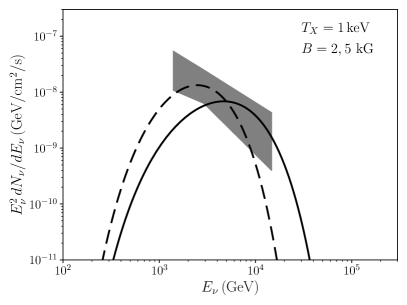
- Computing the resulting neutrino flux for varying magnetic fields and corona temperatures, comparing to IceCube’s observed flux from NGC 1068 (14.4 Mpc).
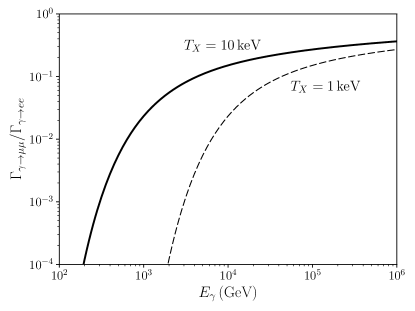
- Assessing suppression from electron-positron pair production in the presence of eV–keV photons, which dominate over keV X-rays in some environments.
Experimental results
Research questions
- RQ1Can TeV-scale neutrinos be produced in AGN cores through a purely leptonic mechanism without proton acceleration?
- RQ2Is muon pair production via high-energy photon–X-ray scattering a viable alternative to pion decay for explaining IceCube’s NGC 1068 neutrino excess?
- RQ3What physical conditions (e.g., magnetic field strength, X-ray radiation density) are required for this mechanism to produce a detectable neutrino flux?
- RQ4How does the flavor ratio of neutrinos from muon decay compare to that from pion decay, and can it be used to distinguish the production mechanism?
- RQ5What energy threshold limits the efficiency of this mechanism, and how does it affect the low-energy tail of the neutrino spectrum?
Key findings
- The model produces a neutrino spectrum compatible with the IceCube observation of 79 events from NGC 1068 at ~1–10 TeV, with a 4.2σ significance.
- For magnetic fields in the range of 0.03–2000 G and corona temperatures of 10–100 keV, the predicted neutrino flux matches the observed flux when electron injection power is ~2–12×1042 erg/s above 1 TeV.
- The mechanism is suppressed in environments dominated by eV–keV photons, which favor electron-positron pair production over muon pair production.
- Neutrino production is efficient only above a threshold energy of ~0.3 TeV × (10 keV/T), meaning the spectrum is expected to be cut off at lower energies if the X-ray temperature is high.
- The flavor ratio from muon decay (νe:νμ:ντ ≈ 1.2:0.9:0.9 after oscillations) differs from that of pion decay (≈1:1:1), offering a potential observational discriminator.
- The mechanism cannot account for the full diffuse neutrino flux observed by IceCube, as it is inefficient at energies above ~100 TeV.
Read this paper
Open the full text in the Nubint reader and ask about any passage as you read.
Read this paper on NubintThis review was generated by AI from the original paper. Please check the paper before citing it.