
[Paper Review] Nova: An Iterative Planning and Search Approach to Enhance Novelty and Diversity of LLM Generated Ideas
Nova introduces an iterative planning and external-knowledge retrieval framework to boost novelty and diversity in LLM-generated research ideas, achieving 3.4x more unique novel ideas and at least 2.5x more top-rated ideas than baselines.
Scientific innovation is pivotal for humanity, and harnessing large language models (LLMs) to generate research ideas could transform discovery. However, existing LLMs often produce simplistic and repetitive suggestions due to their limited ability in acquiring external knowledge for innovation. To address this problem, we introduce an enhanced planning and search methodology designed to boost the creative potential of LLM-based systems. Our approach involves an iterative process to purposely plan the retrieval of external knowledge, progressively enriching the idea generation with broader and deeper insights. Validation through automated and human assessments indicates that our framework substantially elevates the quality of generated ideas, particularly in novelty and diversity. The number of unique novel ideas produced by our framework is 3.4 times higher than without it. Moreover, our method outperforms the current state-of-the-art, generating at least 2.5 times more top-rated ideas based on 170 seed papers in a Swiss Tournament evaluation.
Motivation & Objective
- Motivate and enable LLMs to generate higher-quality, more novel ideas for scientific research.
- Address repetitive ideas by designing goal-directed external knowledge retrieval.
- Develop an iterative planning pipeline that plans knowledge retrieval to enrich idea generation.
- Demonstrate the effectiveness of planning-driven knowledge search through automatic and human evaluations.
Proposed method
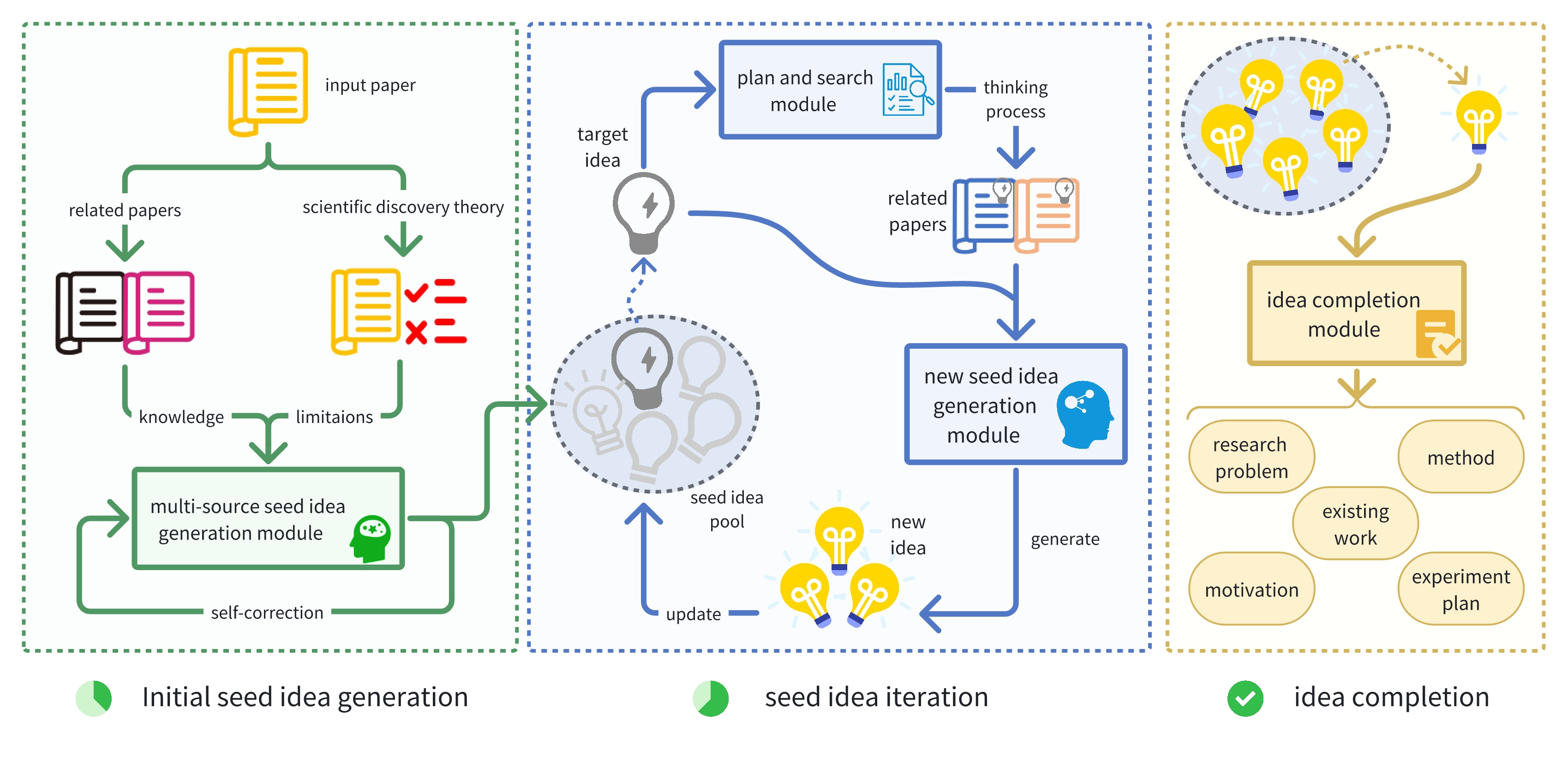
- An iterative planning and search framework that prompts LLMs to devise knowledge retrieval plans targeting novelty and diversity.
- Multi-source seed idea generation using related literature and scientific discovery methods to generate initial ideas (15 seed ideas per input paper).
- Iterative cycles where each iteration plans retrieval, fetches external papers, generates new seeds, and uses self-reflection to prune ideas (3 per iteration).
- Final stage expands seed ideas into initial and final proposals by decomposing ideas into sub-modules and detailing methodologies.
- Automatic evaluation via Swiss-system tournament style ranking (Claude-3.5-Sonnet zero-shot ranker) for quality, and novelty/diversity metrics based on topically similar papers and cosine similarity thresholds.
- Human evaluation with NLP/ML/CV experts assessing novelty and overall quality to validate automatic metrics.

Experimental results
Research questions
- RQ1Does iterative planning and external knowledge retrieval improve novelty and diversity of LLM-generated ideas compared to prior state-of-the-art methods?
- RQ2How do automatic (Swiss Tournament, novelty, diversity metrics) and human evaluations align in judging idea quality?
- RQ3What is the contribution of planning versus retrieval components to the observed gains?
- RQ4Can the framework scale across a large seed-paper set and still yield high-quality ideas?
Key findings
- Nova generates 3.4x more unique novel ideas than a baseline lacking the iterative planning framework.
- Nova achieves at least 2.5x more top-rated ideas compared with current state-of-the-art methods in a Swiss Tournament evaluation over 170 seed papers.
- Automatic evaluation shows Nova attains higher Swiss scores and higher proportions of ideas rated 4 or 5.
- Human evaluation confirms Nova obtains the highest scores in overall quality and novelty among compared agents.
- Ablation studies indicate both planning and retrieval are essential; removing planning stops progress in unique idea generation, while removing both yields limited gains.
Read this paper
Open the full text in the Nubint reader and ask about any passage as you read.
Read this paper on NubintThis review was generated by AI from the original paper. Please check the paper before citing it.