
[Paper Review] Med42 -- Evaluating Fine-Tuning Strategies for Medical LLMs: Full-Parameter vs. Parameter-Efficient Approaches
This paper compares full-parameter fine-tuning and parameter-efficient fine-tuning (notably LoRA) for medical LLMs built on Llama-2, reporting Med42 achieving 72% accuracy on USMLE and detailing decontamination and openness of models.
This study presents a comprehensive analysis and comparison of two predominant fine-tuning methodologies - full-parameter fine-tuning and parameter-efficient tuning - within the context of medical Large Language Models (LLMs). We developed and refined a series of LLMs, based on the Llama-2 architecture, specifically designed to enhance medical knowledge retrieval, reasoning, and question-answering capabilities. Our experiments systematically evaluate the effectiveness of these tuning strategies across various well-known medical benchmarks. Notably, our medical LLM Med42 showed an accuracy level of 72% on the US Medical Licensing Examination (USMLE) datasets, setting a new standard in performance for openly available medical LLMs. Through this comparative analysis, we aim to identify the most effective and efficient method for fine-tuning LLMs in the medical domain, thereby contributing significantly to the advancement of AI-driven healthcare applications.
Motivation & Objective
- Motivate the need for domain-specific fine-tuning of medical LLMs to improve retrieval, reasoning, and QA.
- Develop and evaluate medical LLMs (Med42) based on Llama-2 with full-parameter and LoRA-style tuning.
- Assess performance across established medical benchmarks and analyze training efficiency and contamination risks.
- Provide open-access deployment of the best-performing model to advance AI in healthcare.
Proposed method
- Construct medical instruction-tuned datasets from Stack Exchange medical forums and selective general-domain medical content.
- Fine-tune 7B and 70B Llama-2 models with full-parameter tuning and with LoRA-based parameter-efficient tuning.
- Apply mask loss by concatenating system/prompt/assistant samples and autoregressively train only the response tokens.
- Use AdamW with cosine LR schedule, warmup, and standard regularization; specify epoch counts and learning rates for FP-FT and LoRA.
- Evaluate zero-shot performance on diverse medical benchmarks using Eleuther AI’s evaluation harness, with contaminant sample decontamination.
- Release Med42 (70B) on HuggingFace for reproducibility and open research.
Experimental results
Research questions
- RQ1How do full-parameter fine-tuning and LoRA-based parameter-efficient fine-tuning compare in medical QA and reasoning tasks?
- RQ2Does model size (7B vs 70B) influence the relative gains from full-parameter vs. LoRA fine-tuning in medical domains?
- RQ3What is the impact of dataset decontamination on reported benchmark performance?
- RQ4How does Med42 compare to other open medical LLMs on standard benchmarks and USMLE-style questions?
Key findings
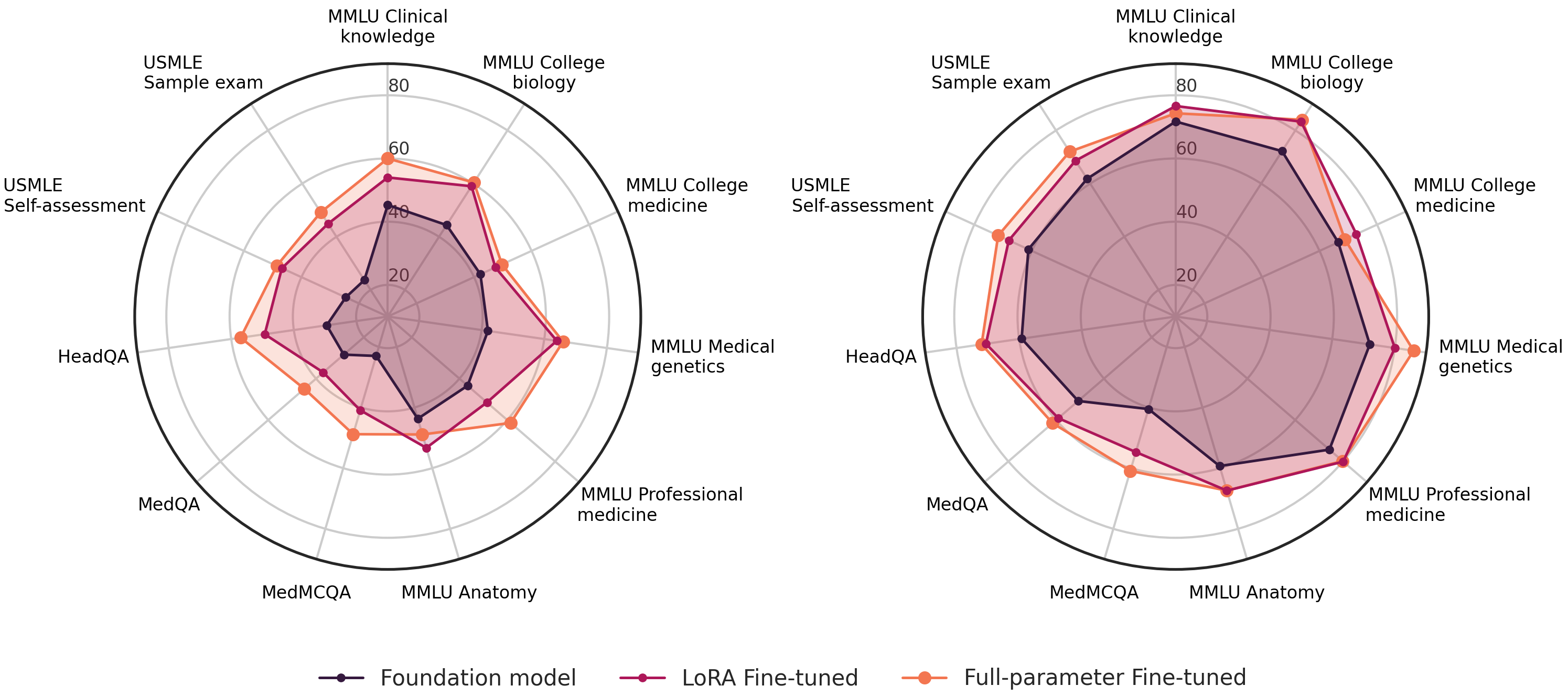
- Fine-tuned models outperform their base counterparts across medical benchmarks.
- Full-parameter fine-tuning generally outperforms LoRA in most datasets.
- LoRA achieves performance close to full-parameter fine-tuning, offering a viable resource-efficient alternative.
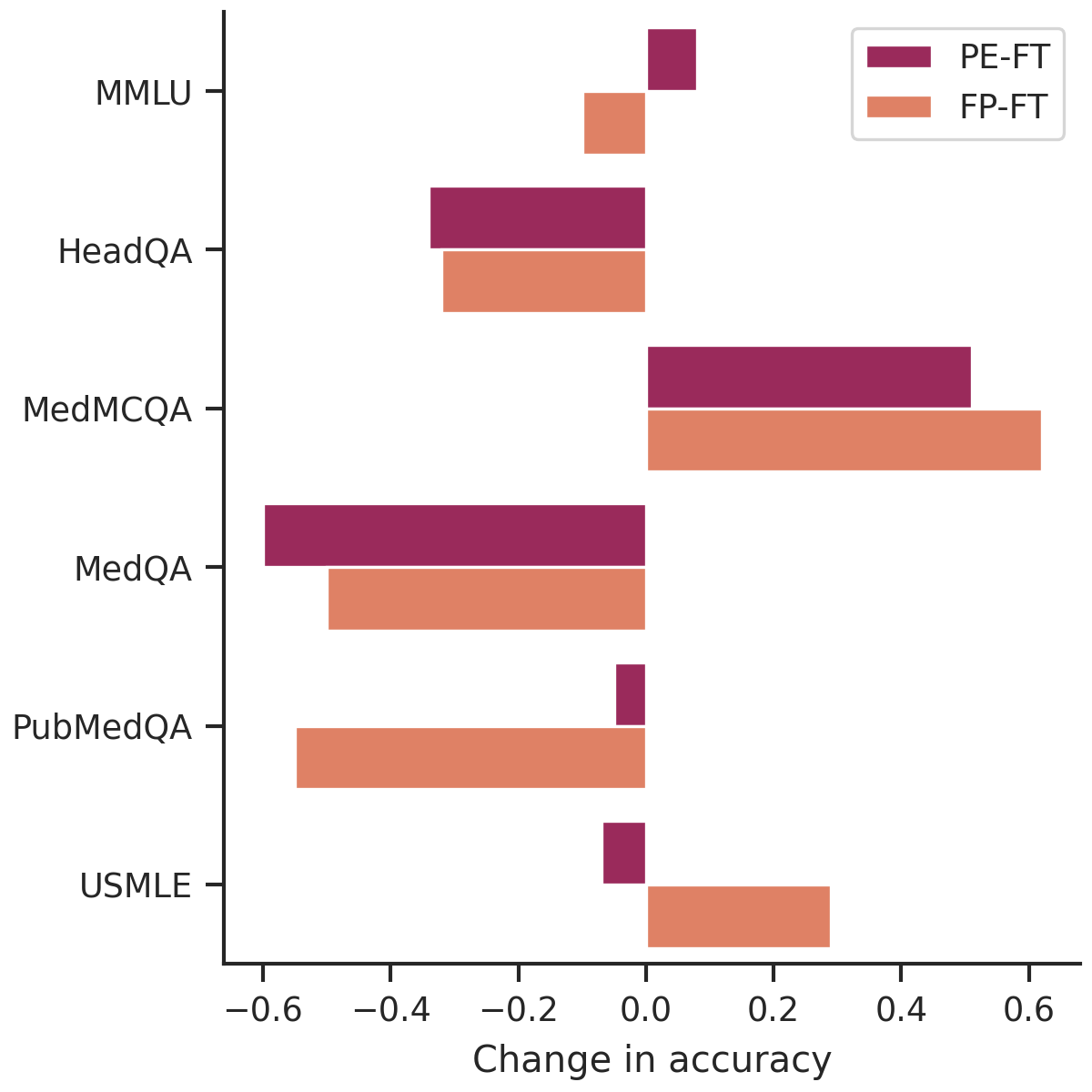
- Decontamination caused only small changes in accuracy for the larger fine-tuned models, indicating robustness of results.
- Med42-70B achieves strong zero-shot performance on USMLE-related tasks and outperforms several open medical LLMs in comparisons.
- The study emphasizes open licensing and reproducibility, releasing Med42 and the evaluation framework.
Better researchstarts right now
From reading papers to final review, dramatically reduce your research time.
No credit card · Free plan available
This review was created by AI and reviewed by human editors.