
[Paper Review] Nucleon Electric Dipole Moment from the $θ$ Term with Lattice Chiral Fermions
This study computes the nucleon electric dipole moment (EDM) from the QCD θ term using lattice QCD with overlap fermions, preserving chiral symmetry to enable reliable chiral extrapolation. The authors achieve a physical pion mass result of $ d_n = -0.00148(14)(31)\bar{\theta} $ e·fm and $ d_p = 0.0038(11)(8)\bar{\theta} $ e·fm, demonstrating the superiority of chiral fermions for precision EDM calculations and enabling future studies of strong CP violation.
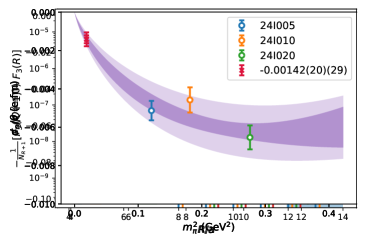
We calculate the nucleon electric dipole moment (EDM) from the $θ$ term with overlap fermions on three domain wall lattices with different sea pion masses at lattice spacing 0.11 fm. Due to the chiral symmetry conserved by the overlap fermions, we have well defined topological charge and chiral limit for the EDM. Thus, the chiral extrapolation can be carried out reliably at nonzero lattice spacings. We use three to four different partially quenched valence pion masses for each sea pion mass and find that the EDM dependence on the valence and sea pion masses behaves oppositely, which can be described by partially quenched chiral perturbation theory. With the help of the cluster decomposition error reduction (CDER) technique, we determine the neutron and proton EDM at the physical pion mass to be $d_{n}=-0.00148\left(14 ight)\left(31 ight)\barθ$ e$\cdot$fm and $d_{p}=0.0038\left(11 ight)\left(8 ight)\barθ$ e$\cdot$fm. This work is a clear demonstration of the advantages of using chiral fermions in the nucleon EDM calculation and paves the road to future precise studies of the strong $CP$ violation effects.
Motivation & Objective
- To compute the nucleon electric dipole moment (EDM) from the QCD θ term using lattice QCD with chiral fermions to ensure a well-defined chiral limit.
- To overcome systematic challenges in previous lattice calculations of NEDM, particularly those arising from incorrect CP form factors and poor signal-to-noise ratios.
- To perform reliable chiral extrapolation using partially quenched valence and sea quark masses on three domain wall fermion ensembles with different pion masses.
- To apply the cluster decomposition error reduction (CDER) technique to enhance statistical precision and reduce noise in matrix element calculations.
- To provide a first-principles, nonperturbative determination of the neutron and proton EDMs at the physical pion mass, enabling improved constraints on the strong CP violation parameter $\bar{\theta}$.
Proposed method
- The calculation employs overlap fermions on three domain wall fermion gauge ensembles with lattice spacing 0.11 fm and sea pion masses from ~300 to ~600 MeV, ensuring exact chiral symmetry and well-defined topological charge.
- Three to four valence pion masses are used per ensemble to study both valence and sea quark mass dependence, enabling partially quenched chiral perturbation theory fits.
- The cluster decomposition error reduction (CDER) technique is applied to the matrix element of the topological charge operator and electromagnetic current, improving signal-to-noise by truncating correlations beyond the finite correlation length.
- A two-state fit is used to extract the matrix element $ F_{3,n}(Q^2) $, with systematic uncertainties estimated via error propagation and consistency checks across multiple fitting procedures.
- Systematic uncertainties are evaluated for CDER cutoff choice, momentum extrapolation, chiral extrapolation, and two-state fit, with final uncertainties combined in quadrature.
- The physical pion mass limit is obtained via chiral extrapolation using both unitary and partially quenched data points, with the chiral limit providing strong constraints on the fit.
Experimental results
Research questions
- RQ1What is the nucleon electric dipole moment induced by the QCD θ term at the physical pion mass, using a method that preserves chiral symmetry?
- RQ2How does the nucleon EDM depend on both valence and sea quark masses, and can this dependence be described by partially quenched chiral perturbation theory?
- RQ3What is the optimal CDER cutoff for minimizing statistical error and systematic bias in the matrix element calculation?
- RQ4How do different sources of systematic uncertainty—CDER, momentum extrapolation, chiral extrapolation, and fitting procedure—affect the final EDM result?
- RQ5Can chiral fermions enable a reliable chiral extrapolation without requiring a separate continuum limit extrapolation, thus reducing systematic errors?
Key findings
- The neutron EDM at the physical pion mass is determined to be $ d_n = -0.00148(14)(31)\bar{\theta} $ e·fm, with statistical error (14) and systematic error (31) reported separately.
- The proton EDM at the physical pion mass is found to be $ d_p = 0.0038(11)(8)\bar{\theta} $ e·fm, with statistical (11) and systematic (8) uncertainties.
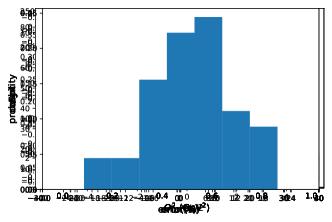
- The CDER technique reduces noise and improves signal-to-noise ratio, with optimal cutoff at $ R_0 = 9a $, confirmed by exponential decay of correlation functions.
- Systematic uncertainties are estimated at 13% (CDER), 10% (momentum extrapolation), 3% (chiral extrapolation), and 12% (CDER consistency), with total systematic uncertainty of 21%.
- The chiral extrapolation is well-constrained due to the chiral symmetry of overlap fermions, allowing reliable results without prior continuum extrapolation.
- The results demonstrate the clear advantage of using chiral fermions in lattice QCD calculations of the nucleon EDM, enabling precise, first-principles studies of strong CP violation.
Read this paper
Open the full text in the Nubint reader and ask about any passage as you read.
Read this paper on NubintThis review was generated by AI from the original paper. Please check the paper before citing it.