
[Paper Review] Numerical wetting benchmarks -- advancing the plicRDF-isoAdvector unstructured Volume-of-Fluid (VOF) method
This paper advances the plicRDF-isoAdvector unstructured Volume-of-Fluid (VOF) method for simulating wetting on complex surfaces by introducing a rigorous benchmark suite. It demonstrates second-order accuracy in interface advection, excellent agreement with reference solutions for droplet spreading on flat and spherical surfaces, and mesh-convergent results for 2D capillary rise, validating the method’s robustness and accuracy for wetting problems with complex geometries.
The numerical simulation of wetting and dewetting of geometrically complex surfaces benefits from unstructured numerical methods because they discretize the domain with second-order accuracy. A recently developed unstructured geometric Volume-of-Fluid (VOF) method, the plicRDF-isoAdvector method, is chosen to investigate wetting processes because of its volume conservation property and high computational efficiency. The present work verifies and validates the plicRDF-isoAdvector method for wetting problems. We present four verification studies. The first study investigates the accuracy of the interface advection near walls. The method is further investigated for the spreading of droplets on a flat and a spherical surface, respectively, for which excellent agreement with the reference solutions is obtained. Furthermore, a 2D capillary rise is considered, and a benchmark comparison based on results from previous work is performed. The benchmark suite, input data, and Jupyter Notebooks used in this study are publicly available to facilitate further research and comparison with other numerical codes.
Motivation & Objective
- To verify and validate the plicRDF-isoAdvector unstructured VOF method for wetting processes on geometrically complex surfaces.
- To address the challenge of accurately simulating contact line dynamics and interface deformation in complex geometries with high volume conservation and computational efficiency.
- To provide a reproducible benchmark suite with input data and Jupyter Notebooks for method comparison and validation in wetting simulations.
- To identify limitations in simulating extreme contact angles (very hydrophilic or hydrophobic) and propose improvements to the contact angle treatment in the RDF-based PLIC reconstruction.
Proposed method
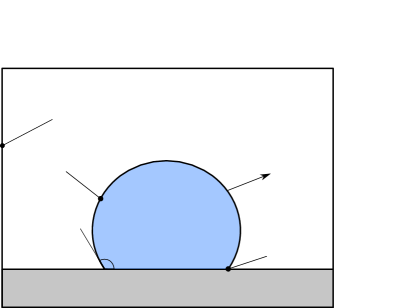
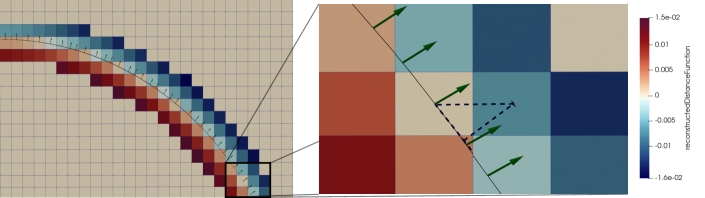
- The plicRDF-isoAdvector method uses a geometric VOF approach with piecewise linear interface calculation (PLIC) reconstructed via a radial basis function (RDF) weighted sum of signed-distance values to determine cell-centered interface orientation.
- Interface advection is performed using a face-vertex flux calculation (FVFC) scheme that ensures volume conservation and high computational efficiency on unstructured meshes.
- The method employs a conservative level contour interface reconstruction (CLCIR) technique to maintain sharp interfaces and prevent numerical diffusion.
- A novel benchmark suite is developed, including droplet spreading on flat and spherical surfaces, and 2D capillary rise, with comparisons to analytical and reference numerical solutions.
- Mesh refinement studies are conducted using both no-slip and Navier slip boundary conditions to assess convergence and robustness.
- Post-processing is performed using Jupyter Notebooks, and all input data and results are made publicly available for reproducibility and method comparison.
Experimental results
Research questions
- RQ1Does the plicRDF-isoAdvector method achieve second-order convergence in interface advection near walls on unstructured meshes?
- RQ2How accurately does the method capture droplet spreading dynamics on flat and spherical surfaces compared to reference solutions?
- RQ3Is the method mesh-convergent for capillary rise in 2D, particularly in the oscillatory regime governed by Bosanquet’s theory?
- RQ4How does the method perform for extreme contact angles, especially in hydrophilic and hydrophobic regimes?
- RQ5Can the method maintain accuracy and convergence order when applied to non-uniform mesh grading near solid walls?
Key findings
- The plicRDF-isoAdvector method exhibits a first-to-second-order convergence transition in interface advection near walls, confirming its geometric accuracy on unstructured grids.
- For droplet spreading on a flat surface, the method shows excellent agreement with reference solutions, except for highly hydrophobic cases where deviations emerge due to numerical noise.
- On a spherical surface, the method produces accurate results for droplet spreading, though it shows sensitivity to numerical noise in the contact line region.
- In the 2D capillary rise benchmark, the method achieves mesh convergence for both no-slip and Navier slip conditions, with the stationary rise height matching the corrected analytical value given by eq. (47).
- For oscillatory capillary rise (Ω = 0.1 and 0.5), the method dampens oscillations slightly faster than other solvers like interFoam, yet converges to the correct stationary height.
- The study identifies that contact angle treatment via RDF-based PLIC reconstruction is a key limitation, especially for extreme wetting conditions, and recommends rethinking the weighted contribution of contact angle in the reconstruction process.
Read this paper
Open the full text in the Nubint reader and ask about any passage as you read.
Read this paper on NubintThis review was generated by AI from the original paper. Please check the paper before citing it.