
[Paper Review] Observational Signatures of Supermassive Black Hole Binaries
This chapter surveys electromagnetic observational methods to identify sub-parsec supermassive black hole binaries, reviews macro-scale evidence and signatures, and discusses future prospects including time-domain surveys and gravitational-wave detectors.
Despite solid theoretical and observational grounds for the pairing of supermassive black holes (SMBHs) after galaxy mergers, definitive evidence for the existence of close (sub-parsec) separation SMBH binaries (SMBHBs) approaching merger is yet to be found. This chapter reviews techniques aimed at discovering such SMBHBs in galactic nuclei. We motivate the search with a brief overview of SMBHB formation and evolution, and the gaps in our present-day theoretical understanding. We then present existing observational evidence for SMBHBs and discuss ongoing efforts to provide definitive evidence for a population at sub-parsec orbital separations, where many of the aforementioned theoretical gaps lie. We conclude with future prospects for discovery with electromagnetic (primarily time-domain) surveys, high-resolution imaging experiments, and low-frequency gravitational-wave detectors.
Motivation & Objective
- Motivate the search for close SMBHBs and outline the gaps in current theory.
- Summarize existing observational evidence for SMBHBs across scales.
- Evaluate and compare electromagnetic identification techniques and their pros/cons.
- Connect SMBHB population predictions to observable signatures and survey strategies.
- Outline future prospects with upcoming EM and GW facilities.
Proposed method
- Model the SMBHB population via a continuity framework linking EM-bright SMBHBs to the quasar population (Eq. 2–3).
- Relate quasar luminosity to binary mass using accretion-rate distributions (Eq. 3).
- Derive simple residence-time based estimates for observable SMBHB fractions (Eq. 6).
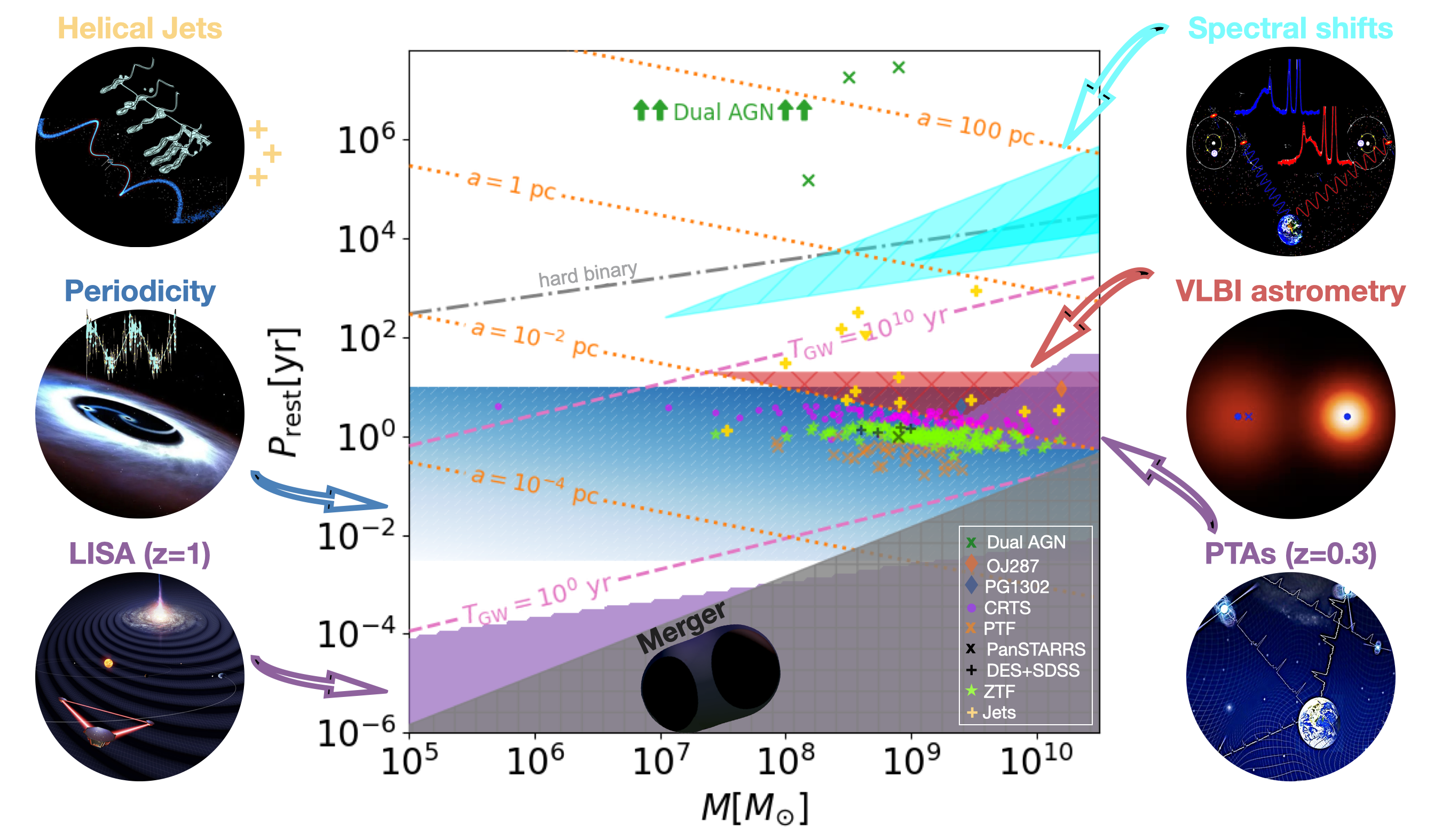
- Discuss observational signatures across scales: dual AGN, cored ellipticals, spectral features, and time-domain signals.
- Describe and compare detection methods including kiloparsec-to-parsec scale approaches, spectral line analysis, and direct imaging/astrometry.
- Highlight future observational avenues (e.g., LSST, Roman, ngVLA, EHT, GRAVITY+) for SMBHB discovery.
Experimental results
Research questions
- RQ1What observational signatures are ubiquitous and uniquely identifiable as SMBHBs across different scales?
- RQ2How can electromagnetic surveys constrain the SMBHB population and orbital decay processes?
- RQ3What is the expected fraction of quasars hosting SMBHBs as a function of period, mass, and redshift?
- RQ4What are the relative strengths and limitations of macro-scale (dual AGN, cored ellipticals) versus micro-scale (spectral, photometric, astrometric, jet-based) SMBHB search methods?
- RQ5How will upcoming EM and GW facilities improve definitive detection of sub-parsec SMBHBs?
Key findings
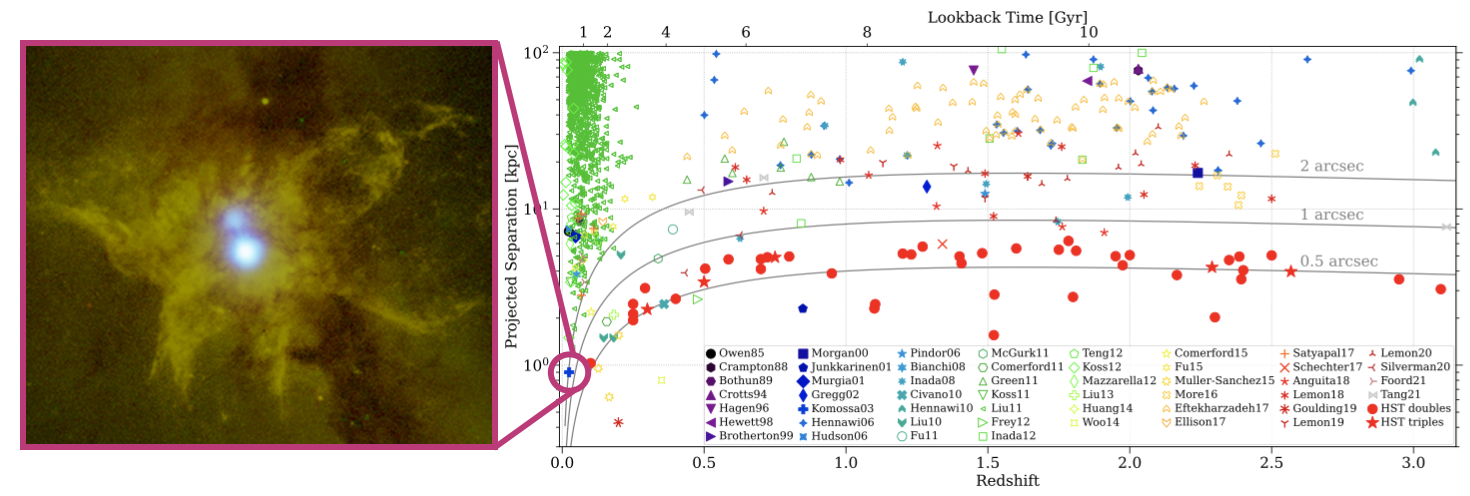
- Dozens of dual AGN have been observed across multiple wavelengths, with confirmations via high-resolution imaging and IFU spectroscopy.
- Cored elliptical galaxies show mass deficits and core properties consistent with binary scouring scenarios.
- VLBI can resolve dual AGN down to ~10 pc in the local universe, while X-ray and optical methods provide broader but shallower surveys.
- Direct orbital tracking is only feasible for a few nearby systems (e.g., a record 7.3 pc separation), highlighting observational limits.
- Synthetic population modeling links SMBHBs to the quasar population, allowing estimates of SMBHB fractions via residence times and quasar lifetimes (Eq. 6).
- The final-parsec problem is being reframed as a need for definitive evidence of SMBHBs at sub-parsec separations and detailed environmental interactions.
Read this paper
Open the full text in the Nubint reader and ask about any passage as you read.
Read this paper on NubintThis review was generated by AI from the original paper. Please check the paper before citing it.