
[Paper Review] A unified accretion disc model for supermassive black holes in galaxy formation simulations: method and implementation
This paper presents a unified accretion disc model for supermassive black holes (SMBHs) in galaxy formation simulations, integrating advection-dominated inflow-outflow solutions (ADIOS) and thin $α$-disc physics to self-consistently model disc transitions from thick to thin states and SMBH spin evolution via Lense-Thirring precession. The model predicts significantly lower disc luminosities and enhanced jet production compared to standard thin-disc models, with strong implications for electromagnetic and gravitational wave counterparts of SMBH binaries.
It is well established that supermassive black hole (SMBH) feedback is crucial for regulating the evolution of massive, if not all, galaxies. However, modelling the interplay between SMBHs and their host galaxies is challenging due to the vast dynamic range. Previous simulations have utilized simple subgrid models for SMBH accretion, while recent advancements track the properties of the unresolved accretion disc, usually based on the thin $α$-disc model. However, this neglects accretion in the radiatively inefficient regime, expected to occur through a thick disc for a significant portion of an SMBH's lifetime. To address this, we present a novel 'unified' accretion disc model for SMBHs, harnessing results from the analytical advection-dominated inflow-outflow solution (ADIOS) model and state-of-the-art GR(R)MHD simulations. Going from low to high Eddington ratios, our model transitions from an ADIOS flow to a thin $α$-disc via a truncated disc, incorporating self-consistently SMBH spin evolution due to Lense-Thirring precession. Utilizing the moving mesh code AREPO, we perform simulations of single and binary SMBHs within gaseous discs to validate our model and assess its impact. The disc state significantly affects observable luminosities, and we predict markedly different electromagnetic counterparts in SMBH binaries. Crucially, the assumed disc model shapes SMBH spin magnitudes and orientations, parameters that gravitational wave observatories like LISA and IPTA are poised to constrain. Our simulations emphasize the importance of accurately modelling SMBH accretion discs and spin evolution, as they modulate the available accretion power, profoundly shaping the interaction between SMBHs and their host galaxies.
Motivation & Objective
- To address the limitations of existing subgrid accretion models in galaxy formation simulations, which often assume only thin $α$-discs and neglect radiatively inefficient accretion regimes.
- To incorporate realistic accretion disc transitions—from thick ADIOS flows to truncated and thin discs—across a range of Eddington ratios.
- To self-consistently model SMBH spin evolution driven by Lense-Thirring precession, which affects feedback efficiency and gravitational wave signatures.
- To assess the impact of disc state on observable luminosities and jet production, particularly for SMBH binaries and future multi-messenger missions like LISA and SKA.
- To improve predictions for electromagnetic and gravitational wave counterparts of SMBH mergers by replacing simplistic accretion models with a physically grounded, unified framework.
Proposed method
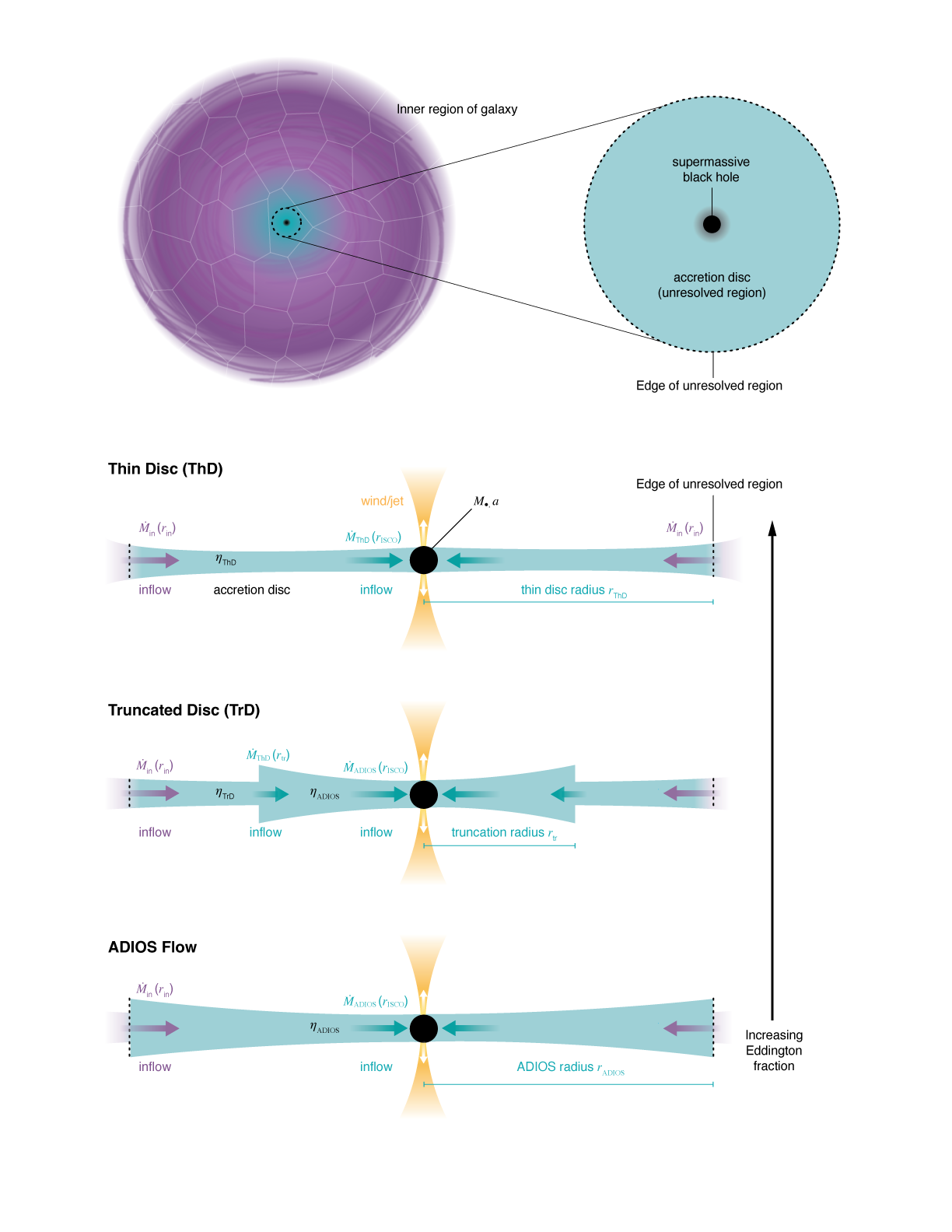
- The model combines analytical ADIOS solutions with results from GR(R)MHD simulations to describe accretion flows from low to high Eddington ratios.
- It transitions smoothly from a thick, radiatively inefficient ADIOS flow at low accretion rates to a thin $α$-disc at high rates via a truncated disc state.
- SMBH spin evolution is computed using Lense-Thirring precession, with spin magnitude and direction dynamically coupled to the disc geometry and angular momentum transfer.
- The unified model is implemented in the moving-mesh code arepo to simulate isolated and binary SMBH systems embedded in gaseous discs.
- Simulations track accretion rates, luminosities, jet power, and spin evolution across different disc states to assess their impact on observables.
- The model is validated by comparing predicted luminosities and jet efficiencies to those from standard thin-disc assumptions.
Experimental results
Research questions
- RQ1How does the transition from thick ADIOS flows to thin $α$-discs affect the predicted luminosity of SMBHs in galaxy formation simulations?
- RQ2To what extent does the choice of accretion disc model influence SMBH spin evolution, including both magnitude and orientation?
- RQ3How do the predicted electromagnetic and jet luminosities differ between the unified model and standard thin $α$-disc models?
- RQ4What are the implications of the unified model for the detectability of SMBH binaries in X-ray, optical, infrared, and radio bands?
- RQ5How does the disc state affect the gravitational wave background and recoil velocities in SMBH binary mergers?
Key findings
- The unified model reduces predicted disc luminosities by up to an order of magnitude compared to the thin $α$-disc model, especially in low-Eddington regimes, due to the dominance of the hot, inner ADIOS flow.
- The model predicts significantly higher jet luminosities from geometrically thick ADIOS flows, making radio detections with SKA and ngVLA more likely.
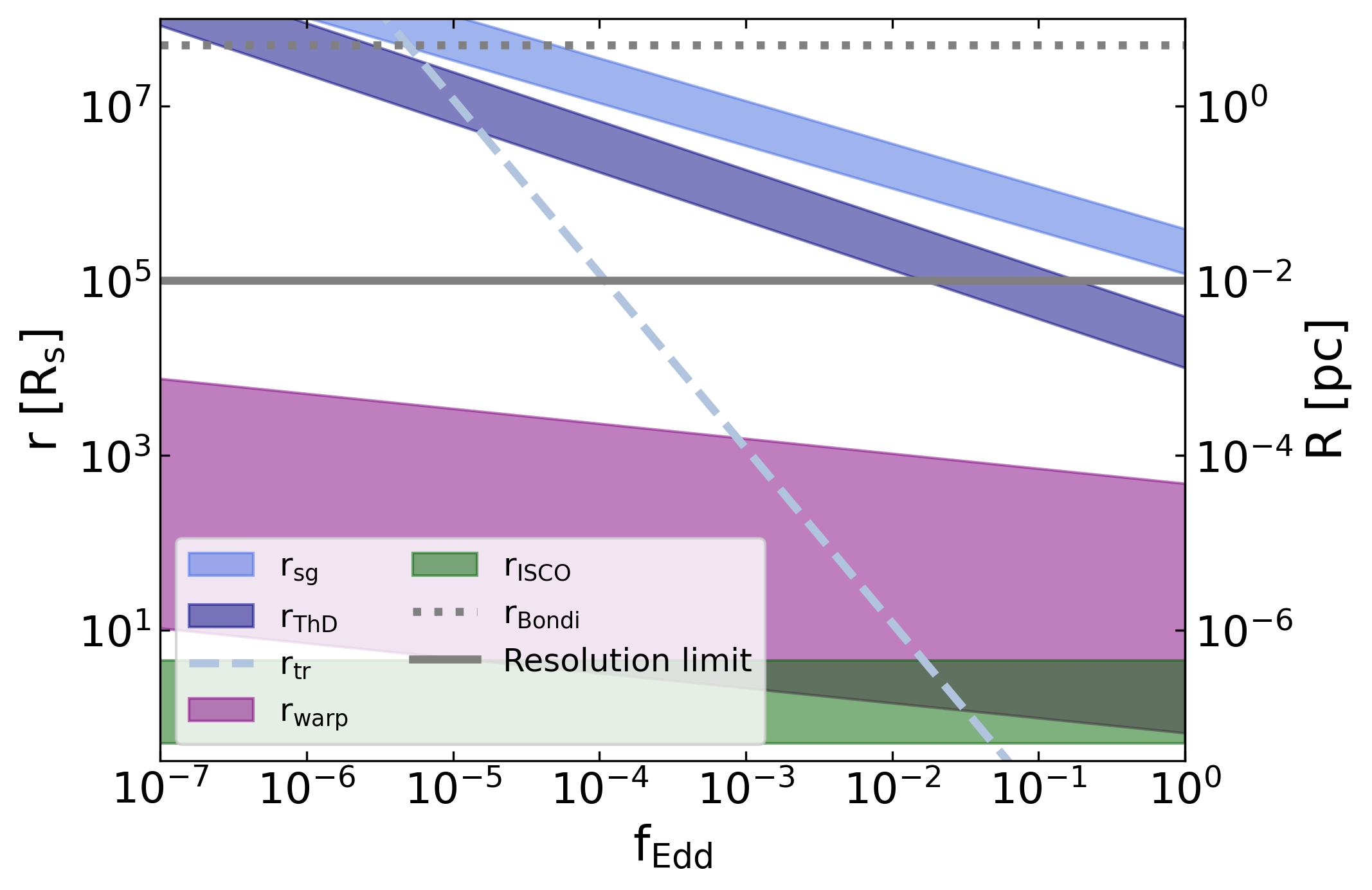
- SMBH spin magnitude evolves only mildly across disc states due to low external inflow rates, but spin direction evolves rapidly under Lense-Thirring precession in the truncated disc regime.
- The spin direction evolves from slow Bardeen-Petterson alignment to fast solid-body precession, which could enhance the spatial distribution of jet energy in feedback.
- For SMBH binaries, differences in spin evolution across disc states can significantly alter recoil velocities and merger rates, impacting the gravitational wave background.
- The model predicts a drastically reduced redshift range for detectable disc luminosities compared to thin-disc models, with spectral energy distributions shifted toward higher-energy emission.
Read this paper
Open the full text in the Nubint reader and ask about any passage as you read.
Read this paper on NubintThis review was generated by AI from the original paper. Please check the paper before citing it.