
[Paper Review] On-Chip Multidimensional Dynamic Control of Twisted Moiré Photonic Crystal for Smart Sensing and Imaging
This paper presents a MEMS-integrated twisted moiré photonic crystal (TMPhC) platform that enables on-chip, multidimensional dynamic control over interlayer gap and twist angle, achieving simultaneous wavelength and polarization sensing via adaptive computational reconstruction. The device enables high-accuracy spectropolarimetric reconstruction across the telecom band and demonstrates proof-of-concept hyperspectral and hyperpolarimetric imaging with preserved spatial resolution using a single detector.
Reconfigurable optics, optical systems that have a dynamically tunable configuration, are emerging as a new frontier in photonics research. Recently, twisted moiré photonic crystal has become a competitive candidate for implementing reconfigurable optics because of its high degree of tunability. However, despite its great potential as versatile optics components, simultaneous and dynamic modulation of multiple degrees of freedom in twisted moiré photonic crystal has remained out of reach, severely limiting its area of application. In this paper, we present a MEMS-integrated twisted moiré photonic crystal sensor that offers precise control over the interlayer gap and twist angle between two photonic crystal layers, and demonstrate an active twisted moiré photonic crystal-based optical sensor that can simultaneously resolve wavelength and polarization. Leveraging twist- and gap-tuned resonance modes, we achieve high-accuracy spectropolarimetric reconstruction of light using an adaptive sensing algorithm over a broad operational bandwidth in the telecom range and full Poincaré sphere. Our research showcases the remarkable capabilities of multidimensional control over emergent degrees of freedom in reconfigurable nanophotonics platforms and establishes a scalable pathway towards creating comprehensive flat-optics devices suitable for versatile light manipulation and information processing tasks.
Motivation & Objective
- To overcome the limitation of static configurations in twisted moiré photonic crystals by enabling active, dynamic tuning of interlayer gap and twist angle.
- To develop a reconfigurable on-chip platform capable of simultaneously resolving wavelength and polarization using a single optical sensor.
- To demonstrate adaptive computational sensing for spectropolarimetric reconstruction across the telecom band and full Poincaré sphere.
- To enable hyperspectral and hyperpolarimetric imaging with preserved spatial resolution using temporal multiplexing instead of spatial arrays.
- To establish a scalable, chip-integrated pathway for multifunctional flat-optics devices for sensing, imaging, and light manipulation.
Proposed method
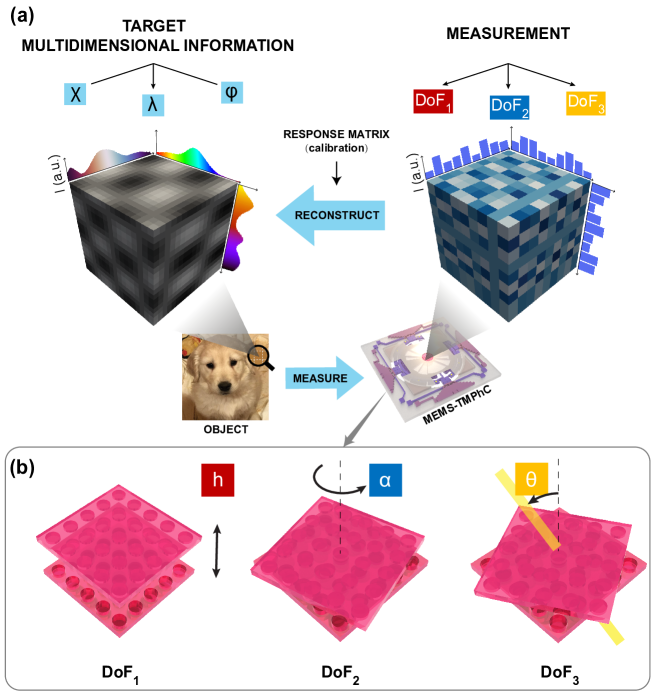
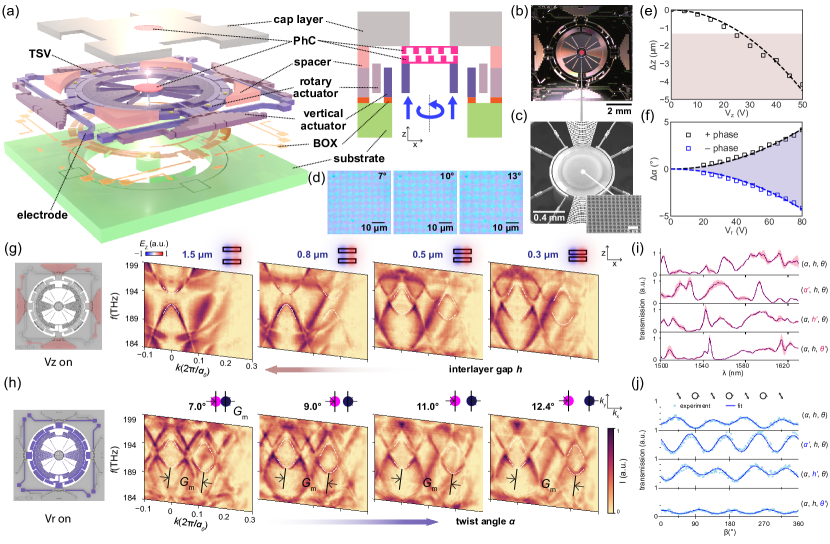
- The device integrates a twisted bilayer photonic crystal with a MEMS actuator to dynamically tune the interlayer gap (h) and twist angle (α), enabling real-time control of moiré superlattice periodicity.
- Optical response is modulated through interlayer and intralayer Bloch state coupling, generating tunable resonance modes sensitive to wavelength and polarization.
- A computational sensing framework uses a measurement matrix derived from responses across multiple configurations of h, α, and detection angle (θ) to reconstruct spectral and polarimetric information.
- An adaptive sensing algorithm leverages prior knowledge and contextual information to improve reconstruction accuracy under varying conditions.
- Hyperspectral and hyperpolarimetric imaging are achieved by sequentially measuring the same spatial scene under different TMPhC configurations and reconstructing the full signal using the same algorithm.
- The system uses a monochrome camera and a single photonic crystal, preserving spatial resolution by avoiding spatial multiplexing with arrays.
Experimental results
Research questions
- RQ1Can active, multidimensional tuning of interlayer gap and twist angle in a twisted moiré photonic crystal enable simultaneous wavelength and polarization sensing?
- RQ2How does dynamic control of h and α affect the tunability and sensitivity of resonance modes for spectropolarimetric reconstruction?
- RQ3To what extent can adaptive computational sensing improve reconstruction accuracy in the presence of noise or varying signal conditions?
- RQ4Can a single, reconfigurable TMPhC sensor achieve high-fidelity hyperspectral and hyperpolarimetric imaging without spatially multiplexed detectors?
- RQ5What is the performance limit of such a system in terms of spectral and polarimetric resolution across the telecom band and full Poincaré sphere?
Key findings
- The MEMS-TMPhC sensor enables dynamic, on-chip tuning of both interlayer gap and twist angle, achieving precise control over moiré superlattice periodicity and optical response.
- The system demonstrates high-accuracy spectropolarimetric reconstruction of light across the telecom band (1476–1599 nm) and over the full Poincaré sphere using a single detector.
- Adaptive sensing significantly reduces reconstruction error compared to non-adaptive schemes, improving robustness and accuracy under variable conditions.
- Proof-of-concept hyperspectral and hyperpolarimetric imaging is achieved with preserved spatial resolution by using temporal multiplexing instead of spatial arrays.
- The device enables full Poincaré sphere coverage and broadband operation in the telecom range, with tunable resonances spanning multiple wavelengths and polarization states.
- The platform is fully compatible with on-chip integration and scalability, offering a pathway toward compact, multifunctional flat-optics devices for sensing and imaging.
Read this paper
Open the full text in the Nubint reader and ask about any passage as you read.
Read this paper on NubintThis review was generated by AI from the original paper. Please check the paper before citing it.