
[Paper Review] On the temperature dependence of the density of states of liquids at low energies
This study experimentally confirms a universal linear frequency scaling of the vibrational density of states (VDOS) in liquids across a wide temperature range, with the slope of this scaling increasing exponentially with temperature. Using neutron scattering and instantaneous normal mode (INM) theory, the authors show this behavior aligns qualitatively with thermally activated dynamics, though INM theory underestimates the energy scale by a factor of 2–3, suggesting unaccounted anharmonic effects.
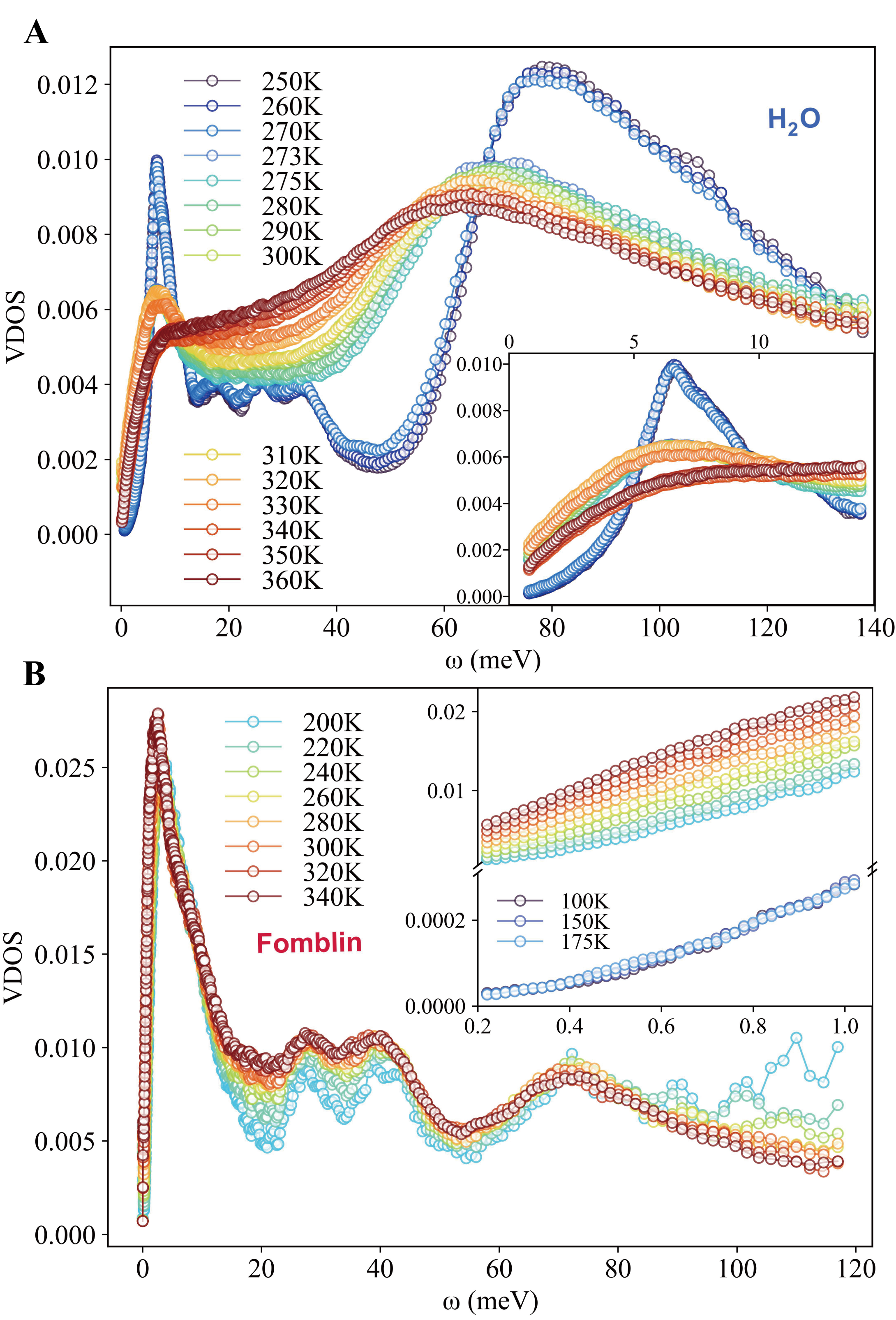
We report neutron-scattering measurements of the density of states (DOS) of water and liquid Fomblin in a wide range of temperatures. In the liquid phase, we confirm the presence of a universal low-energy linear scaling of the experimental DOS as a function of the frequency, $g(ω)= a(T) ω$, which persists at all temperatures. The low-frequency scaling of the DOS exhibits a sharp jump at the melting point of water, below which the standard Debye's law, $g(ω) \propto ω^2$, is recovered. On the contrary, in Fomblin, we observe a continuous transition between the two exponents reflecting its glassy dynamics, which is confirmed by structure measurements. More importantly, in both systems, we find that the slope $a(T)$ grows with temperature following an exponential Arrhenius-like form, $a(T) \propto \exp(-\langle E angle /T)$. We confirm this experimental trend using molecular dynamics simulations and show that the prediction of instantaneous normal mode (INM) theory for $a(T)$ is in qualitative agreement with the experimental data.
Motivation & Objective
- To investigate the low-energy vibrational density of states (VDOS) of liquids across a broad temperature range.
- To determine whether the VDOS scaling in liquids follows a universal linear law and how it evolves with temperature.
- To test the predictions of instantaneous normal mode (INM) theory against experimental neutron scattering data.
- To clarify the physical origin of the temperature dependence of the VDOS slope in liquids.
- To distinguish between first-order (sharp) and continuous (glassy) liquid-solid transitions via VDOS behavior.
Proposed method
- Experimental neutron scattering (INS) was used to measure the VDOS of liquid water and Fomblin oil across temperatures from near melting to ~340 K.
- Molecular dynamics (MD) simulations were performed to complement experimental data and validate the INM approach.
- Instantaneous normal mode (INM) theory was applied to compute the VDOS from the Hessian matrix at each instantaneous configuration.
- The temperature dependence of the VDOS slope was fitted to an Arrhenius-like exponential form, exp(−⟨E⟩/T), to test theoretical predictions.
- The INM results were compared quantitatively with experimental and simulation data to assess accuracy.
- Structural measurements were used to confirm the glassy nature of Fomblin, supporting the interpretation of its continuous transition.
Experimental results
Research questions
- RQ1Does the vibrational density of states (VDOS) in liquids exhibit a universal linear scaling with frequency across a wide temperature range?
- RQ2How does the slope of the low-frequency VDOS scale with temperature, and does it follow an Arrhenius-like exponential dependence?
- RQ3To what extent does instantaneous normal mode (INM) theory quantitatively reproduce the observed temperature dependence of the VDOS slope?
- RQ4What causes the discrepancy between INM predictions and experimental data in the energy scale of the exponential behavior?
- RQ5Can the VDOS distinguish between a first-order solid-liquid transition (e.g., water) and a continuous glassy transition (e.g., Fomblin)?
Key findings
- The VDOS of both liquid water and Fomblin oil exhibits a universal linear scaling with frequency, g(ω) = a(T)ω + ..., across all measured temperatures in the liquid phase.
- The slope a(T) of the linear VDOS increases monotonically with temperature and follows an exponential Arrhenius-like form, exp(−⟨E⟩/T), as predicted by INM theory.
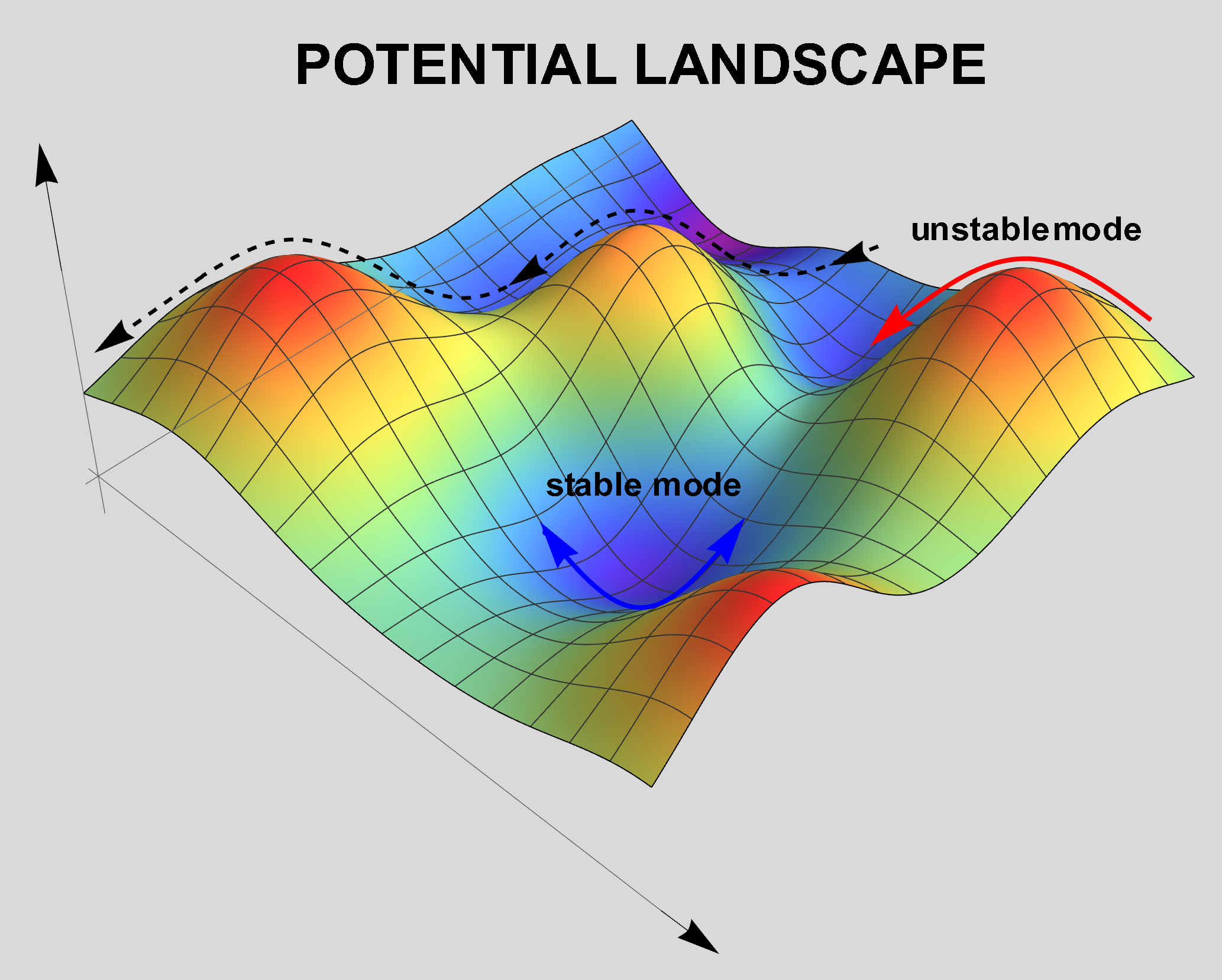
- The experimental data confirm the exponential temperature dependence of the VDOS slope, supporting the role of thermally activated hopping in the liquid potential landscape.
- INM theory qualitatively reproduces the temperature dependence of the VDOS slope but underestimates the energy scale ⟨E⟩ by a factor of approximately 2–3.
- A sharp transition from linear to quadratic (Debye) scaling is observed at the melting point of water, indicating a first-order transition.
- In contrast, Fomblin shows a smooth, continuous transition to Debye-like behavior, consistent with its polymeric glassy structure and lack of long-range order.
Read this paper
Open the full text in the Nubint reader and ask about any passage as you read.
Read this paper on NubintThis review was generated by AI from the original paper. Please check the paper before citing it.