
[Paper Review] Optimal Control of MDPs with Temporal Logic Constraints
This paper presents an optimal algorithm for synthesizing control policies in Markov decision processes (MDPs) that satisfy Linear Temporal Logic (LTL) specifications while minimizing the expected average cost between consecutive visits to surveillance states. By combining automata-based model checking and game-theoretic techniques, the method computes a finite-memory strategy that guarantees both correctness and optimality, achieving a 40.5 optimal average cost per cycle in a robotic surveillance case study—outperforming prior sub-optimal dynamic programming approaches.
In this paper, we focus on formal synthesis of control policies for finite Markov decision processes with non-negative real-valued costs. We develop an algorithm to automatically generate a policy that guarantees the satisfaction of a correctness specification expressed as a formula of Linear Temporal Logic, while at the same time minimizing the expected average cost between two consecutive satisfactions of a desired property. The existing solutions to this problem are sub-optimal. By leveraging ideas from automata-based model checking and game theory, we provide an optimal solution. We demonstrate the approach on an illustrative example.
Motivation & Objective
- To address the gap in optimal control synthesis for MDPs under LTL constraints with real-valued costs.
- To develop a method that guarantees both satisfaction of a temporal logic specification and minimization of the expected average cost between consecutive visits to desired states.
- To overcome the sub-optimality of prior dynamic programming-based solutions in the literature.
- To provide a sound and complete solution for full LTL specifications using recent advances in game theory and probabilistic model checking.
Proposed method
- Construct a product MDP between the original MDP and a Rabin automaton representing the LTL formula.
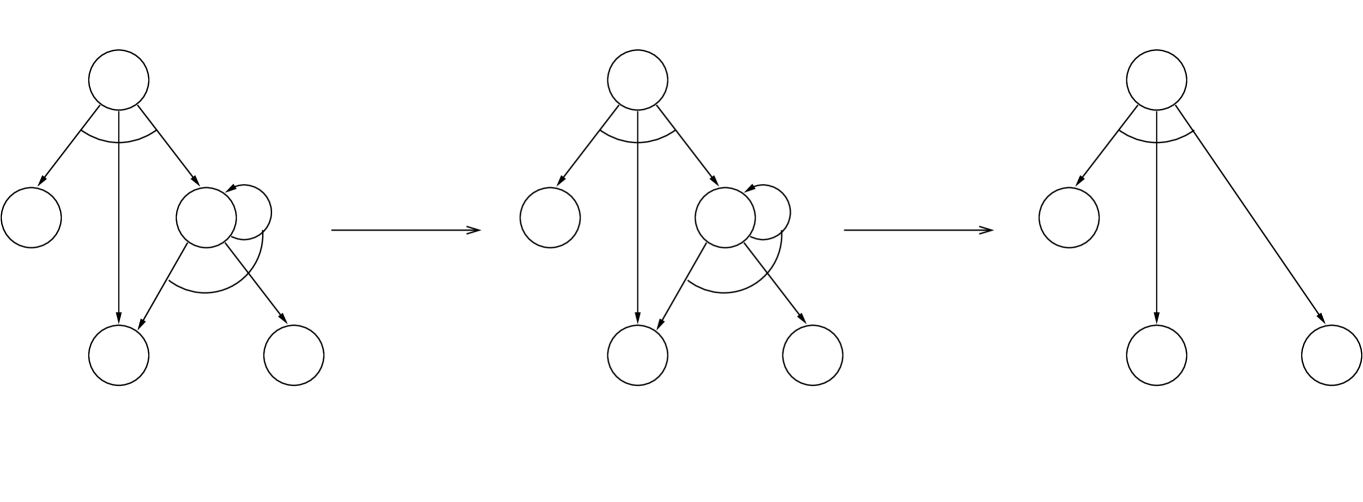
- Identify maximal end components (MAECs) in the product MDP that support long-run behavior satisfying the LTL specification.
- Apply game-theoretic techniques to compute optimal strategies within each MAEC that minimize the average cost per cycle.
- Use finite-memory strategies that first reach an MAEC and then follow an optimal strategy within it.
- Leverage recent results from $1\frac{1}{2}$-player game theory to ensure optimality of the solution.
- Integrate a rule to dynamically shorten the surveillance phase when possible, improving efficiency without sacrificing optimality.
Experimental results
Research questions
- RQ1Can we synthesize a control policy for an MDP that guarantees satisfaction of an LTL formula while minimizing the expected average cost between consecutive visits to a surveillance state?
- RQ2Is it possible to achieve optimality in this control synthesis problem, rather than relying on sub-optimal dynamic programming heuristics?
- RQ3How can automata-based model checking and game-theoretic techniques be combined to solve the optimal control problem under temporal logic constraints?
- RQ4What is the structure of the optimal strategy in terms of finite-memory control and phase-based execution?
- RQ5How does the proposed method compare quantitatively to existing sub-optimal approaches in terms of average cost per cycle?
Key findings
- The proposed method achieves an optimal average cost per cycle (ACPC) of 40.5 in the robotic surveillance case study, which is lower than the 50.5 ACPC achieved by the sub-optimal method in [11].
- The average number of jobs performed per round was 130, with a median of only 14, indicating stable and efficient performance independent of round history.
- In 98% of executions, the second phase of each round was shortened using the optimization rule, significantly reducing unnecessary surveillance cycles.
- The number of steps in the first phase (base return) was consistently 5 for rounds >1, due to the fixed path from the job state to the base.
- The optimal strategy was synthesized as a finite-memory policy that first reaches a maximal end component (MAEC) and then follows an optimal strategy within it.
- The solution is sound and complete for full LTL, providing the first optimal solution for this class of problems, unlike prior sub-optimal approaches.
Read this paper
Open the full text in the Nubint reader and ask about any passage as you read.
Read this paper on NubintThis review was generated by AI from the original paper. Please check the paper before citing it.