
[Paper Review] Optimal Reconstruction of Baryon Acoustic Oscillations for DESI 2024
The paper assesses and optimizes BAO reconstruction settings for DESI 2024 using DR1-like mocks and blinded data to ensure robustness of BAO measurements against reconstruction choices.
Baryon acoustic oscillations (BAO) provide a robust standard ruler to measure the expansion history of the Universe through galaxy clustering. Density-field reconstruction is now a widely adopted procedure for increasing the precision and accuracy of the BAO detection. With the goal of finding the optimal reconstruction settings to be used in the DESI 2024 galaxy BAO analysis, we assess the sensitivity of the post-reconstruction BAO constraints to different choices in our analysis configuration, performing tests on blinded data from the first year of DESI observations (DR1), as well as on mocks that mimic the expected clustering and selection properties of the DESI DR1 target samples. Overall, we find that BAO constraints remain robust against multiple aspects in the reconstruction process, including the choice of smoothing scale, treatment of redshift-space distortions, fiber assignment incompleteness, and parameterizations of the BAO model. We also present a series of tests that DESI followed in order to assess the maturity of the end-to-end galaxy BAO pipeline before the unblinding of the large-scale structure catalogs.
Motivation & Objective
- Evaluate how post-reconstruction BAO constraints depend on reconstruction choices for DESI 2024 analyses.
- Test the robustness of BAO measurements to smoothing scales, redshift-space distortion treatment, fiber assignment effects, and BAO modeling parameterizations.
- Validate the end-to-end DESI BAO pipeline on blinded DR1 data and mocks before unblinding the catalogs.
- Provide guidance on optimal reconstruction settings and modeling for DESI DR1-like BAO analyses.
Proposed method
- Use DESI DR1 target samples (BGS, LRGs, ELGs, QSO) and corresponding mocks (AbacusSummit N-body and EZmock) matched to DESI properties.
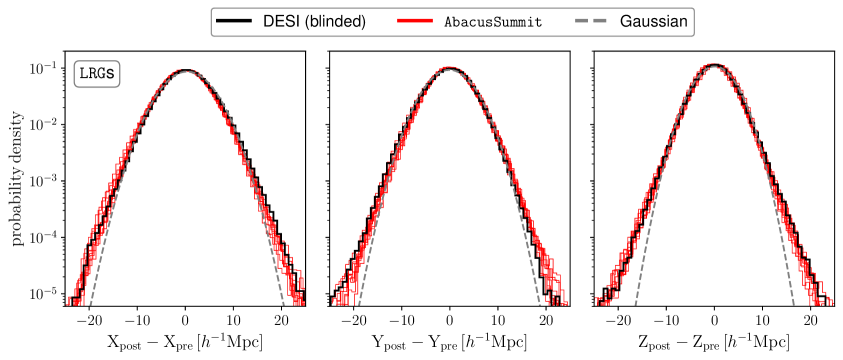
- Apply density-field reconstruction with an iterative FFT-based approach (IFFT) to estimate displacement fields and recover the linear density field.
- Implement pyrecon to process data and mocks, including grid-based density painting, smoothing with a Gaussian kernel, and multiple reconstruction conventions (RecSym and RecIso).
- Model BAO in Fourier and configuration space with a damped, anisotropic power spectrum and a smooth broadband term, including dilation parameters (alpha_perp, alpha_parallel) and damping scales (Sigma parameters).
- Use priors and nuisance terms via desilike and MCMC (emcee) to perform BAO fits to power spectrum and correlation function multipoles.
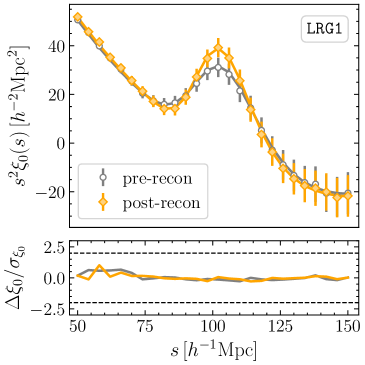
- Evaluate reconstruction performance across tracers and redshift bins, and study fiducial cosmology impact on BAO in a controlled mock/blinded setting.
Experimental results
Research questions
- RQ1How sensitive are DESI DR1-like BAO constraints to the choice of reconstruction smoothing scale and RSD treatment?
- RQ2What is the impact of fiber assignment incompleteness and BAO model parameterizations on recovered BAO distances?
- RQ3Do different DESI target samples (BGS, LRGs, ELGs, QSO) show consistent BAO measurements under various reconstruction settings?
- RQ4What uncertainties or biases remain after end-to-end, blinded data testing, and how robust is the pipeline prior to unblinding?
Key findings
- BAO constraints remain robust against multiple reconstruction choices, including smoothing scale, RSD treatment, fiber assignment incompleteness, and BAO model parameterizations.
- A series of end-to-end, blinded-data tests were performed to assess the maturity of the DESI BAO pipeline before unblinding the catalogs.
- The analysis uses iterative FFT-based reconstruction (IFFT) with pyrecon, and finds consistent results with alternative multigrid approaches while offering reduced computational cost.
- Reconstruction and modeling choices were tuned using mocks that mimic DESI DR1 target samples to optimize the DESI 2024 BAO analysis pipeline.
Read this paper
Open the full text in the Nubint reader and ask about any passage as you read.
Read this paper on NubintThis review was generated by AI from the original paper. Please check the paper before citing it.