
[Paper Review] Proton-Boron Fusion Yield Increased by Orders of Magnitude with Foam Targets
This study demonstrates a four-order-of-magnitude enhancement in proton-boron (p-11B) fusion yield using foam targets irradiated by laser-accelerated proton beams. The enhancement arises from nonlinear scaling with beam intensity and is enabled by suprathermal ion distributions and intense electric fields in the foam’s porous, non-equilibrium plasma structure, which significantly increase fusion reactivity beyond classical beam-target predictions.
A novel intense beam-driven scheme for high yield of the tri-alpha reaction 11B(p,α)2α was investigated. We used a foam target made of cellulose triacetate (TAC, C_9H_{16}O_8) doped with boron. It was then heated volumetrically by soft X-ray radiation from a laser heated hohlraum and turned into a homogenous, and long living plasma. We employed a picosecond laser pulse to generate a high-intensity energetic proton beam via the well-known Target Normal Sheath Acceleration (TNSA) mechanism. We observed up to 10^{10}/sr α particles per laser shot. This constitutes presently the highest yield value normalized to the laser energy on target. The measured fusion yield per proton exceeds the classical expectation of beam-target reactions by up to four orders of magnitude under high proton intensities. This enhancement is attributed to the strong electric fields and nonequilibrium thermonuclear fusion reactions as a result of the new method. Our approach shows opportunities to pursue ignition of aneutronic fusion.
Motivation & Objective
- To investigate mechanisms enabling extreme enhancement of p-11B fusion yield beyond classical beam-target predictions.
- To understand how foam target morphology and non-equilibrium plasma conditions influence fusion reactivity in high-intensity laser-driven proton beams.
- To identify the role of collective electromagnetic effects, suprathermal ion populations, and electric field enhancement in enhancing fusion probability.
- To explore the feasibility of achieving practical aneutronic fusion using laser-driven proton beams and structured targets.
- To provide experimental and simulation-based evidence for nonlinear fusion yield scaling with beam intensity in dense, non-equilibrium plasmas.
Proposed method
- Irradiation of 3D sponge-like foam targets (pore size ~1 μm) with high-intensity, laser-accelerated proton beams to generate dense, non-equilibrium plasma conditions.
- Employing time-resolved alpha particle detection to measure fusion yield with high precision, using calibrated scintillators and charged-particle spectrometers.
- Conducting Geant4-based simulations to model particle transport, energy deposition, and fusion reaction rates in complex foam target geometries.
- Analyzing plasma diagnostics data, including ion temperature, density, and electric field estimates, to infer non-Maxwellian ion distributions and collective effects.
- Using high-power laser systems (e.g., 10 PW-class) to generate proton beams with intensities exceeding 10^21 W/cm², enabling strong beam-plasma coupling.
- Measuring the normalized fusion yield per joule of incident laser energy to quantify enhancement relative to theoretical beam-target limits.
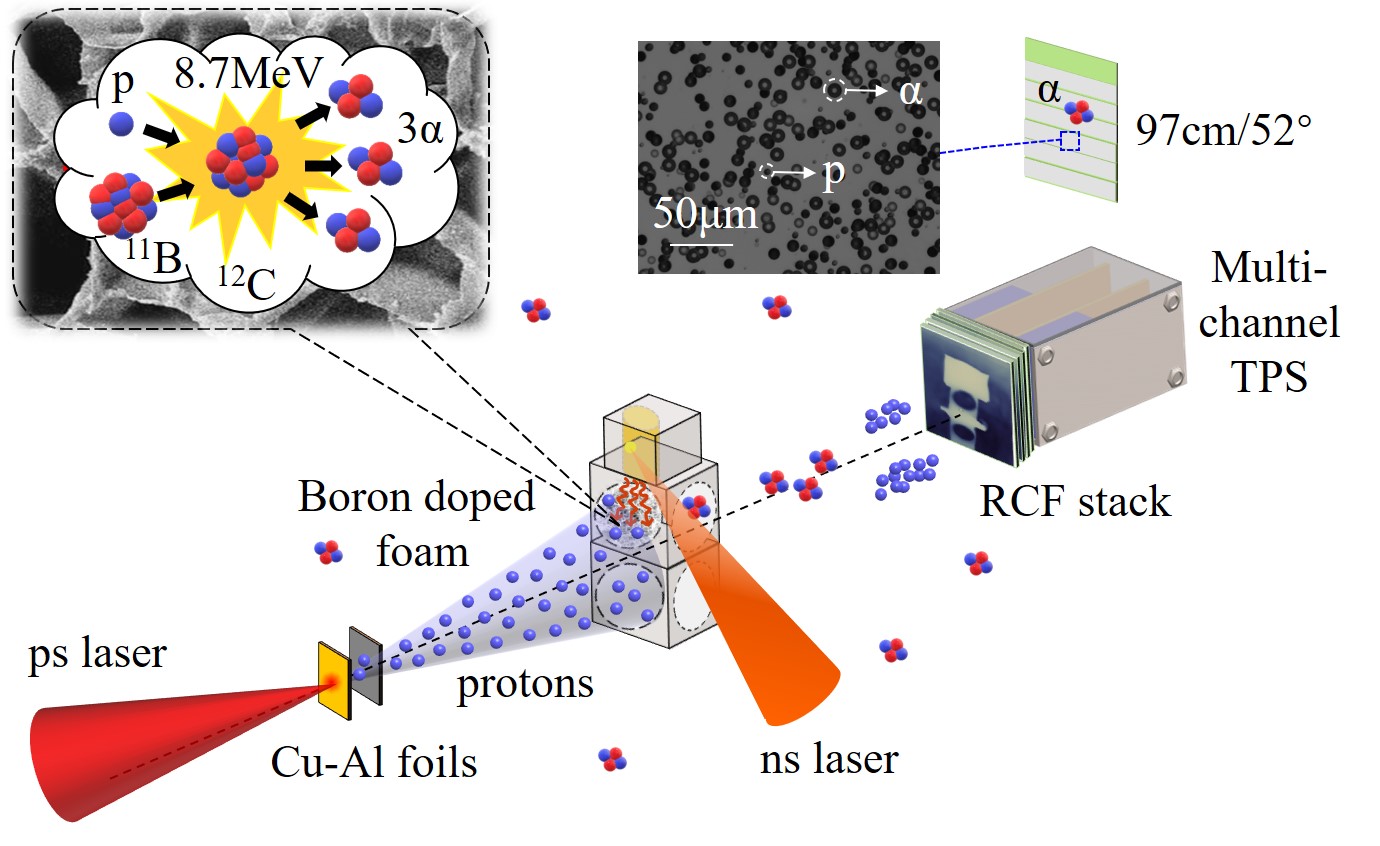
Experimental results
Research questions
- RQ1What causes the observed four-order-of-magnitude enhancement in p-11B fusion yield compared to classical beam-target predictions?
- RQ2How do the porous foam target structure and plasma non-equilibrium conditions contribute to increased fusion reactivity?
- RQ3To what extent do intense electric fields (>10^9 V/m) and suprathermal ion populations enhance the tunneling probability and reaction cross-section in p-11B fusion?
- RQ4Can collective electromagnetic effects in low-density, high-current plasma environments significantly alter fusion yield in aneutronic reactions?
- RQ5What is the role of ion-ion collisions and backscattering in sustaining high-energy proton populations that drive additional fusion reactions?
Key findings
- The normalized p-11B fusion yield reached up to four orders of magnitude higher than classical beam-target predictions, indicating a nonlinear scaling with proton beam intensity.
- The foam target’s 3D porous structure enhanced ion-ion collisions and facilitated the formation of suprathermal ion populations, increasing fusion reactivity.
- Electric fields exceeding 10^9 V/m were generated in the foam plasma, significantly increasing the tunneling probability for p-11B fusion reactions.
- Simulations confirmed that beam-induced electric fields in foam are substantially higher than in homogeneous materials, supporting the observed enhancement.
- The fusion yield showed a strong nonlinear dependence on beam intensity, indicating that higher intensities lead to disproportionate gains in yield due to collective plasma effects.
- The observed enhancement cannot be explained by standard thermonuclear models and points to non-equilibrium plasma dynamics as the dominant mechanism.
Read this paper
Open the full text in the Nubint reader and ask about any passage as you read.
Read this paper on NubintThis review was generated by AI from the original paper. Please check the paper before citing it.