
[Paper Review] Pupil-Adaptive 3D Holography Beyond Coherent Depth-of-Field
This paper proposes a pupil-adaptive neural framework for 3D holography that dynamically adjusts the depth-of-field in holographic reconstructions based on real-time eye pupil size, enabling photorealistic defocus blur indistinguishable from incoherent light in the real world. By learning pupil-dependent receptive fields, the method overcomes the inherent limitations of coherent holography, achieving up to 5 dB higher PSNR than prior methods and demonstrating natural focus cues on a physical prototype.
Recent holographic display approaches propelled by deep learning have shown remarkable success in enabling high-fidelity holographic projections. However, these displays have still not been able to demonstrate realistic focus cues, and a major gap still remains between the defocus effects possible with a coherent light-based holographic display and those exhibited by incoherent light in the real world. Moreover, existing methods have not considered the effects of the observer's eye pupil size variations on the perceived quality of 3D projections, especially on the defocus blur due to varying depth-of-field of the eye. In this work, we propose a framework that bridges the gap between the coherent depth-of-field of holographic displays and what is seen in the real world due to incoherent light. To this end, we investigate the effect of varying shape and motion of the eye pupil on the quality of holographic projections, and devise a method that changes the depth-of-the-field of holographic projections dynamically in a pupil-adaptive manner. Specifically, we introduce a learning framework that adjusts the receptive fields on-the-go based on the current state of the observer's eye pupil to produce image effects that otherwise are not possible in current computer-generated holography approaches. We validate the proposed method both in simulations and on an experimental prototype holographic display, and demonstrate significant improvements in the depiction of depth-of-field effects, outperforming existing approaches both qualitatively and quantitatively by at least 5 dB in peak signal-to-noise ratio.
Motivation & Objective
- To bridge the gap between coherent holographic displays and natural incoherent light imaging by modeling pupil-dependent defocus effects.
- To address the lack of realistic focus cues in current computer-generated holography, especially the unnatural defocus blur caused by coherent light.
- To enable dynamic depth-of-field adaptation in holographic displays based on real-time observer pupil size variations.
- To improve image fidelity and photorealism in holographic projections by mimicking incoherent light transport effects.
- To develop a generalizable framework that supports diverse input modalities, including single RGB images.
Proposed method
- A unified neural framework is designed to learn pupil-adaptive receptive fields that adjust in real time based on eye tracking data.
- The method uses a differentiable wave propagation model to simulate how varying pupil sizes affect the perceived depth-of-field in holographic reconstructions.
- It incorporates a rendering pipeline that generates photorealistic reconstructions under different pupil conditions, shaping the SLM phase pattern to mimic incoherent light effects.
- The framework employs a loss function that enforces both high image fidelity and accurate defocus blur, minimizing artifacts like ringing and speckle.
- It supports multiple input modalities, including RGB-D and single RGB images, enabling broad applicability.
- The system is validated on a physical prototype display with real-time eye tracking, demonstrating dynamic adaptation to pupil changes.
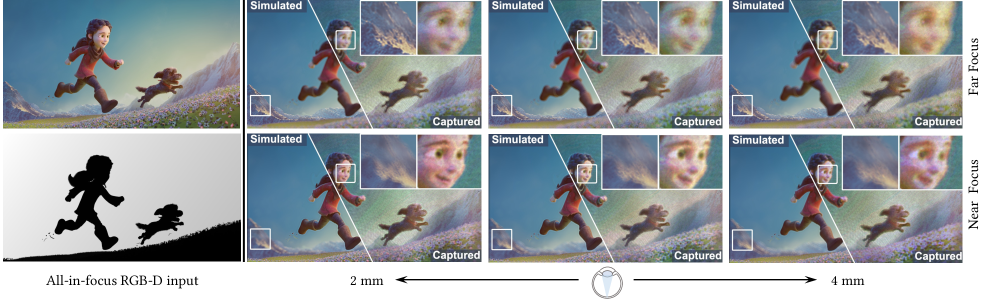
Experimental results
Research questions
- RQ1How can holographic displays simulate realistic defocus blur caused by incoherent light, given the constraints of coherent light-based wavefront modulation?
- RQ2To what extent can a neural framework dynamically adapt the depth-of-field of holographic projections based on real-time pupil size measurements?
- RQ3Can pupil-adaptive holography improve image quality and perceived realism beyond current coherent holography methods?
- RQ4How does the proposed method generalize across different input modalities, such as single RGB images or RGB-D data?
- RQ5What is the impact of pupil-dependent defocus on perceived depth and visual comfort in near-eye holographic displays?
Key findings
- The proposed method achieves up to 5 dB higher peak signal-to-noise ratio (PSNR) than state-of-the-art methods, demonstrating superior image fidelity.
- Holograms synthesized with the framework exhibit natural defocus blur that closely matches real-world incoherent imaging, eliminating the unnatural sharpness and artifacts common in coherent displays.
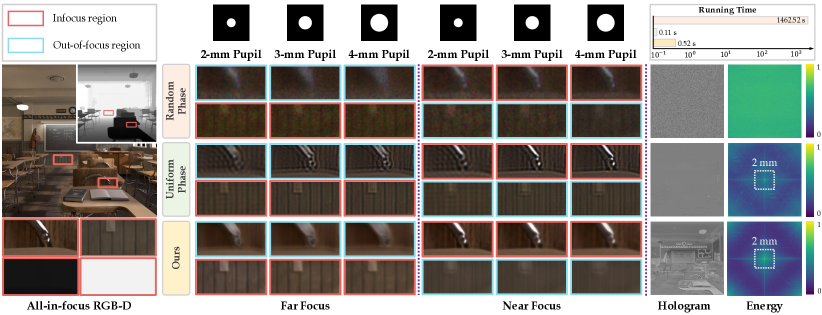
- The system successfully mitigates ringing artifacts in out-of-focus regions, particularly around edges, which are prevalent in prior methods like TensorHolo V1/V2.
- Experimental results on a physical prototype display confirm that pupil-adaptive holography produces perceptually realistic depth-of-field effects under varying pupil conditions.
- The framework generalizes well to single RGB image inputs, producing plausible and realistic defocus effects without requiring depth maps.
- Subjective evaluation is planned for future work, but the results suggest significant improvements in perceived realism and visual comfort.
Read this paper
Open the full text in the Nubint reader and ask about any passage as you read.
Read this paper on NubintThis review was generated by AI from the original paper. Please check the paper before citing it.