
[Paper Review] R2LIVE: A Robust, Real-time, LiDAR-Inertial-Visual tightly-coupled state Estimator and mapping
R2LIVE presents a real-time, tightly-coupled LiDAR-inertial-visual state estimator that fuses data from LiDAR, IMU, and camera sensors using an error-state iterated Kalman filter for real-time odometry and factor graph optimization for map refinement. It achieves sub-0.3° rotational and sub-0.25% translational error in 300m sequences, demonstrating high accuracy and robustness in feature-deprived, dynamic, and large-scale environments.
In this letter, we propose a robust, real-time tightly-coupled multi-sensor fusion framework, which fuses measurement from LiDAR, inertial sensor, and visual camera to achieve robust and accurate state estimation. Our proposed framework is composed of two parts: the filter-based odometry and factor graph optimization. To guarantee real-time performance, we estimate the state within the framework of error-state iterated Kalman-filter, and further improve the overall precision with our factor graph optimization. Taking advantage of measurement from all individual sensors, our algorithm is robust enough to various visual failure, LiDAR-degenerated scenarios, and is able to run in real-time on an on-board computation platform, as shown by extensive experiments conducted in indoor, outdoor, and mixed environment of different scale. Moreover, the results show that our proposed framework can improve the accuracy of state-of-the-art LiDAR-inertial or visual-inertial odometry. To share our findings and to make contributions to the community, we open source our codes on our Github.
Motivation & Objective
- To address the limitations of LiDAR-only SLAM in feature-deprived or degenerate environments such as narrow tunnels or low-texture areas.
- To improve the robustness and accuracy of state estimation by tightly fusing measurements from LiDAR, inertial sensors, and visual cameras.
- To achieve real-time performance on embedded platforms while maintaining high-precision localization and mapping.
- To enable large-scale, dense 3D mapping with minimal drift and without requiring explicit loop closure mechanisms.
Proposed method
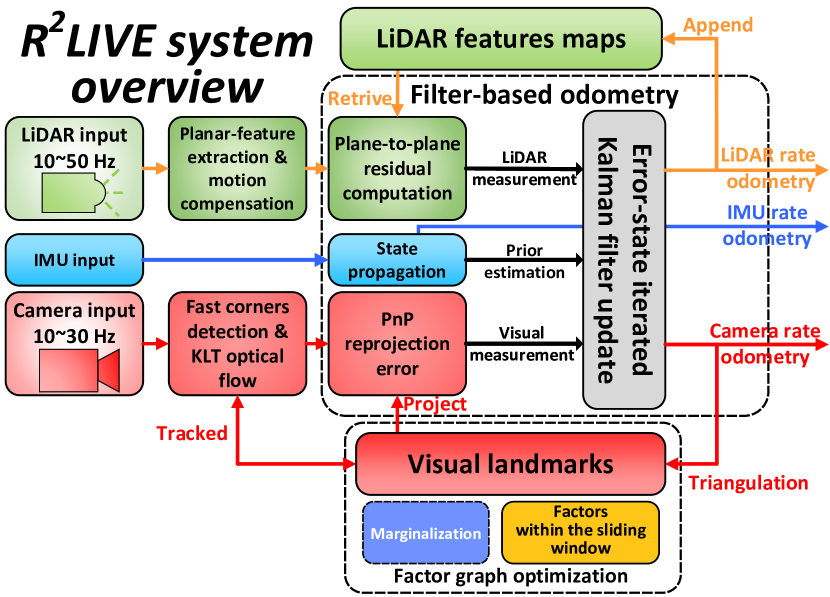
- The system employs a high-rate error-state iterated Kalman filter (ESIKF) to tightly couple LiDAR, inertial, and visual measurements for real-time state estimation.
- A separate, low-rate factor graph optimization refines the local map by optimizing keyframe poses and visual landmark positions in a sliding window.
- The LiDAR-inertial odometry component uses a novel Kalman gain computation that reduces complexity to scale with state dimension rather than measurement dimension.
- Visual features are extracted and tracked using a visual-inertial odometry module, which is tightly coupled with LiDAR and IMU data in the ESIKF framework.
- The system leverages both geometric features (edges, planes) from LiDAR and sparse visual features to enhance robustness under sensor failure or motion challenges.
- The factor graph optimization runs on a separate thread, allowing it to operate at a lower frequency than the main filter, balancing accuracy and computational load.
Experimental results
Research questions
- RQ1Can a tightly-coupled fusion of LiDAR, inertial, and visual sensors significantly improve robustness in environments with low geometric features or sensor degradation?
- RQ2To what extent can a filter-based odometry system with error-state iterated Kalman filtering maintain real-time performance while achieving high accuracy on embedded platforms?
- RQ3How well does the system perform in large-scale indoor-outdoor environments with complex dynamics and moving objects?
- RQ4Can the system achieve loop closure and accurate mapping without explicit loop closure detection or post-processing?
- RQ5What is the quantitative improvement in localization accuracy compared to state-of-the-art LiDAR-inertial or visual-inertial systems under aggressive motion and sensor failure?
Key findings
- In a 300-meter outdoor trajectory with high dynamic motion (up to 130°/s angular rate), R2LIVE achieved a median relative pose error of 0.27° (rotational) and 0.21% (translational), outperforming Vins-Mono and Fast-LIO.
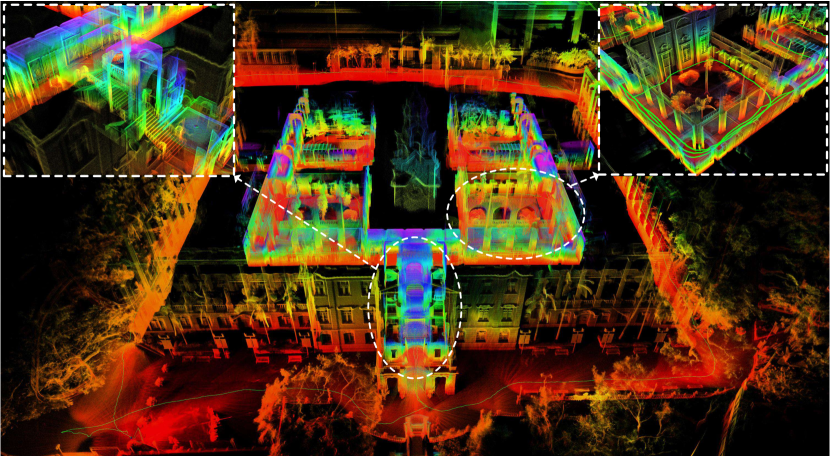
- The system successfully reconstructed a dense, high-precision 3D map of the HKU main building (both indoor and outdoor), with point clouds aligning tightly with the official street map.
- Without any explicit loop closure processing, R2LIVE closed the loop after traversing 876 meters, demonstrating extremely low drift in long-term operation.
- The system achieved real-time performance on both desktop (Intel i7-9700K) and embedded platforms (Intel i7-8550U), with average odometry processing times of 15.98ms and 24.37ms respectively.
- In a tunnel-like environment with moving pedestrians and limited LiDAR FoV, the system remained robust and stable, maintaining accurate state estimation despite visual and LiDAR challenges.
- The factor graph optimization significantly improved map accuracy, as evidenced by tighter alignment with satellite imagery and reduced trajectory drift in long sequences.
Read this paper
Open the full text in the Nubint reader and ask about any passage as you read.
Read this paper on NubintThis review was generated by AI from the original paper. Please check the paper before citing it.