
[Paper Review] Resource Theory of Imaginarity: New Distributed Scenarios
This paper introduces a distributed resource theory of imaginarity, demonstrating that imaginary parts in quantum states enable operational advantages in quantum information tasks. It establishes exact solutions for imaginarity distillation and state conversion in bipartite systems using LQRCC protocols, proves a quantum advantage in ancilla-free channel discrimination via imaginarity, and experimentally validates the protocols in a photonic setup, showing that imaginarity is a non-trivial quantum resource in distributed scenarios.
The resource theory of imaginarity studies the operational value of imaginary parts in quantum states, operations, and measurements. Here we introduce and study the distillation and conversion of imaginarity in distributed scenario. This arises naturally in bipartite systems where both parties work together to generate the maximum possible imaginarity on one of the subsystems. We give exact solutions to this problem for general qubit states and pure states of arbitrary dimension. We present a scenario that demonstrates the operational advantage of imaginarity: the discrimination of quantum channels without the aid of an ancillary system. We then link this scenario to LOCC discrimination of bipartite states. We experimentally demonstrate the relevant assisted distillation protocol, and show the usefulness of imaginarity in the aforementioned two tasks.
Motivation & Objective
- To develop a distributed resource theory of imaginarity where one party (Bob) holds the resource and the other (Alice) assists via local operations and classical communication.
- To solve the problem of assisted imaginarity distillation for arbitrary two-qubit states and pure states of arbitrary dimension.
- To demonstrate an operational advantage of imaginarity in ancilla-free quantum channel discrimination, where real channels become distinguishable only when imaginarity is present.
- To establish a formal connection between ancilla-free channel discrimination and LOCC discrimination of normalized Choi matrices.
- To experimentally implement and validate the theoretical protocols using a photonic quantum setup, confirming the usefulness of imaginarity in real-world quantum tasks.
Proposed method
- Formalize the resource theory of imaginarity in a distributed setting using Local Operations, Real operations, and Classical Communication (LQRCC), where only Bob’s system can possess imaginarity.
- Define and solve the assisted imaginarity distillation problem using a convex optimization framework, deriving exact analytical solutions for qubit and pure state cases.
- Map ancilla-free channel discrimination to LOCC discrimination of normalized Choi matrices, enabling the use of established tools from quantum state discrimination.
- Construct a protocol that maps channel discrimination tasks into LOCC scenarios via Choi isomorphism, preserving the probabilities of successful discrimination.
- Implement the protocols experimentally using a photonic setup with spontaneous parametric down-conversion to generate entangled states and simulate quantum channels.
- Use waveplates and beam splitters to prepare Werner states and control polarization, enabling the realization of real operations and measurements with and without imaginarity.
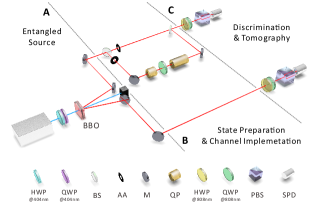
Experimental results
Research questions
- RQ1Can imaginarity be distilled in a distributed setting where only one party holds the resource, and the other assists via local operations and classical communication?
- RQ2What is the maximum amount of imaginarity that can be distilled from an arbitrary two-qubit state under LQRCC operations?
- RQ3Does imaginarity provide a genuine operational advantage in ancilla-free quantum channel discrimination, and if so, how is it quantified?
- RQ4How is the discrimination of real quantum channels related to the LOCC discrimination of their normalized Choi states?
- RQ5Can the theoretical advantages of imaginarity in channel discrimination be experimentally verified using photonic quantum systems?
Key findings
- Exact analytical solutions for imaginarity distillation are derived for arbitrary two-qubit states and pure states of any dimension under LQRCC protocols.
- The paper proves that two real quantum channels can be perfectly distinguishable in an ancilla-free scenario when imaginarity is used, but become completely indistinguishable when restricted to real states and measurements.
- A formal equivalence is established between ancilla-free channel discrimination and LOCC discrimination of normalized Choi matrices, showing that the advantage of imaginarity arises from the non-locality of the measurement process.
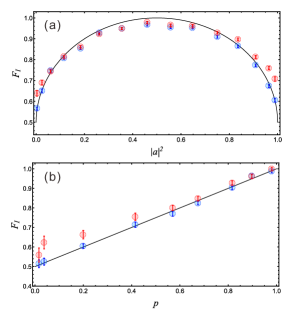
- The experimental implementation in a photonic setup successfully demonstrates the distillation protocol and the channel discrimination advantage, confirming the theoretical predictions.
- The results show that imaginarity is not merely a mathematical artifact but a physically useful resource in distributed quantum information processing.
- The study reveals that the presence of imaginary parts in quantum operations enables tasks that are impossible under real-only operations, even in the absence of an ancillary system.
Read this paper
Open the full text in the Nubint reader and ask about any passage as you read.
Read this paper on NubintThis review was generated by AI from the original paper. Please check the paper before citing it.