
[Paper Review] Search for the He-η bound states with the WASA-at-COSY facility
This study searches for the elusive He-η bound state—known as η-mesic helium—using the WASA-at-COSY detector at the Research Center Jülich. By measuring the excitation function of the dd → ³He p π⁻ and dd → ³He n π⁰ reactions near the η-meson production threshold with high-statistics beam-ramping, the experiment aims to detect a resonance-like structure indicative of the bound state; no such structure was observed in the 2008 data, and analysis of 2010 data with sixfold higher statistics is ongoing, with potential for improved cross-section limits or a discovery.
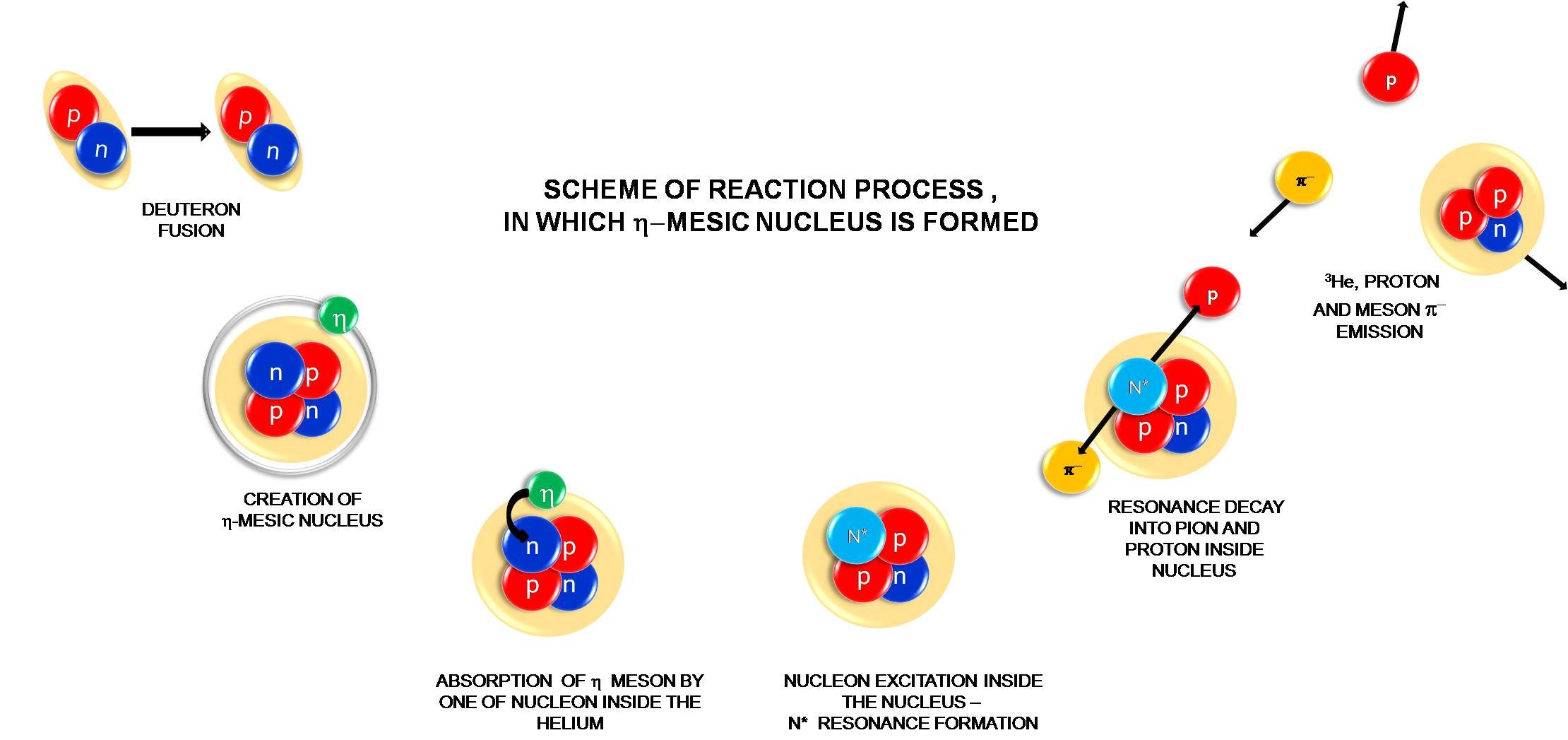
The eta-mesic nuclei in which the η meson is bound with nucleus via strong interaction was postulated already in 1986, however till now no experiment confirmed empirically its existence. The discovery of this new kind of an exotic nuclear matter would be very important for better understanding of the η meson structure and its interaction with nucleons. The search for η-mesic helium is carried out with high statistic and high acceptance with the WASA-at-COSY detection setup in the Research Center Juelich. The search is conducted via the measurement of the excitation function for the chosen decay channels of the 4He-η system. Till now two reactions dd --> (4He-η)_bs --> 3Hepπ- and dd --> (4He-η)_bs --> 3 Henπ0 were measured with the beam momentum ramped around the eta production threshold. This report includes the description of experimental method and status of the analysis.
Motivation & Objective
- To empirically confirm the existence of η-mesic ⁴He, a hypothetical bound state of the η meson and ⁴He nucleus via strong interaction.
- To investigate the nature of the η-nucleon interaction and its implications for the N*(1535) resonance and the flavor-singlet component of the η meson.
- To improve experimental sensitivity to η-mesic nuclei by increasing statistics and reducing systematic uncertainties through beam momentum ramping.
- To set a more stringent upper limit on the production cross-section of the ⁴He-η bound state, or to observe a resonance-like signal in the excitation function.
Proposed method
- Employing the WASA-at-COSY detection setup at the COSY synchrotron to measure the excitation function of the dd → (⁴He-η)₆₆ → ³He p π⁻ and dd → (⁴He-η)₆₆ → ³He n π⁰ reactions.
- Ramping the deuteron beam momentum continuously from 2.127 GeV/c to 2.422 GeV/c to cover excess energy Q ∈ (-70, 30) MeV, minimizing systematic uncertainties.
- Applying kinematic cuts on p and π⁻ kinetic energy and p-π⁻ opening angle in the center-of-mass frame to isolate the signal of the bound state.
- Using quasi-elastic pp scattering for relative normalization of excitation function data points.
- Estimating average luminosity at L ≈ 1.5 × 10³¹ cm⁻²s⁻¹ based on the binary reaction dd → ³He n.
- Analyzing decay chains including π⁰ → γγ to identify the ³He n π⁰ final state with high efficiency.
Experimental results
Research questions
- RQ1Does a resonance-like structure appear in the excitation function of the dd → ³He p π⁻ reaction near the η-meson production threshold, indicating the existence of the ⁴He-η bound state?
- RQ2Can the 2010 data with six times higher statistics than the 2008 run improve the sensitivity to the ⁴He-η bound state or set a tighter upper limit on its production cross-section?
- RQ3Is the observed kinematic signature—specifically the 180° p-π⁻ relative angle in the N*(1525) rest frame—consistent with the decay of a ⁴He-η bound state?
- RQ4What constraints do the experimental results place on the real part of the η-nucleus scattering length, particularly in relation to the condition |Re(aₙₜₕᵤcₑ)| > |Im(aₙₜₕᵤcₑ)| for bound state formation?
- RQ5How do the results compare with theoretical predictions for η-mesic nuclei, especially regarding the role of the N*(1535) resonance and the flavor-singlet component of the η meson?
Key findings
- No resonance-like structure was observed in the excitation function of the dd → ³He p π⁻ reaction in the 2008 data, which covered excess energy from -51.4 MeV to 22 MeV.
- The 2010 experiment collected more than 40 times higher statistics than the 2008 run, with data taken over 155 hours and average luminosity of ~1.5 × 10³¹ cm⁻²s⁻¹.
- Two decay channels were measured: dd → (⁴He-η)₆₆ → ³He p π⁻ and dd → (⁴He-η)₆₆ → ³He n π⁰ → ³He n γγ, enhancing signal identification.
- The analysis of the 2010 data is ongoing, with the potential to either observe a signal from the ⁴He-η bound state or reduce the upper limit on its production cross-section by a factor of about six.
- The beam-ramping technique successfully minimized systematic uncertainties, improving the precision of the excitation function measurement.
- The experimental setup and analysis strategy are designed to test the theoretical condition for bound state formation: |Re(aₙₜₕᵤcₑ)| > |Im(aₙₜₕᵤcₑ)|, with implications for η-meson properties and nucleon interactions.
Read this paper
Open the full text in the Nubint reader and ask about any passage as you read.
Read this paper on NubintThis review was generated by AI from the original paper. Please check the paper before citing it.