
[Paper Review] Searching for Time-Dependent Axion Dark Matter Signals in Pulsars
This study presents the first time-domain search for axion dark matter signals in pulsars using matched filtering on MeerKAT data from PSR J2144−3933, demonstrating that time-domain analysis enhances sensitivity to axion-to-photon coupling compared to time-averaged flux methods. The authors set a new upper limit of $ g_{a\gamma\gamma} < 5.5 \times 10^{-11}(D/0.165\,\text{pc})\,\text{GeV}^{-1} $ over the axion mass range $ 3.9{-}4.7\,\mu\text{eV} $, leveraging the pulsar's periodic signal modulation due to rotation and plasma effects.
Axion dark matter can be converted into photons in the magnetospheres of neutron stars leading to a spectral line centred on the Compton wavelength of the axion. Due to the rotation of the star and the plasma effects in the magnetosphere the signal is predicted to be periodic with significant time variation - a unique smoking gun for axion dark matter. As a proof of principle and to develop the methodology, we carry out the first time domain search of the signal using data from PSR J2144$-$3933 taken as part of the MeerTIME project on MeerKAT telescope. We search for specific signal templates using a matched filter technique and discuss when a time-domain analysis (as is typically the case in pulsar observations) gives greater sensitivity to the axion-coupling to photons in comparison to a simple time-averaged total flux study. We do not find any candidate signals and, hence, impose an upper limit on the axion-to-photon coupling of $g_{aγγ}<4 imes 10^{-11}\,{ m GeV}^{-1}$ over the mass range $m_{ m a}=3.9-4.7\,μ{ m eV}$ using this data. This limit relies on PSR J2144$-$3933 not being an extremely aligned rotator, as strongly supported by simple arguments based on the observed pulse profile width. We discuss the possibilities of improving this limit using future observations with MeerKAT and also SKA1-mid and the possibility of using other objects. Finally, to evade modelling uncertainties in axion radio signals, we also carry out a generic ``any periodic-signal search" in the data, finding no evidence for an axion signal.
Motivation & Objective
- To develop and apply a time-domain analysis method to detect axion dark matter signals in pulsar radio emissions.
- To quantify the sensitivity gain from using time-variability in pulsar signals compared to time-averaged flux measurements.
- To set a new upper limit on the axion-to-photon coupling $ g_{a\gamma\gamma} $ using real observational data from PSR J2144−3933.
- To test the robustness of the signal model by performing a generic periodic-signal search independent of axion-specific templates.
Proposed method
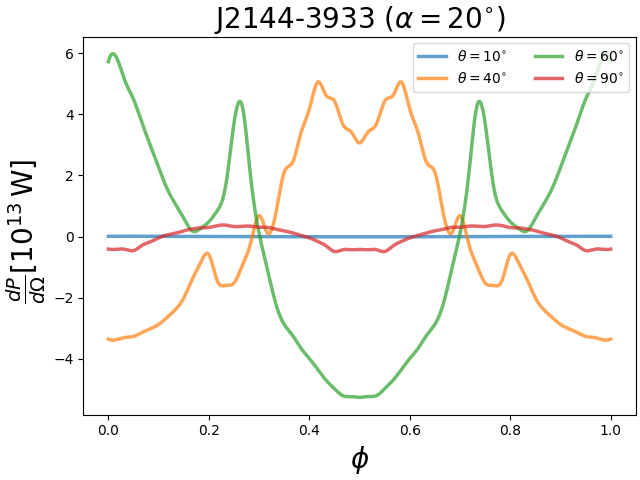
- Employed a matched filter technique using theoretical signal templates derived from ray-tracing simulations of axion-to-photon conversion in neutron star magnetospheres.
- Used interpolated ray-tracing results (via SciPy) to model time-dependent flux profiles across varying viewing angles $ \theta $ and $ \alpha $, reducing computational cost.
- Performed a time-domain search on MeerTIME project data from MeerKAT, focusing on the periodic modulation of the signal due to pulsar rotation and plasma effects.
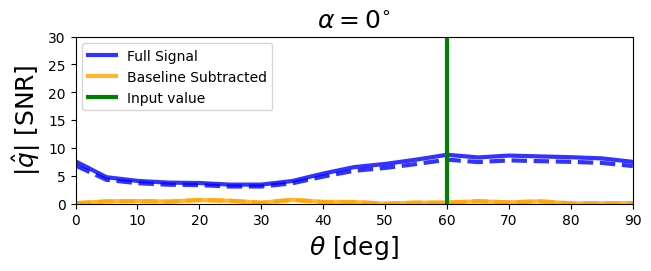
- Compared sensitivity of time-domain analysis to standard time-averaged flux methods, showing modest but meaningful SNR improvement.
- Conducted a generic periodic-signal search to detect any narrowband, modulated signal without assuming axion-specific models.
Experimental results
Research questions
- RQ1Can time-domain analysis of pulsar signals significantly improve sensitivity to axion dark matter compared to time-averaged flux measurements?
- RQ2What is the upper limit on the axion-to-photon coupling $ g_{a\gamma\gamma} $ based on a time-domain search in real data from PSR J2144−3933?
- RQ3How does the inclusion of plasma effects and rotation-induced modulation affect the detectability of axion signals in pulsars?
- RQ4Can a generic periodic-signal search detect axion-like signals without relying on specific theoretical templates?
Key findings
- The time-domain analysis provides a modest but measurable improvement in signal-to-noise ratio over time-averaged flux methods, enhancing detection prospects.
- No candidate axion signals were detected in the data, leading to an upper limit of $ g_{a\gamma\gamma} < 5.5 \times 10^{-11}(D/0.165\,\text{pc})\,\text{GeV}^{-1} $ for axion masses between 3.9 and 4.7 $\mu\text{eV}$.
- The derived limit is robust under the assumption that PSR J2144−3933 is not an extremely aligned rotator, supported by pulse profile width analysis.
- The interpolation of ray-tracing results achieved sufficient accuracy for analysis, validating its use in place of full simulations for arbitrary angles.
- A generic periodic-signal search found no evidence of modulated signals, reinforcing the null result and reducing model-dependence.
- Future observations with MeerKAT and SKA1-mid are expected to improve sensitivity, especially with optimized time-domain strategies.
Read this paper
Open the full text in the Nubint reader and ask about any passage as you read.
Read this paper on NubintThis review was generated by AI from the original paper. Please check the paper before citing it.