
[Paper Review] SLICK: Strong Lensing Identification of Candidates Kindred in gravitational wave data
SLICK is a deep learning pipeline that identifies strongly lensed gravitational wave signals using combined Q-transform and Sine-Gaussian filter maps, achieving 5× higher efficiency than traditional methods at a 0.001 false positive rate. It outperforms prior approaches by integrating multi-map data and enables rapid, accurate lensing candidate detection for future GW surveys.
By the end of the next decade, we hope to have detected strongly lensed gravitational waves by galaxies or clusters. Although there exist optimal methods for identifying lensed signal, it is shown that machine learning (ML) algorithms can give comparable performance but are orders of magnitude faster than non-ML methods. We present the SLICK pipeline which comprises a parallel network based on deep learning. We analyse the Q-transform maps (QT maps) and the Sine-Gaussian maps (SGP-maps) generated for the binary black hole signals injected in Gaussian as well as real noise. We compare our network performance with the previous work and find that the efficiency of our model is higher by a factor of 5 at a false positive rate of 0.001. Further, we show that including SGP maps with QT maps data results in a better performance than analysing QT maps alone. When combined with sky localisation constraints, we hope to get unprecedented accuracy in the predictions than previously possible. We also evaluate our model on the real events detected by the LIGO--Virgo collaboration and find that our network correctly classifies all of them, consistent with non-detection of lensing.
Motivation & Objective
- To develop a fast, accurate method for identifying strongly lensed gravitational wave signals in upcoming observing runs with high event rates.
- To overcome the computational bottleneck of traditional posterior overlap methods, which take hours to days per pair.
- To improve detection efficiency by leveraging deep learning on time-frequency representations of GW signals.
- To evaluate the performance of multi-map input (Q-transform and Sine-Gaussian maps) compared to single-map approaches.
- To validate the model on real LIGO-Virgo events to confirm consistency with non-detection of lensing.
Proposed method
- Trained two deep neural networks—DenseNet121 and a 6-block CNN—on Q-transform (QT) maps and Sine-Gaussian (SGP) maps, respectively.
- Combined the outputs of the two networks via early fusion to produce a final lensing probability score for each event pair.
- Trained and validated models on synthetic data: Gaussian noise (Dataset-G) and real O3 noise (Dataset-R), with final testing on real LIGO-Virgo events (Dataset-LHV).
- Used ROC curve analysis and false positive rate (FPR) comparisons to benchmark performance against prior work, including G21.
- Incorporated sky localization constraints as a complementary screening step, though not integrated directly into the model architecture.
- Selected the final best model (Model-QrSg) based on superior performance on both synthetic and real data, especially in minimizing false positives.
Experimental results
Research questions
- RQ1Can a deep learning pipeline achieve significantly faster and more efficient identification of strongly lensed gravitational wave pairs compared to traditional Bayesian posterior overlap methods?
- RQ2Does combining Q-transform and Sine-Gaussian filter maps improve detection performance over using either map type alone?
- RQ3How does the model perform on real LIGO-Virgo events, and does it correctly classify them as non-lensed, consistent with expectations?
- RQ4To what extent do sky localization constraints enhance the pipeline’s predictive accuracy when used as a post-processing filter?
- RQ5Can the model generalize to complex signals such as spinning, precessing, or eccentric binary black hole systems in future extensions?
Key findings
- SLICK achieves 5× higher detection efficiency than previous methods at a false positive rate of 0.001, significantly improving speed and accuracy.
- The model using both Q-transform and Sine-Gaussian maps (Model-QrSg) outperforms models using only Q-transform or only Sine-Gaussian maps, reducing false positives.
- On real LIGO-Virgo events, the model correctly classified all events as non-lensed, consistent with the non-detection of lensing in these signals.
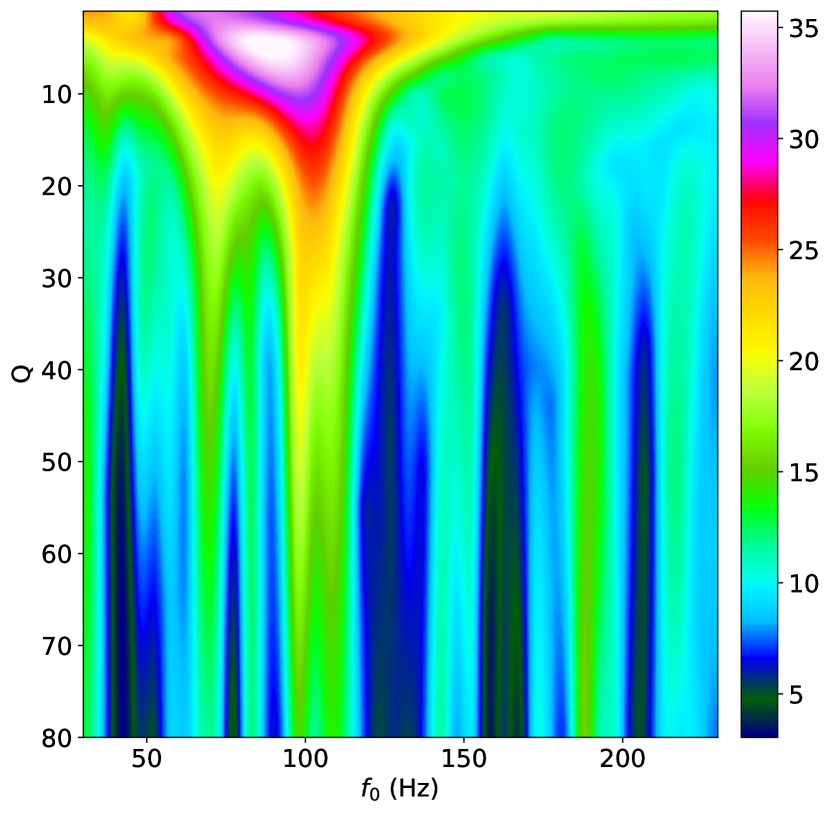
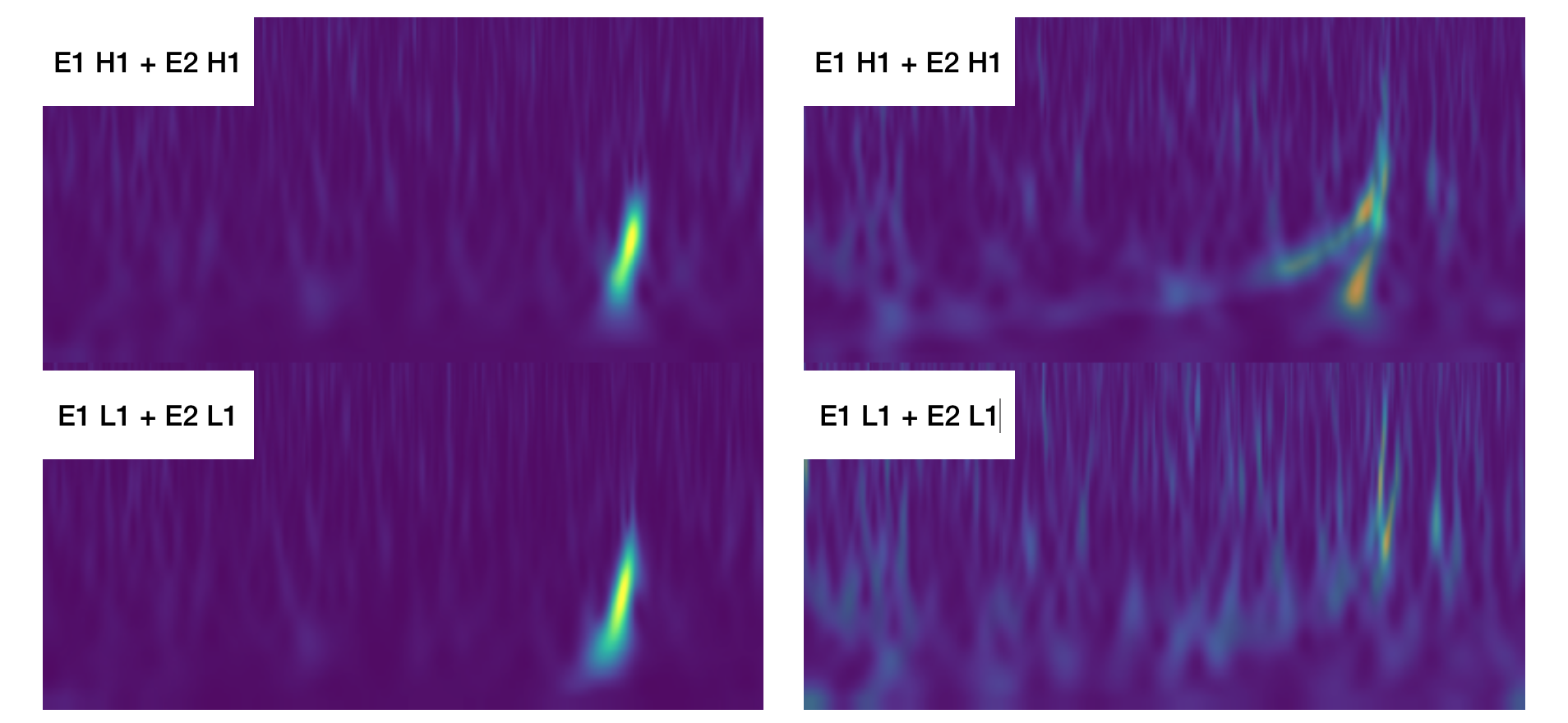
- The inclusion of SGP maps reduces false positives compared to QT maps alone, as shown in visual and statistical analysis of signal superposition artifacts.
- The final best model, Model-QrSg, was selected based on superior performance across both synthetic and real data, demonstrating robustness and generalization.
- Sky localization constraints are expected to further improve performance and are recommended as a post-processing filter, though not required for model integration.
Read this paper
Open the full text in the Nubint reader and ask about any passage as you read.
Read this paper on NubintThis review was generated by AI from the original paper. Please check the paper before citing it.