
[Paper Review] Spectroscopy of hadrons with heavy quarks from lattice QCD
This paper reviews lattice QCD calculations of hadrons containing heavy quarks, focusing on spectroscopy and structure of conventional and exotic states such as charmonium, tetraquarks, pentaquarks, and hybrids. Using Lüscher's formalism and finite-volume methods, it identifies bound states and resonances near thresholds, including the $T_{cc}$ tetraquark and $X(3960)$, and confirms strong diquark-antidiquark dominance in $bb\bar{u}\bar{d}$ states.
Lattice QCD results on hadrons with heavy quarks are briefly reviewed. The focus is on the spectrum of conventional and exotic hadrons. Structure of certain conventional hadrons is addressed as well.
Motivation & Objective
- To understand the spectroscopic properties of hadrons with heavy quarks using lattice QCD.
- To determine the existence and properties of exotic hadrons such as tetraquarks, pentaquarks, and hybrid mesons.
- To investigate the structure of hadrons, particularly the dominance of diquark-antidiquark components in tetraquarks.
- To address the challenge of multi-channel decays and resonance extraction in finite-volume QCD.
- To explore the feasibility of simulating real-time evolution of hadronic systems using quantum computers in the future.
Proposed method
- Extracting hadron masses from two-point correlation functions $\langle O_i(t_E)O_j^\dagger(0) \rangle$ in Euclidean time.
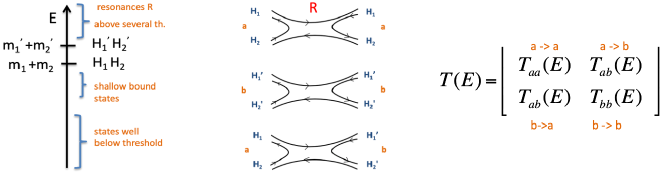
- Applying Lüscher's formalism to relate finite-volume energy levels to infinite-volume scattering amplitudes $T(E)$.
- Using coupled-channel scattering analysis to identify poles corresponding to resonances or bound states in multi-channel systems.
- Employing the Born-Oppenheimer approximation with static heavy quarks to compute potentials for $\bar{b}b$ and $\bar{b}Gb$ systems.
- Performing lattice simulations at multiple pion masses to study the stability of bound states under chiral extrapolation.
- Analyzing pole positions in the complex energy plane to extract masses and widths of resonances.

Experimental results
Research questions
- RQ1What is the spectroscopy of charmonium-like states with $I=0$ in the $\bar{D}D - \bar{D}_sD_s$ coupled channels?
- RQ2Does the $T_{cc}$ tetraquark state appear as a bound state in $DD^*$ scattering, and how does its binding depend on $m_\pi$?
- RQ3What is the dominant Fock component in the $bb\bar{u}\bar{d}$ tetraquark, and is it stabilized by diquark-antidiquark structure?
- RQ4How do the $Z_b$ resonances arise from the $B\bar{B}^*$ potential, and what role does attraction at short distances play?
- RQ5Can lattice QCD resolve the structure of exotic hadrons like $X(3960)$ and $P_c$ pentaquarks through scattering pole analysis?
Key findings
- The $T_{cc}$ tetraquark is found to be a bound state $0.4$ MeV below the $DD^*$ threshold in experiment, with lattice simulations showing significant attraction in $DD^*$ scattering.
- At higher $m_\pi \approx 280$ MeV, the $T_{cc}$-like state transitions from a bound state to a virtual bound state, indicating sensitivity to quark mass.
- The $bb\bar{u}\bar{d}$ tetraquark with $J^P = 1^+$ is predicted to be deeply bound and dominated by the $[bb]_{\bar{3}_c}^{S=1}[\bar{u}\bar{d}]_{3_c}^{S=0}$ diquark-antidiquark configuration.
- A candidate $P_c$ pentaquark state with $J^P = 1/2^-$ is found $6 \pm 3$ MeV below the $\bar{D}\Sigma_c$ threshold, indicating a bound state in one-channel scattering.
- The $X(3960)$ state is predicted to be an exotic scalar with large coupling to $\bar{D}_sD_s$ and small coupling to $\bar{D}D$, consistent with its $\bar{c}s\bar{s}c$ content.
- The $Z_b$ resonance is likely stabilized by an attractive $B\bar{B}^*$ potential at short distances, as confirmed by lattice simulations of the static potential.
Read this paper
Open the full text in the Nubint reader and ask about any passage as you read.
Read this paper on NubintThis review was generated by AI from the original paper. Please check the paper before citing it.