
[Paper Review] Statistics for Galaxy Outflows at $z\sim 6-9$ with Imaging and Spectroscopic Signatures Identified with JWST/NIRCam and NIRSpec Data
This study analyzes ionized gas outflows in 61 high-redshift galaxies (z≈6–9) using JWST/NIRCam and NIRSpec data, identifying five galaxies with spatially extended [O iii] emission and five with broad [O iii] lines, suggesting widespread outflows driven by stellar feedback. The higher fraction of extended gas compared to low-redshift galaxies points to frequent major mergers triggering prolonged outflow cycles in early galaxies.
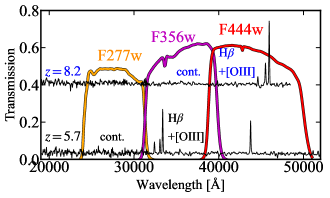
We present statistics of $z\sim 6-9$ galaxy outflows indicated by spatially-extended gas emission and broad lines. With a total of 61 spectroscopically confirmed galaxies at $z\sim 6-9$ in the JWST CEERS, GLASS, and ERO data, we find four galaxies with [O{\sc iii}]+H$β$ ionized gas emission significantly extended beyond the kpc-scale stellar components on the basis of the emission line images constructed by the subtraction of NIRCam broadband (line on/off-band) images. By comparison with low-$z$ galaxies, the fraction of galaxies with the spatially extended gas, 4/18, at $z\sim 6-9$ is an order of magnitude higher than those at $z\sim 0-1$, which can be explained by events triggered by frequent major mergers at high redshift. We also investigate medium- and high-resolution NIRSpec spectra of 30 galaxies at $z\sim 6-9$, and identify five galaxies with broad ($140-800$ km s$^{-1}$) lines in the [O{\sc iii}] forbidden line emission, suggestive of galaxy outflows. One galaxy at $z=6.38$ shows both the spatially-extended gas emission and the broad lines, while none of the galaxies with the spatially-extended gas emission or broad lines present a clear signature of AGN either in the line diagnostics or Type 1 AGN line broadening ($>1000$ km s$^{-1}$), which hint outflows mainly driven by stellar feedback. The existence of galaxies with/without spatially-extended gas emission or broad lines may be explained by different viewing angles towards outflows, or that these are galaxies in the early, late, post phases of galaxy outflows at high redshift, where the relatively large fractions of such galaxies indicate the longer-duration and/or more-frequent outflows at the early cosmic epoch.
Motivation & Objective
- To investigate the prevalence and physical origins of ionized gas outflows in high-redshift galaxies at z≈6–9.
- To determine whether spatially extended [O iii] emission and broad emission lines—signatures of outflows—occur more frequently at high redshift than in the local universe.
- To distinguish between feedback mechanisms (stellar vs. AGN) driving outflows by analyzing line profiles and diagnostics.
- To explore the evolutionary phases of outflows (early, late, post-outflow) through the coexistence or absence of spatial extension and broad lines.
- To quantify the fraction of galaxies exhibiting extended ionized gas and ongoing outflows to assess their role in early galaxy evolution.
Proposed method
- Constructed [O iii] emission line images by subtracting NIRCam broadband (on/off-band) stellar continuum components from multi-band imaging data.
- Identified spatially extended [O iii] emission by comparing emission morphology to kpc-scale stellar components in 61 spectroscopically confirmed galaxies.
- Analyzed medium- and high-resolution NIRSpec spectra of 30 galaxies to detect broad [O iii] emission lines (FWHM = 140–800 km s⁻¹), indicative of outflows.
- Fitted emission lines with double-Gaussian components to isolate broad components associated with outflows.
- Assessed outflow ejection efficiency via the ratio of maximum outflow velocity to escape velocity (v_max/v_esc < 1), indicating gas retention in halos.
- Excluded AGN contributions using line diagnostics (e.g., BPT ratios) and absence of Type 1 AGN line broadening (>1000 km s⁻¹).
Experimental results
Research questions
- RQ1What is the fraction of z≈6–9 galaxies exhibiting spatially extended [O iii] emission beyond their stellar components?
- RQ2How frequently do galaxies at z≈6–9 show broad [O iii] emission lines indicative of ionized gas outflows?
- RQ3Are the observed outflows primarily driven by stellar feedback or AGN activity, based on spectral and morphological diagnostics?
- RQ4What is the relationship between spatially extended gas and broad emission lines in the context of outflow evolution phases?
- RQ5How do the observed outflow statistics compare to low-redshift galaxies, and what does this imply about the role of major mergers in triggering outflows?
Key findings
- Five out of 61 galaxies (8.2%) at z≈6–9 show spatially extended [O iii] emission beyond their kpc-scale stellar components, a fraction an order of magnitude higher than at z≈0–1.
- Five galaxies exhibit broad [O iii] emission lines (140–800 km s⁻¹), indicating ongoing ionized gas outflows, with one galaxy (ERO_05144) showing both extended emission and broad lines.
- All five outflow-identified galaxies have v_max/v_esc < 1, indicating that the ionized gas is unlikely to escape the dark matter halos, suggesting gas retention in the CGM.
- No galaxies with extended emission or broad lines show clear AGN signatures in line diagnostics or Type 1 AGN line broadening, supporting stellar feedback as the dominant driver.
- The coexistence of galaxies with extended emission but no broad lines, and vice versa, suggests a cyclic outflow model involving early, late, and post-outflow phases.
- The higher fraction of extended gas at high redshift compared to low redshift is likely due to frequent major mergers in early cosmic epochs, which may prolong post-outflow phases or enhance outflow efficiency.
Read this paper
Open the full text in the Nubint reader and ask about any passage as you read.
Read this paper on NubintThis review was generated by AI from the original paper. Please check the paper before citing it.