
[Paper Review] Structure, Stability and Superconductivity of N-doped Lutetium Hydrides at kbar Pressures
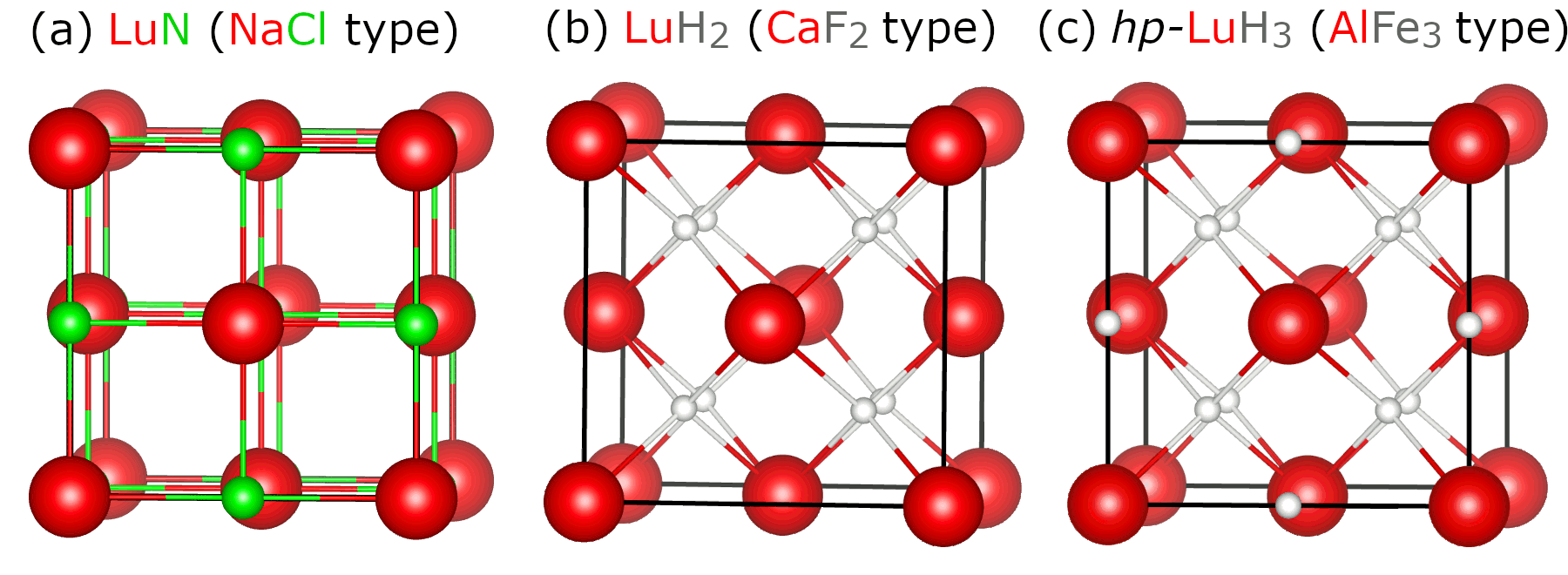
This study uses density functional theory (DFT) to investigate N-doped lutetium hydrides under kbar pressures, focusing on structures with face-centered cubic (fcc) lutetium lattices as potential candidates for the reported near-ambient superconductivity (Tc ≈ 294 K at 10 kbar). Although no phase reaches room-temperature superconductivity, fluorite-type LuH2 shows the closest match to experimental equation of state and exhibits a predicted Tc of 0.09 K, while the highest Tc among studied phases is 17 K for fluorite LuNH.
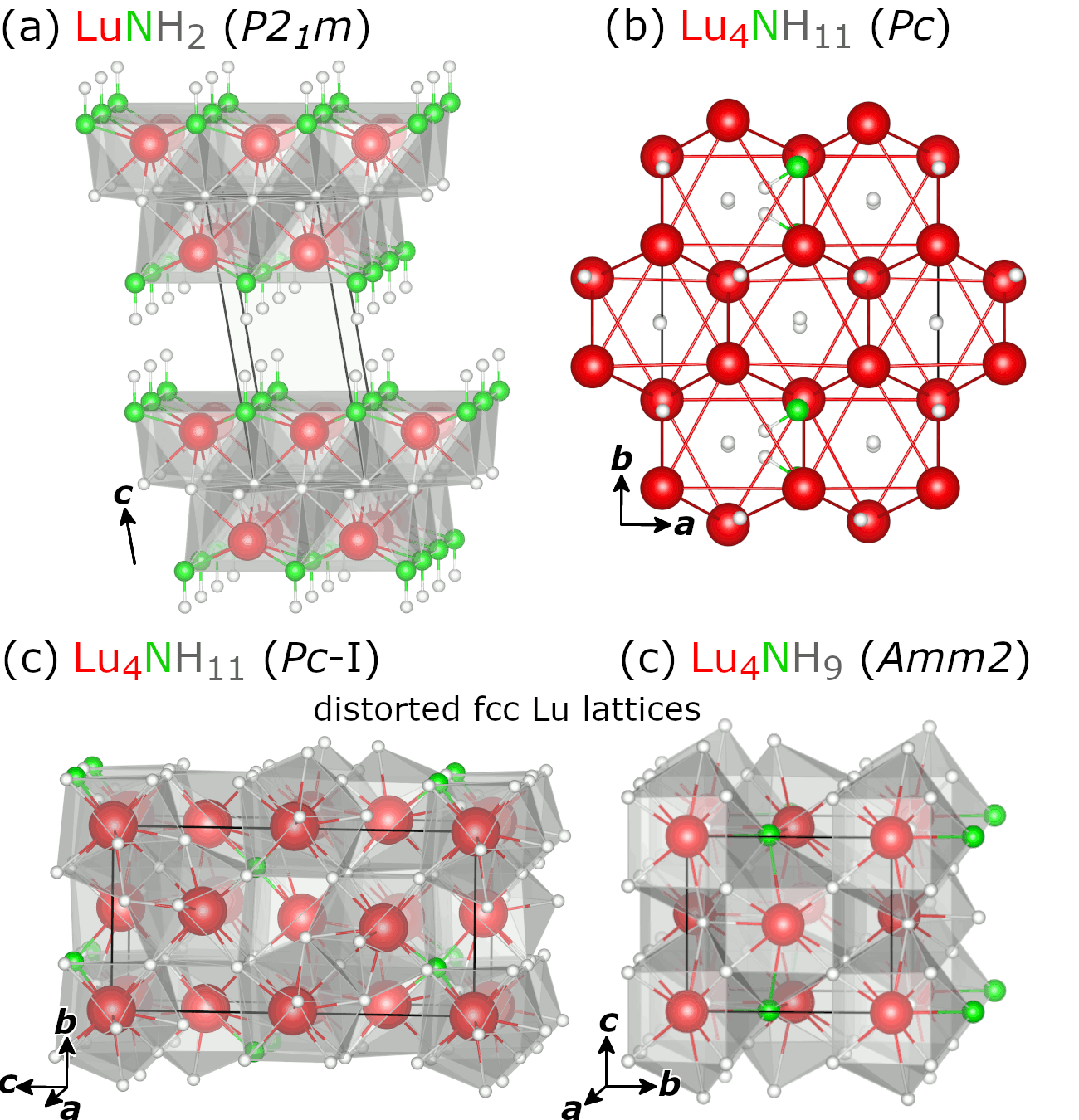
The structure of the material responsible for the room temperature and near ambient pressure superconductivity reported in an N-doped lutetium hydride [Nature, 615, 244 (2023)] has not been conclusively determined. Herein, density functional theory calculations are performed in an attempt to uncover what it might be. Guided by a range of strategies including crystal structure prediction and modifications of existing structure types, we present an array of Lu-N-H phases that are dynamically stable at experimentally relevant pressures. Although none of the structures found are thermodynamically stable, and none are expected to remain superconducting above 17 K at 10 kbar, a number of metallic compounds with fcc Lu lattices -- as suggested by the experimental X-ray diffraction measurements of the majority phase -- are identified. The system whose calculated equation of states matches best with that measured for the majority phase is fluorite-type LuH2, whose 10 kbar superconducting critical temperature was estimated to be 0.09 K using the Allen-Dynes modified McMillan equation.
Motivation & Objective
- To identify metastable Lu-N-H phases with fcc lutetium lattices that could explain the reported 294 K superconductivity in N-doped lutetium hydrides at 10 kbar.
- To assess the structural stability, electronic properties, and superconducting critical temperatures (Tc) of candidate phases under kbar pressures.
- To determine which phase best matches the experimental equation of state (EoS) and X-ray diffraction data from the majority phase in the experiment.
- To evaluate the role of electron-phonon coupling and phonon frequencies in determining Tc for these compounds.
- To explore the limitations of standard DFT in predicting high-Tc superconductivity in complex hydride systems under moderate pressure.
Proposed method
- Employed density functional theory (DFT) with the PBE exchange-correlation functional to calculate electronic and structural properties of Lu-N-H phases.
- Used crystal structure prediction and structural modification strategies to explore diverse stoichiometries and prototype structures.
- Applied the Allen-Dynes modified McMillan equation to estimate superconducting critical temperatures (Tc) using calculated phonon frequencies and electron-phonon coupling constants.
- Calculated equations of state (EoS) for candidate phases and compared them to experimental EoS fits for the majority phase.
- Evaluated X-ray diffraction (XRD) similarity indices between candidate structures and the experimental fcc Lu lattice.
- Assessed electronic structure via density of states (DOS) at the Fermi level and analyzed orbital contributions to the DOS.
Experimental results
Research questions
- RQ1Which Lu-N-H phases with fcc lutetium lattices are dynamically stable at kbar pressures and consistent with experimental XRD data?
- RQ2Which phase exhibits the closest agreement with the experimental equation of state (EoS) for the majority phase in the N-doped Lu hydride?
- RQ3What are the predicted superconducting critical temperatures (Tc) for the identified fcc Lu-based phases under 10 kbar pressure?
- RQ4How do electron-phonon coupling and phonon frequencies influence the Tc estimates in these compounds?
- RQ5Why do none of the studied phases achieve the reported 294 K Tc despite structural and electronic similarities to the experimental phase?
Key findings
- The fluorite-type LuH2 phase exhibits the closest match to the experimental equation of state, with deviations below 0.3% up to 80 kbar.
- None of the investigated Lu-N-H compounds are thermodynamically stable (i.e., not on the convex hull) up to 10 GPa at 0 K, with only binaries like LuH2, LuH3, LuN, and NH3 forming the convex hull.
- The highest predicted Tc among the studied phases is 17 K for fluorite-type LuNH, while LuH2 predicts only 0.09 K using the Allen-Dynes modified McMillan equation.
- XRD similarity indices indicate fair agreement between the experimental fcc Lu lattice and several candidates, including LuH2, LuH3, ZnS-type LuH, $Fd\bar{3}m$ Lu4NH7, and $R3m$ Lu4NH4.
- Metallic behavior is observed in many phases, with significant variation in DOS at the Fermi level: LuH2 shows very low DOS at EF, primarily from Lu p-states.
- The logarithmic average phonon frequency (ωln) ranges from ~150 to 680 K, and electron-phonon coupling constants (λ) range from 0.1 to 0.8, indicating moderate to strong coupling in some phases.
Read this paper
Open the full text in the Nubint reader and ask about any passage as you read.
Read this paper on NubintThis review was generated by AI from the original paper. Please check the paper before citing it.