
[Paper Review] Symmetry constraints on superconductivity in twisted bilayer graphene: Fractional vortices, $4e$ condensates or non-unitary pairing
This paper derives symmetry-enforced constraints on superconductivity in twisted bilayer graphene (TBG), showing that in the absence of flavor polarization, any superconducting state must be either non-unitary pairing, a charge $4e$ superconductor, or a unitary $2e$ superconductor hosting fractional vortices with $h/4e$ flux. These exotic states arise from the $\mathrm{SU}(4)$ flavor symmetry of TBG and are robust regardless of the pairing mechanism.
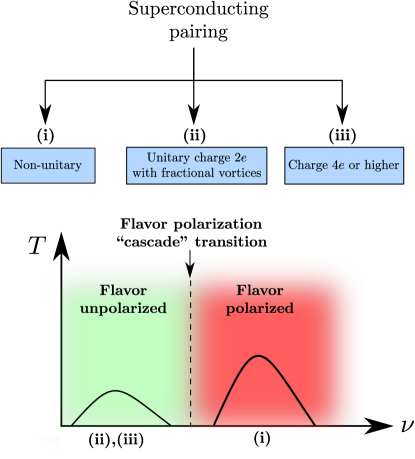
When two graphene sheets are twisted relative to each other by a small angle, enhanced correlations lead to superconductivity whose origin remains under debate. Here, we derive some general constraints on superconductivity in twisted bilayer graphene (TBG), independent of its underlying mechanism. Neglecting weak coupling between valleys, the global symmetry group of TBG consists of independent spin rotations in each valley in addition to valley charge rotations, $ { m SU}(2) imes { m SU}(2) imes { m U}_V(1) $. This symmetry is further enhanced to a full ${ m SU}(4)$ in the idealized chiral limit. In both cases, we show that any charge $2e$ pairing must break the global symmetry. Additionally, if the pairing is unitary the resulting superconductor admits fractional vortices. This leads to the following general statement: Any superconducting condensate in either symmetry class has to satisfy one of three possibilities: (i) the superconducting pairing is non-unitary, (ii) the superconducting condensate has charge $2e$ but admits at least half quantum vortices which carry a flux of $h/4e$, or (iii) the superconducting condensate has charge $2me$, $m>1$, with vortices carrying $h/2me$ flux. The latter possibility can be realized by a symmetric charge $4e$ superconductor ($m=2$). Non-unitary pairing (i) is expected in TBG for superconductors observed in the vicinity of flavor polarized states. On the other hand, in the absence of flavor polarization, e.g. in the vicinity of charge neutrality, one of the two exotic possibilities (ii) and (iii) is expected. We sketch how all three scenarios can be realized in different limits within a strong coupling theory of superconductivity based on skyrmions. Finally we discuss the effect of symmetry lowering anisotropies and experimental implications of these scenarios.
Motivation & Objective
- To identify universal symmetry constraints on superconductivity in twisted bilayer graphene (TBG), independent of the microscopic pairing mechanism.
- To determine the implications of the $\mathrm{SU}(4)$ flavor symmetry (or its subgroups) on the nature of the superconducting order parameter.
- To classify possible superconducting states in TBG based on symmetry, particularly in regions without flavor polarization.
- To connect these symmetry-protected states to experimentally observable signatures such as fractional vortices and modified Fraunhofer patterns.
- To explore the role of Hund's coupling and symmetry-lowering perturbations in stabilizing or modifying these exotic superconducting phases.
Proposed method
- Derive the global symmetry group of TBG as $\mathrm{SU}(2)_S \times \mathrm{U}_V(1)$ (low-energy) or $\mathrm{SU}(4)$ (chiral limit), treating spin and valley degrees of freedom as flavor indices.
- Analyze the transformation properties of the pairing matrix under the full flavor symmetry group to determine which pairing states preserve or break the symmetry.
- Use group theory to show that any unitary $2e$ pairing must break the global symmetry, leading to fractional vortices with $h/4e$ flux.
- Establish that the only allowed $2e$ superconducting states are either non-unitary or admit fractional vortices, otherwise higher charge condensates ($2me$, $m>1$) are required.
- Construct a strong-coupling theory based on skyrmions to realize all three scenarios: non-unitary pairing, $4e$ superconductivity, and fractional vortices.
- Analyze the experimental signatures, including modified periodicity in Fraunhofer patterns and detectable $h/4e$ flux jumps in mesoscopic annular Josephson junctions.
Experimental results
Research questions
- RQ1What are the universal symmetry constraints on superconducting order parameters in twisted bilayer graphene, independent of the pairing mechanism?
- RQ2Why must any unitary $2e$ superconductor in TBG necessarily host fractional vortices with $h/4e$ flux?
- RQ3Under what conditions can a $4e$ superconducting condensate emerge as a symmetry-allowed state in TBG?
- RQ4How do symmetry-lowering effects like Hund's coupling influence the stability of fractional vortices and non-unitary pairing?
- RQ5What are the measurable experimental signatures of these exotic superconducting states, particularly in Josephson junctions and mesoscopic rings?
Key findings
- Any unitary $2e$ superconductor in TBG must break the global $\mathrm{SU}(4)$ flavor symmetry, leading to the emergence of fractional vortices with $h/4e$ flux.
- In the absence of flavor polarization, superconductivity in TBG must be either non-unitary, a charge $4e$ condensate, or a unitary $2e$ superconductor with fractional vortices.
- The $4e$ superconducting state is symmetry-allowed and can be realized in the strong-coupling skyrmion-based theory, with vortices carrying $h/8e$ flux.
- Fractional vortices in $2e$ superconductors can be probed via modified Fraunhofer patterns with periodicity $2\pi/m$ for $m=2$, observable in mesoscopic junctions.
- In mesoscopic annular geometries, $h/4e$ flux jumps can directly signal the presence of half-quantum vortices, avoiding the logarithmic energy divergence of large systems.
- A temperature window exists where Hund's coupling has melted (favoring singlet pairing) but the $4e$ condensate remains stable, allowing observation of fractional vortices.
Read this paper
Open the full text in the Nubint reader and ask about any passage as you read.
Read this paper on NubintThis review was generated by AI from the original paper. Please check the paper before citing it.