
[Paper Review] Systematic Literature Review of Commercial Participation in Open Source Software
This systematic literature review synthesizes 92 studies on commercial participation in open source software (OSS), identifying three core dimensions: motivations (economic, technical, social), contribution models, and impacts on OSS development. It reveals that corporate involvement is driven by strategic benefits, shapes community dynamics, and significantly influences project sustainability and innovation.
Open source software (OSS) has been playing a fundamental role in not only information technology but also our social lives. Attracted by various advantages of OSS, increasing commercial companies take extensive participation in open source development and have had a broad impact. This paper provides a comprehensive systematic literature review (SLR) of existing research on company participation in OSS. We collected 92 papers and organized them based on their research topics, which cover three main directions, i.e., participation motivation, contribution model, and impact on OSS development. We found the explored motivations of companies are mainly from economic, technological, and social aspects. Existing studies categorize companies' contribution models in OSS projects mainly through their objectives and how they shape OSS communities. Researchers also explored how commercial participation affects OSS development. We conclude with research challenges and promising research directions on commercial participation in OSS. This study contributes to a comprehensive understanding of commercial participation in OSS development.
Motivation & Objective
- To address the lack of a comprehensive, up-to-date synthesis of research on commercial participation in open source software (OSS).
- To identify and categorize the motivations driving companies to contribute to OSS projects.
- To examine how companies model their participation in OSS communities and the resulting community dynamics.
- To assess the impacts of commercial participation on OSS development, sustainability, and community health.
- To provide a structured, evidence-based reference for researchers, practitioners, and OSS communities.
Proposed method
- Conducted a systematic literature review (SLR) using ACM Digital Library, IEEE Xplore, Scopus, and Google Scholar with snowball sampling.
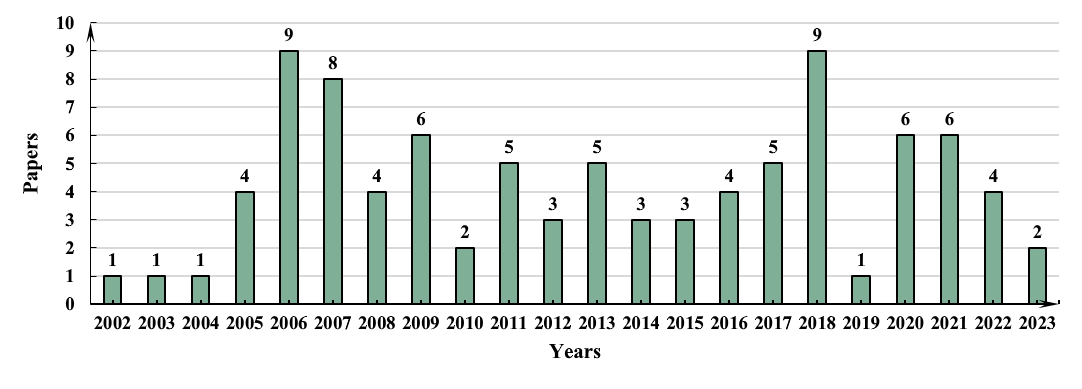
- Applied inclusion/exclusion criteria to filter 92 relevant papers published between 2002 and 2023 across 51 venues.
- Classified papers based on research topics into three thematic dimensions: motivations, contribution models, and impacts on OSS development.
- Performed qualitative synthesis and thematic analysis of full-text papers to extract and organize findings on company motivations, participation models, and effects.
- Used visualization techniques to present publication trends, venue distribution, and methodological approaches.
- Developed detailed review protocols to minimize subjectivity and ensure reproducibility in paper selection and data extraction.

Experimental results
Research questions
- RQ1What are the primary motivations driving companies to participate in open source software projects?
- RQ2How do companies model their participation in OSS communities, and what factors shape these models?
- RQ3What are the measurable impacts of commercial participation on OSS development, community dynamics, and project sustainability?
Key findings
- Companies are primarily motivated to participate in OSS by economic benefits such as cost reduction, market access, and innovation leverage.
- Technological motivations include improving software quality, accelerating development cycles, and gaining access to skilled developers and cutting-edge technologies.
- Social motivations involve enhancing corporate reputation, building developer ecosystems, and contributing to industry standards.
- Contribution models are largely shaped by companies’ strategic goals, with some focusing on feature development, others on infrastructure or security contributions.
- Commercial participation significantly increases code volume—e.g., over 90% of OpenStack’s codebase is contributed by companies—demonstrating their dominant role in major projects.
- While commercial involvement accelerates project development, it also introduces risks to community autonomy and long-term sustainability if companies withdraw or dominate project direction.
Read this paper
Open the full text in the Nubint reader and ask about any passage as you read.
Read this paper on NubintThis review was generated by AI from the original paper. Please check the paper before citing it.