
[Paper Review] The effect of ambiguity in strategic environments: an experiment
This experimental study examines how ambiguity affects contributions in a threshold public goods game using a representative sample of 1,500 Spaniards. Contrary to theoretical predictions of increased contributions under ambiguity due to max-min preferences, the authors find no significant effect of ambiguity on average contributions, suggesting that ambiguity aversion does not substantially alter behavior in strategic, uncertain environments like climate change mitigation.
We experimentally study a game in which success requires a sufficient total contribution by members of a group. There are significant uncertainties surrounding the chance and the total effort required for success. A theoretical model with max-min preferences towards ambiguity predicts higher contributions under ambiguity than under risk. However, in a large representative sample of the Spanish population (1,500 participants) we find that the ATE of ambiguity on contributions is zero. The main significant interaction with the personal characteristics of the participants is with risk attitudes, and it increases contributions. This suggests that policymakers concerned with ambiguous problems (like climate change) do not need to worry excessively about ambiguity.
Motivation & Objective
- To investigate how ambiguity in environmental outcomes affects voluntary contributions in strategic, group-based decision-making settings.
- To test whether ambiguity aversion—predicted by max-min preferences—leads to higher contributions compared to risk conditions.
- To examine the role of individual characteristics such as risk attitudes, altruism, and cognitive ability in shaping responses to ambiguity.
- To assess whether strategic uncertainty and social preferences obscure the impact of ambiguity in real-world policy-relevant contexts.
- To provide empirical evidence on how people respond to uncertainty in collective action problems like climate change, using a large, representative population sample.
Proposed method
- Conducted a laboratory experiment with 1,500 participants from a representative sample of the Spanish population, stratified by gender, age, and education.
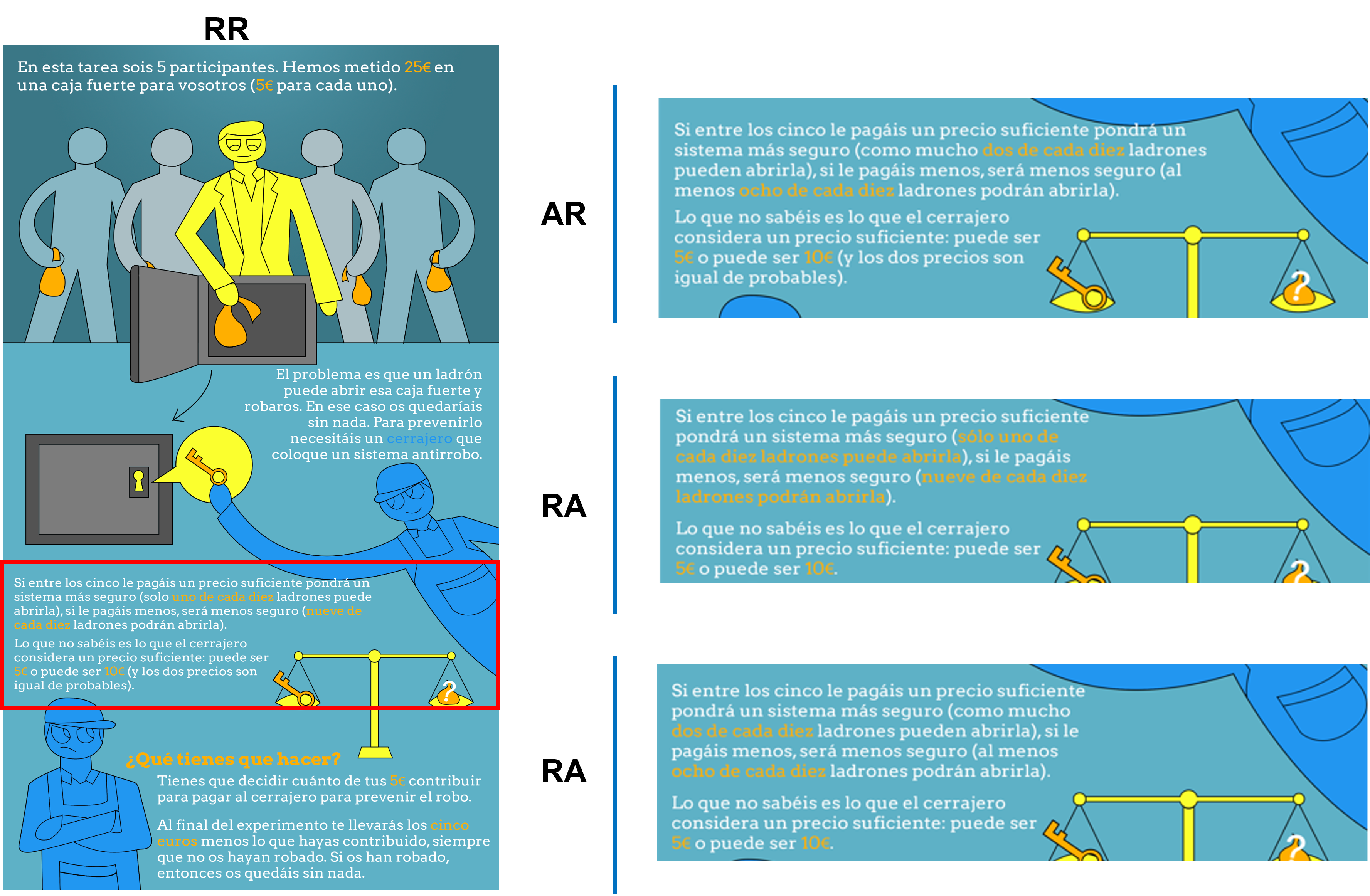
- Used a threshold public goods game where group success required a minimum total contribution to avoid a total loss of funds.
- Varied experimental treatments to compare conditions of risk (known probabilities) versus ambiguity (unknown probabilities) regarding the likelihood of loss.
- Elicited participants' beliefs about others' contributions and measured perception accuracy to assess strategic uncertainty.
- Collected data on individual characteristics including risk aversion, ambiguity aversion, altruism, cognitive reflection (CRT), and socioeconomic status.
- Analyzed contributions using regression models with fixed effects and robust standard errors, testing interactions between ambiguity, risk attitudes, and personal traits.
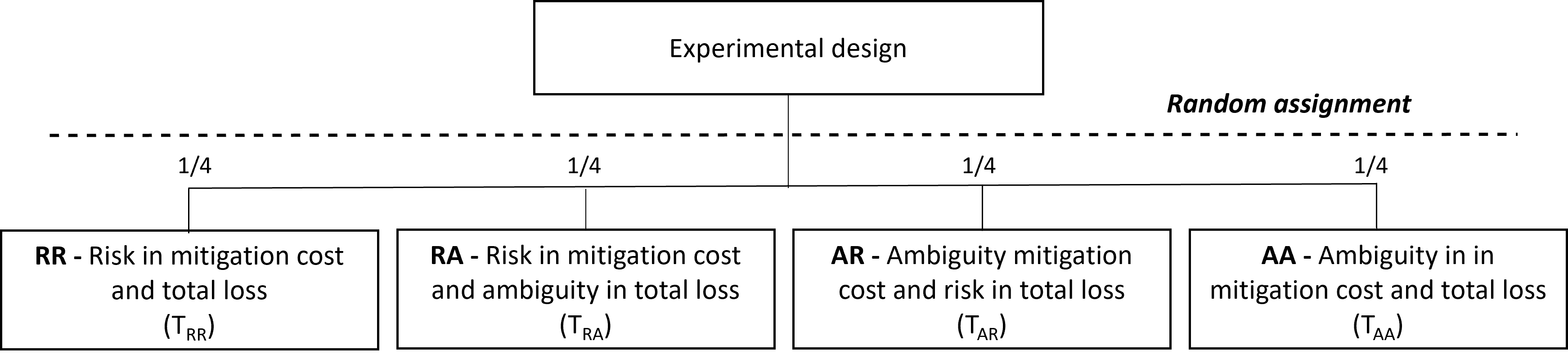
Experimental results
Research questions
- RQ1Does ambiguity in environmental outcomes lead to higher contributions in a threshold public goods game compared to risk?
- RQ2How do individual differences in risk and ambiguity attitudes affect contributions under uncertainty?
- RQ3To what extent does strategic uncertainty—uncertainty about others’ actions—moderate the effect of environmental ambiguity?
- RQ4Does altruism or social preferences mask the impact of ambiguity on contributions?
- RQ5What are the policy implications of ambiguity effects in collective action problems such as climate change mitigation?
Key findings
- The average treatment effect (ATE) of ambiguity on contributions is zero, indicating no significant difference in contributions between ambiguous and risky conditions.
- Risk aversion significantly reduces contributions, with a coefficient of -1.001*** (p < 0.05), suggesting risk-averse individuals contribute less.
- The interaction between risk aversion and ambiguity is negative and significant, implying risk-averse individuals are less responsive to ambiguity.
- Contributions averaged 2.72 per participant, exceeding the symmetric high-equilibrium contribution level of 2.00, suggesting strong cooperative tendencies.
- There is no evidence that max-min preferences drive higher contributions under ambiguity; instead, preferences appear intermediate between pessimism and optimism.
- The lack of ambiguity effect persists even when controlling for beliefs about others’ contributions, perception accuracy, and pivotality, indicating robustness to strategic uncertainty.
Read this paper
Open the full text in the Nubint reader and ask about any passage as you read.
Read this paper on NubintThis review was generated by AI from the original paper. Please check the paper before citing it.