
[Paper Review] The Landscape of Emerging AI Agent Architectures for Reasoning, Planning, and Tool Calling: A Survey
This survey surveys recent AI agent architectures (single and multi-agent) focusing on reasoning, planning, and tool calling, and discusses design choices, patterns, and future directions.
This survey paper examines the recent advancements in AI agent implementations, with a focus on their ability to achieve complex goals that require enhanced reasoning, planning, and tool execution capabilities. The primary objectives of this work are to a) communicate the current capabilities and limitations of existing AI agent implementations, b) share insights gained from our observations of these systems in action, and c) suggest important considerations for future developments in AI agent design. We achieve this by providing overviews of single-agent and multi-agent architectures, identifying key patterns and divergences in design choices, and evaluating their overall impact on accomplishing a provided goal. Our contribution outlines key themes when selecting an agentic architecture, the impact of leadership on agent systems, agent communication styles, and key phases for planning, execution, and reflection that enable robust AI agent systems.
Motivation & Objective
- Explain current capabilities and limitations of AI agent implementations.
- Summarize single-agent and multi-agent architectures and their design patterns.
- Identify key themes for selecting agent architectures and the role of leadership and communication.
- Provide insights and considerations for future AI agent design and evaluation.
Proposed method
- Review and synthesize existing single-agent methods (e.g., ReAct, RAISE, Reflexion, AutoGPT+P, LATS).
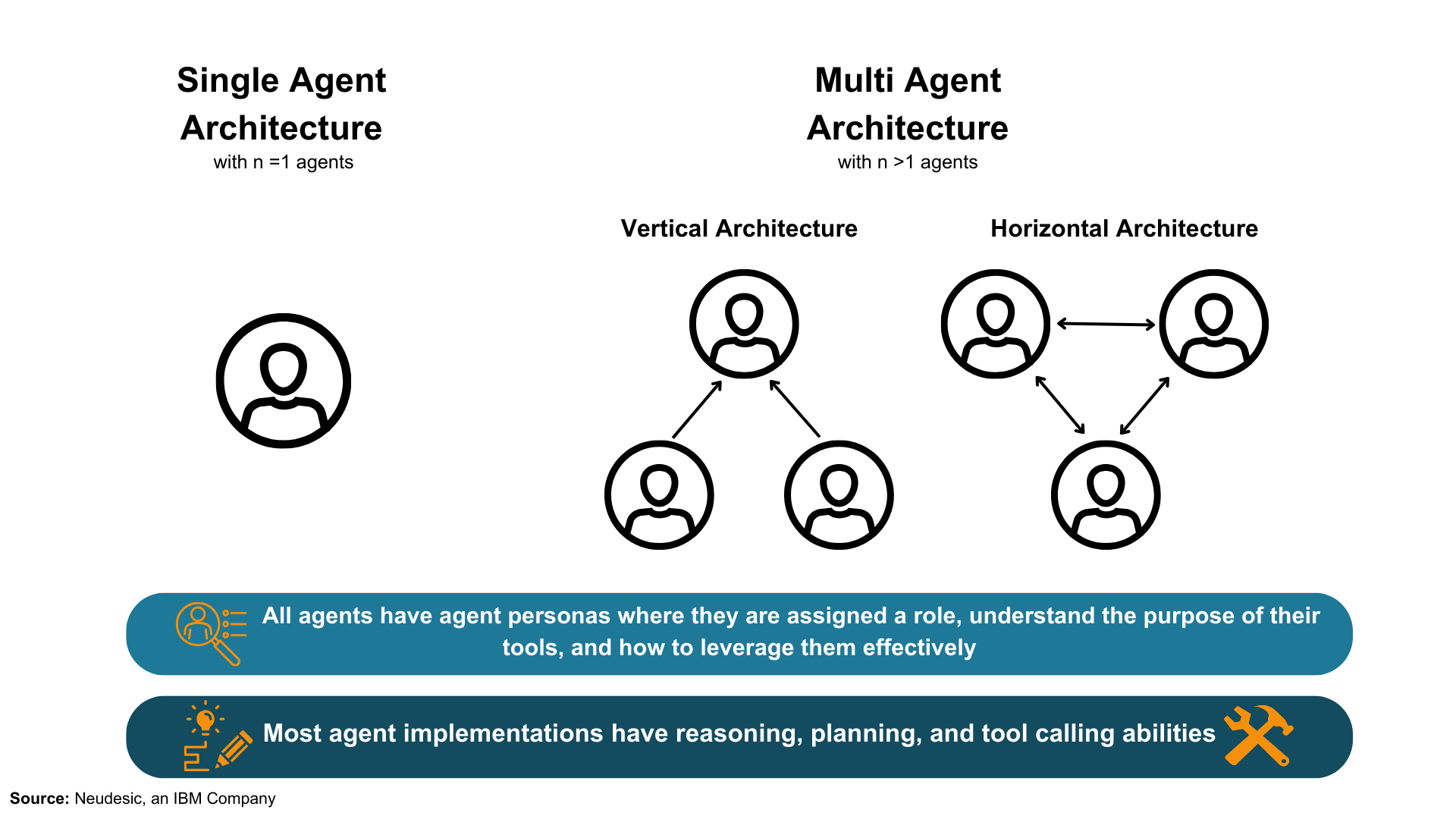
- Classify agent architectures into single-agent and multi-agent, with vertical and horizontal categorizations.
- Analyze planning, reasoning, and tool-calling requirements as core agent capabilities.
- Evaluate how leadership, memory, and dynamic team structures impact performance.
- Discuss benchmarks, evaluation challenges, and real-world applicability of agent systems.
Experimental results
Research questions
- RQ1What are the main architectural patterns (single vs. multi-agent) for AI agents in reasoning, planning, and tool calling?
- RQ2How do leadership structures, communication styles, and planning phases affect agent performance?
- RQ3What are the major challenges in evaluating and deploying AI agents in real-world tasks?
Key findings
- Single-agent patterns suit well-defined tasks with limited tools and opportunities for human feedback.
- Multi-agent patterns excel when parallelism, diverse personas, or collaborative work are beneficial.
- Leaders and dynamic, rotating teams improve task completion speed and reduce communication overhead (e.g., teams with a leader completed tasks faster by about 10%).
- Structured communication (publish–subscribe, information filtering) and defined roles reduce chatter and improve coordination in multi-agent systems.
- Planning phases, feedback loops, and memory/reflection are critical for robust goal achievement across architectures.

Read this paper
Open the full text in the Nubint reader and ask about any passage as you read.
Read this paper on NubintThis review was generated by AI from the original paper. Please check the paper before citing it.