
[Paper Review] AutoGen: Enabling Next-Gen LLM Applications via Multi-Agent Conversation
AutoGen presents a generic, open-source framework for building LLM applications through customizable, conversable agents that cooperate via multi-agent conversations, enabling various patterns and tool/human integrations.
AutoGen is an open-source framework that allows developers to build LLM applications via multiple agents that can converse with each other to accomplish tasks. AutoGen agents are customizable, conversable, and can operate in various modes that employ combinations of LLMs, human inputs, and tools. Using AutoGen, developers can also flexibly define agent interaction behaviors. Both natural language and computer code can be used to program flexible conversation patterns for different applications. AutoGen serves as a generic infrastructure to build diverse applications of various complexities and LLM capacities. Empirical studies demonstrate the effectiveness of the framework in many example applications, with domains ranging from mathematics, coding, question answering, operations research, online decision-making, entertainment, etc.
Motivation & Objective
- Motivate and enable scalable development of LLM applications via multi-agent collaboration.
- Define conversable agents and a conversation-centric programming paradigm to simplify complex workflows.
- Provide built-in agents and flexible control patterns for diverse applications across domains.
- Demonstrate practical applications showing performance and development efficiency gains.
Proposed method
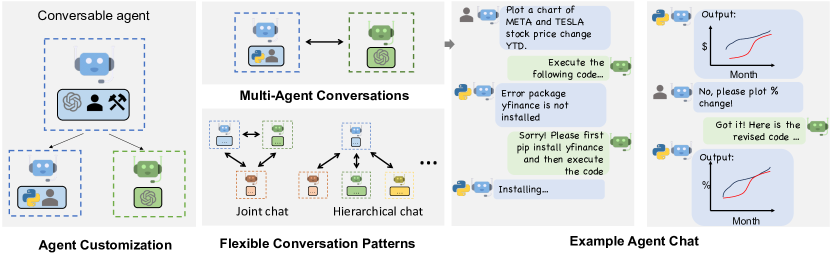
- Introduce conversable agents that can combine LLMs, humans, and tools for modular cooperation.
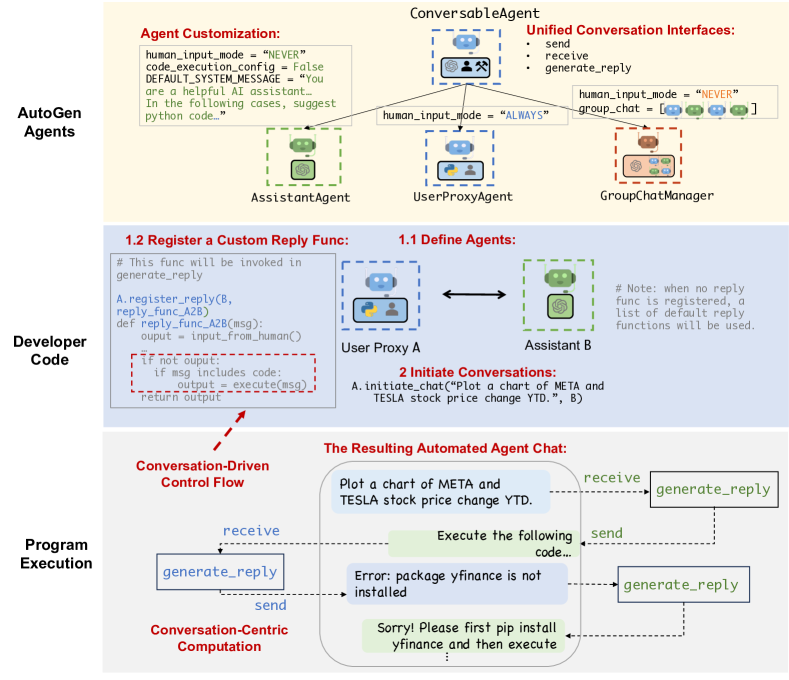
- Present conversation programming as a unified paradigm pairing computation with conversation-driven control flow.
- Describe unified agent interfaces with auto-reply mechanisms to enable autonomous multi-agent dialogue.
- Allow control to be expressed in both natural language prompts and Python code, with transitions between modes.
- Showcase a set of built-in agents and patterns, plus the GroupChatManager for dynamic group chats.
Experimental results
Research questions
- RQ1How can we design reusable, customizable agents that effectively collaborate in multi-agent LLM systems?
- RQ2How can a unified interface and programming paradigm support diverse agent conversation patterns?
- RQ3Can multi-agent conversation frameworks achieve superior performance and development efficiency across tasks like math solving, QA, code generation, and decision making?
Key findings
- AutoGen delivers competitive or superior performance on several tasks compared with baselines in math problem solving, QA, and coding scenarios.
- Dynamic, multi-agent conversation patterns reduce development effort and enable flexible human-in-the-loop and tool usage.
- Grounding and modular agent roles (e.g., grounding agents, safeguards) improve robustness in decision making and code generation tasks.
- The framework supports dynamic group chats and richer interaction patterns beyond static back-and-forth exchanges.
- Experiments show significant productivity gains, including reduced lines of code and faster development cycles.
Better researchstarts right now
From reading papers to final review, dramatically reduce your research time.
No credit card · Free plan available
This review was created by AI and reviewed by human editors.