
[論文レビュー] Thermometry by correlated dephasing of impurities in a 1D Fermi gas
本稿では、一次元超冷却フェルミガス内の2つの静的不純物キュービットの相関あるデコherenceを用いた新しい量子温度計測法を提案する。関数行列式アプローチを用いて多体系の力学を厳密に解くことで、浴に起因するRuderman–Kittel–Kasuya–Yosida(RKKY)型相互作用が不純物間に相関を誘発することを示し、独立したプローブよりも温度計測感度が向上することを明らかにした。特に低温および弱い結合領域で顕著であり、複雑な状態準備を要せず、標準的なラーマー干渉計測法によっても実現可能である。
We theoretically investigate the pure dephasing dynamics of two static impurity qubits embedded within a common environment of ultracold fermionic atoms, which are confined to one spatial dimension. Our goal is to understand how bath-mediated interactions between impurities affect their performance as nonequilibrium quantum thermometers. By solving the dynamics exactly using a functional determinant approach, we show that the impurities become correlated via retarded interactions of the Ruderman-Kittel-Kasuya-Yosida type. Moreover, we demonstrate that these correlations can provide a metrological advantage, enhancing the sensitivity of the two-qubit thermometer beyond that of two independent impurities. This enhancement is most prominent in the limit of low temperature and weak collisional coupling between the impurities and the gas. We show that this precision advantage can be exploited using standard Ramsey interferometry, with no need to prepare correlated initial states nor to individually manipulate or measure the impurities. We also quantitatively assess the impact of ignoring these correlations when constructing a temperature estimate, finding that acceptable precision can still be achieved from a simplified model of independent impurities. Our results demonstrate the rich nonequilibrium physics of impurities dephasing in a common Fermi gas, and may help to provide better temperature estimates at ultralow temperatures.
研究の動機と目的
- 1次元フェルミガスにおける2つの不純物キュービット間の浴に起因する相互作用が、非平衡量子温度計測としての性能に与える影響を調査すること。
- 共通のフェルミ的浴によって誘発される相関が、温度推定における計測的利点をもたらすかどうかを特定すること。
- エンタングルド初期状態や個々のキュービット制御を必要とせず、標準的ラーマー干渉計測法がこれらの相関をどのように活用できるかを評価すること。
- 独立した不純物の簡略化モデルにおいて浴に起因する相関を無視した場合に生じる誤差を定量化すること。
提案手法
- 1次元フェルミガスに結合する2つの静的不純物の多体系問題を扱うために、関数行列式アプローチを用いたデコherenceダイナミクスの厳密解法。
- 非マークフ・および長時間挙動を含む、すべてのスピン配置チャネルのデコherence関数の導出。
- 弱い結合・低温領域におけるデコherence解析に、積率展開を用いる。
- 不純物間の遅延相互作用を媒介するRuderman–Kittel–Kasuya–Yosida(RKKY)メカニズムを介した浴に起因する相互作用の分析。
- 相互情報量および量子ディスコルードを用いた量子相関および古典的相関の定量化;超越方程式によるディスコルードの解析的計算。
- 量子フィッシャー情報量を用いた温度計測精度の評価;相関のある不純物モデルと独立した不純物モデルの比較。

実験結果
リサーチクエスチョン
- RQ11次元フェルミガス内の2つの不純物キュービット間の浴に起因する相互作用が、量子温度計測における計測的利点をもたらすか。
- RQ2RKKY型相関の存在が、不純物のデコherenceダイナミクスおよび温度感度にどのように影響を与えるか。
- RQ3エンタングルド初期状態や個々のキュービット制御を必要とせず、標準的ラーマー干渉計測法が相関のある不純物からどれほど高い精度を抽出できるか。
- RQ4独立した不純物の簡略化モデルを用いて温度を推定する際、浴に起因する相関を無視した場合の影響は何か。
- RQ5相関あるデコherenceが存在する状況下で、温度計測精度が温度、結合強度、不純物間距離にどのように依存するか。
主な発見
- RKKYに起因する相関あるデコherenceにより、独立した不純物の標準的量子限界を超える温度計測感度が向上し、特に低温および弱い結合領域で顕著である。
- 感度の向上は、低温および不純物間距離が小さい場合に顕著であり、この領域でRKKY相互作用が強く、振動的挙動を示す。
- エンタングルド初期状態や個々のキュービット操作を必要とせず、標準的ラーマー干渉計測法によっても感度向上が達成可能である。
- 2不純物系は常に分離可能であるため、計測的利点の原因はエンタングルメントではなく、量子ディスコルードおよび古典的相関が情報増幅に寄与している。
- 浴に起因する相関を無視すると、一部のパrameter領域では許容可能な精度が得られるが、RKKY相互作用が強い場合には相関モデルが著しく高い正確性を示す。
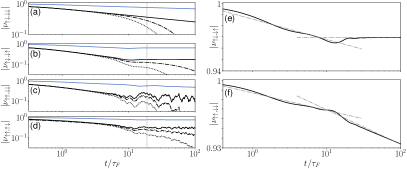
- $\nu_{\uparrow\uparrow,\uparrow\downarrow}$ チャネルのデコherence関数は、低温で低周波数励起状態に結合することにより、低下が遅れる傾向を示し、スーパー・デコherence効果を示唆している。
より良い研究を、今すぐ始めましょう
論文の読解から最終レビューまで、研究時間を劇的に削減しましょう。
クレジットカード登録不要
このレビューはAIが作成し、人間の編集者が確認しました。