
[Paper Review] Toward Robust Corrections for Stellar Contamination in JWST Exoplanet Transmission Spectra
This paper investigates the reliability of stellar models in correcting for photospheric heterogeneities—such as spots and faculae—that contaminate JWST exoplanet transmission spectra. It finds that model discrepancies dominate noise budgets for stars with complex photospheres, but with high-fidelity models, stellar contamination contributes less to noise than photon noise, advocating for data-driven stellar modeling and empirical component retrieval to enable robust atmospheric characterization.
Transmission spectroscopy is still the preferred characterization technique for exoplanet atmospheres, although it presents unique challenges that translate into characterization bottlenecks when robust mitigation strategies are missing. Stellar contamination is one such challenge that can overpower the planetary signal by up to an order of magnitude, and thus not accounting for it can lead to significant biases in the derived atmospheric properties. Yet this accounting may not be straightforward, as important discrepancies exist between state-of-the-art stellar models and measured spectra and between models themselves. Here we explore the extent to which stellar models can be used to reliably correct for stellar contamination and yield a planet's uncontaminated transmission spectrum. We find that discrepancies between stellar models can significantly contribute to the noise budget of JWST transmission spectra of planets around stars with heterogeneous photospheres, the true number of unique photospheric spectral components and their properties can only be accurately retrieved when the stellar models have sufficient fidelity, and under such optimistic circumstances the contribution of stellar contamination to the noise budget of a transmission spectrum is considerably below that of the photon noise for the standard transit observation setup. Therefore, we advocate for further development of model spectra of stars and their active regions in a data-driven manner, empirical approaches for deriving spectra of photospheric components using the observatories with which the atmospheric explorations are carried out, and analysis techniques accounting for multimodal posterior distributions for photospheric parameters of interest, which will be increasingly revealed by precise JWST measurements.
Motivation & Objective
- Address the challenge of stellar contamination in JWST transmission spectra, which can bias atmospheric retrievals by up to an order of magnitude.
- Investigate whether current stellar models can reliably retrieve photospheric components (e.g., spots, faculae) to correct for contamination.
- Assess whether model inaccuracies or data quality limit the precision of contamination correction in transmission spectroscopy.
- Explore the potential of empirical, data-driven approaches to derive photospheric components independent of theoretical models.
- Determine the conditions under which stellar contamination becomes sub-dominant to photon noise in the overall noise budget.
Proposed method
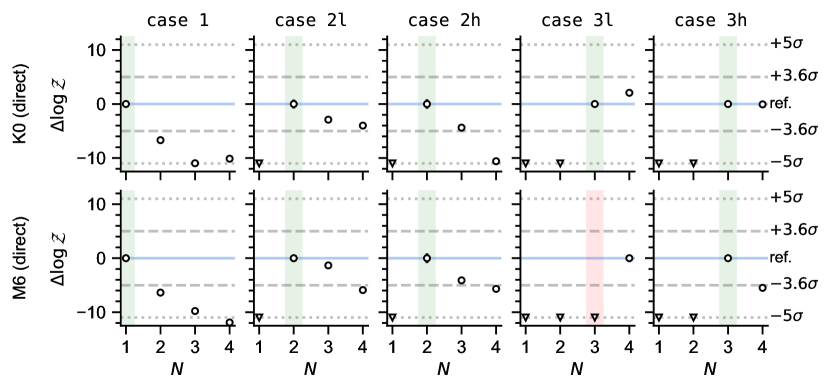
- Use synthetic out-of-transit JWST spectra to simulate observations of stars with heterogeneous photospheres, including K0 and M6 spectral types.
- Apply direct retrieval techniques to infer photospheric component temperatures and filling factors from simulated out-of-transit spectra.
- Compare retrieved component properties against true input values to quantify biases and uncertainties.
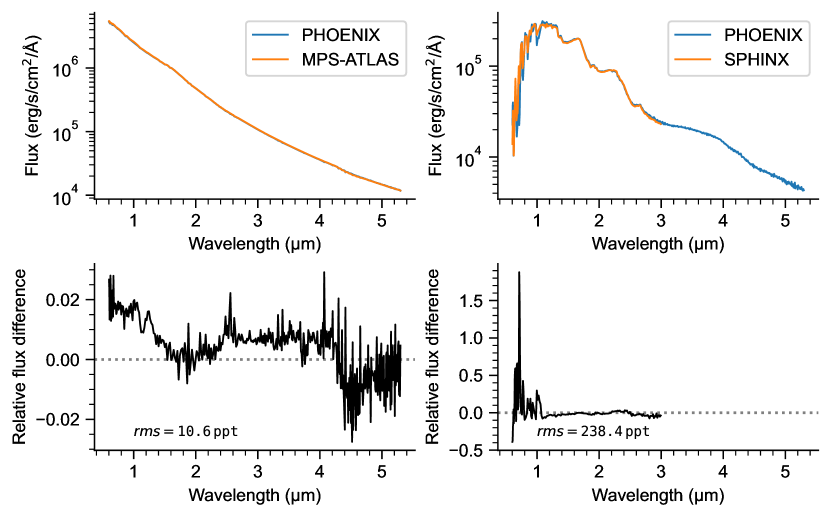
- Evaluate the sensitivity of model spectra to temperature variations across different stellar types using PHOENIX and SPHINX grids.
- Assess the impact of model fidelity by comparing results across multiple stellar model grids, including newer, more realistic ones.
- Investigate the scaling of contamination noise relative to photon noise as a function of out-of-transit to in-transit observation time ratios.
Experimental results
Research questions
- RQ1To what extent do discrepancies between stellar models dominate the noise budget in JWST transmission spectra of planets around stars with heterogeneous photospheres?
- RQ2Can high-fidelity stellar models enable the retrieval of photospheric component properties (temperature, filling factor) with sufficient accuracy to reduce contamination below photon noise?
- RQ3How does the sensitivity of stellar spectra to temperature variations differ between cooler (M6) and warmer (K0) stars, and what does this imply for component detection?
- RQ4In what scenarios do model inaccuracies lead to biased corrections, even with high signal-to-noise out-of-transit data?
- RQ5Can empirical, model-independent methods for deriving photospheric components improve contamination correction beyond current model-based approaches?
Key findings
- Discrepancies between stellar models dominate the noise budget for stars with complex photospheres, especially for cooler, more active stars like M6 dwarfs.
- For K0-type stars, model inaccuracies can lead to biased corrections even when high signal-to-noise out-of-transit spectra are used.
- The sensitivity of stellar spectra to temperature variations is significantly lower in K0 stars (around 20% of the sensitivity of 2500 K models) compared to cooler M6 stars, making component detection more challenging.
- When high-fidelity models are used, the contribution of stellar contamination to the noise budget falls below that of photon noise in standard transit observation setups.
- The presence of magnetically induced features in faculae—poorly captured by 1D models—increases the challenge of fitting spectra but also enhances the detectability of heterogeneities.
- Empirical approaches for deriving photospheric components from JWST data could bypass model inaccuracies and improve correction robustness, especially for active stars.
Read this paper
Open the full text in the Nubint reader and ask about any passage as you read.
Read this paper on NubintThis review was generated by AI from the original paper. Please check the paper before citing it.