
[Paper Review] Tuning the coherent interaction of an electron qubit and a nuclear magnon
This paper demonstrates in situ tuning of the coherent electron-nuclear interaction in a GaAs quantum dot by exploiting electron g-factor anisotropy to control nuclear polarization. Using algorithmic feedback, the authors achieve precise control over the electron-nuclear exchange interaction, enabling deterministic tuning of magnon injection rates and electron qubit coherence time, with direct measurement of single-nucleus hyperfine constants via high-precision spectroscopy.
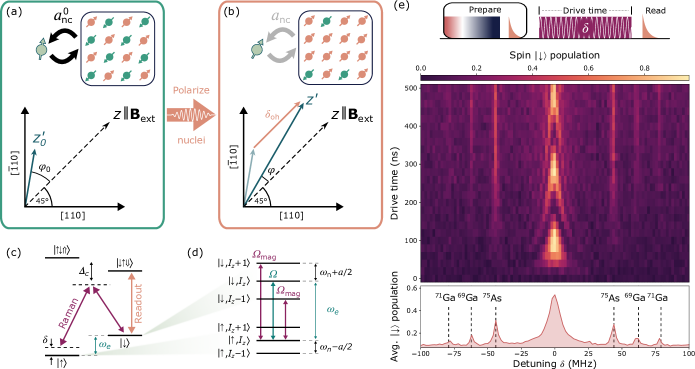
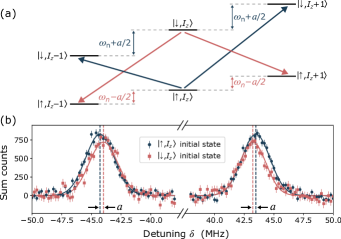
A central spin qubit interacting coherently with an ensemble of proximal spins can be used to engineer entangled collective states or a multi-qubit register. Making full use of this many-body platform requires tuning the interaction between the central spin and its spin register. GaAs quantum dots offer a model realization of the central spin system where an electron qubit interacts with multiple ensembles of $\sim 10^{4}$ nuclear spins. In this work, we demonstrate tuning of the interaction between the electron qubit and the nuclear many-body system in a GaAs quantum dot. The homogeneity of the GaAs system allows us to perform high-precision and isotopically selective nuclear sideband spectroscopy, which reveals the single-nucleus electronic Knight field. Together with time-resolved spectroscopy of the nuclear field, this fully characterizes the electron-nuclear interaction for a priori control. An algorithmic feedback sequence selects the nuclear polarization precisely, which adjusts the electron-nuclear exchange interaction in situ via the electronic g-factor anisotropy. This allows us to tune directly the activation rate of a collective nuclear excitation (magnon) and the coherence time of the electron qubit. Our method is applicable to similar central-spin systems and enables the programmable tuning of coherent interactions in the many-body regime.
Motivation & Objective
- To enable in situ, dynamic tuning of the coherent interaction between a central electron spin qubit and a nuclear spin ensemble in a GaAs quantum dot.
- To overcome the limitation of fixed coupling parameters in solid-state central spin systems by introducing real-time control over the electron-nuclear exchange interaction.
- To achieve programmable control over collective nuclear excitations (magnons) and electron qubit coherence time through feedback-driven nuclear polarization locking.
- To fully characterize the electron-nuclear interaction by measuring single-nucleus hyperfine constants, including non-collinear terms, via isotopically selective nuclear sideband spectroscopy.
- To demonstrate ab initio tuning of the magnon Rabi frequency by adjusting the Overhauser shift through controlled nuclear polarization.
Proposed method
- Utilized isotopically pure GaAs quantum dots to enable high-precision, nuclear sideband spectroscopy of the electron-nuclear interaction.
- Employed time-resolved spectroscopy of the nuclear field to fully characterize the electron-nuclear interaction Hamiltonian, including both collinear and non-collinear hyperfine terms.
- Implemented an algorithmic feedback sequence to lock nuclear polarization at a programmable setpoint, enabling in situ tuning of the electron-nuclear exchange interaction.
- Leveraged the electron g-factor anisotropy—arising from spin-orbit coupling—as the control knob to tune the mean-field nuclear polarization and thus the Overhauser shift.
- Measured the magnon Rabi frequency as a function of electron drive frequency and nuclear polarization, validating theoretical predictions of the interaction strength scaling with $ a_{ ext{nc}} $.
- Used a damped two-level system model with parameters $ heta_1 $, $ heta_2 $, and $ heta_3 $ to fit Rabi oscillations and extract the magnon injection rate $ heta_{ ext{mag}} $.
Experimental results
Research questions
- RQ1Can the coherent electron-nuclear interaction in a GaAs quantum dot be tuned in situ using electronic g-factor anisotropy?
- RQ2To what extent can nuclear polarization be controlled via feedback to modulate the electron-nuclear exchange interaction and Overhauser shift?
- RQ3Can the magnon injection rate be tuned deterministically by adjusting the nuclear polarization, and is this tunability consistent with theoretical predictions?
- RQ4What is the role of non-collinear hyperfine interactions in mediating the electron-nuclear coupling, and can they be measured directly?
- RQ5How does tuning the electron-nuclear interaction affect the electron qubit’s coherence time $ T_2 $, and can this be used to control dephasing dynamics?
Key findings
- The electron-nuclear interaction is tuned in situ via feedback-controlled nuclear polarization, enabling direct manipulation of the Overhauser shift $ heta_{ ext{oh}} $.
- The magnon Rabi frequency $ heta_{ ext{mag}} $ was experimentally tuned over a wide range, with excellent agreement to the theoretical prediction $ heta_{ ext{mag}} = rac{a_{ ext{nc}} heta}{2 heta_n} imes rac{5N_{ ext{As}}}{2} $, confirming ab initio control.
- A hundredfold narrowing of the slow noise spectrum of the nuclear ensemble was achieved through nuclear polarization locking, indicating reduced environmental fluctuations.
- High-precision isotopically selective nuclear sideband spectroscopy enabled direct measurement of single-nucleus hyperfine constants, including non-collinear terms.
- The electron qubit coherence time $ T_2 $ was modified in response to tuning of the electron-nuclear exchange interaction, demonstrating control over dephasing channels.
- The method enables deterministic control over the activation rate of collective nuclear magnons, a key step toward programmable quantum many-body systems in solid-state platforms.
Read this paper
Open the full text in the Nubint reader and ask about any passage as you read.
Read this paper on NubintThis review was generated by AI from the original paper. Please check the paper before citing it.